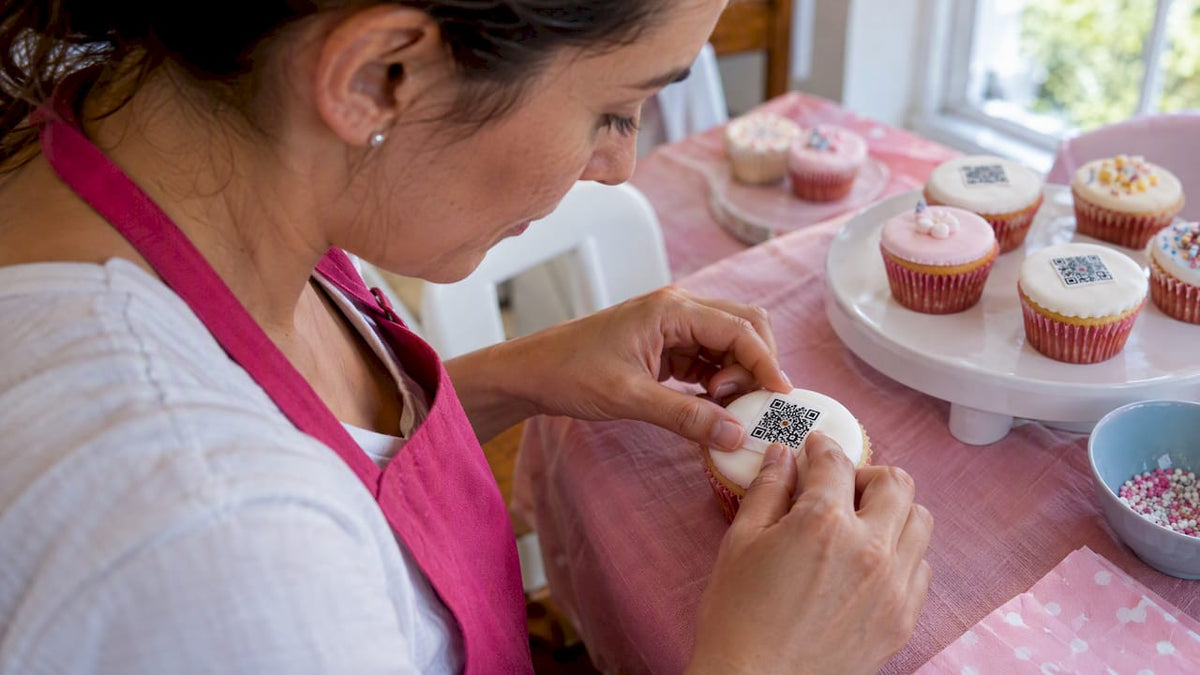
Place the cake on a flat, non-slip base on the floor or in the vehicle's trunk, never on the seat or in your lap, and keep it refrigerated until just before you leave. Secure the box with wedges or a non-slip cloth so it doesn't move, keep the vehicle cool during the journey, and keep a small touch-up kit handy in case the wafer gets scuffed.
In summary:
- Refrigerate the cake from the night before and take it out 20 to 30 minutes before loading it; this reduces condensation on the wafer.
- Apply the wafer to a dry surface: wait until the buttercream is firm, but place it on fondant almost immediately.
- Choose a rigid box in the exact size, secure the corners with wedges, and leave a ventilation gap for short journeys to reduce condensation.
- For long journeys, multi-tiered cakes, or buildings without elevators, consider hiring a professional service before risking the decoration during transport.
Table of contents
- Preparation: refrigeration, when to apply the wafer, and humidity control
- How to pack and secure the cake and wafer for transport
- Car transport: ideal position, temperature control, and driving
- What to bring and how to repair minor damage upon arrival
- Funbakery tips on wafers: when to place and how to pack securely
- Author's perspective: practical lessons and when to seek professional help
- How Funbakery makes secure transport easier: products and design service
- Frequently asked questions
- Sources
Preparation: refrigeration, when to apply the wafer, and humidity control
The hours before transport determine whether the cake arrives intact or with unpleasant surprises. Refrigerating the cake overnight stabilizes the filling and frosting, so it withstands the bumps of the car better without the sponge sinking or the cream sliding under the wafer.
It is best to take the cake out of the refrigerator 20 to 30 minutes before loading it into the vehicle. This window helps prevent thermal shock, which causes condensation on the wafer—a problem that can end in stains or peeling edges, as we explain in our guide to refrigerating cakes with wafers.
The timing for applying the wafer is just as important as the transport itself. Applying it too soon, or using water, often creates visible wrinkles as moisture migrates to the printed surface.
- Refrigerate the cake overnight so the internal structure firms up.
- Take the cake out of the refrigerator 20 to 30 minutes before leaving, never right at the moment of loading.
- Avoid using water as an adhesive: a thin layer of ganache or frosting holds the wafer better without over-wetting it.
- Check that the edges are well adhered and dry before closing the transport box.
Professional tip: if you are unsure when to apply the wafer depending on the type of frosting, check our guide on the exact time to place the wafer before assembling the cake.
How to pack and secure the cake and wafer for transport
Packaging is what separates a cake that arrives perfectly from one that arrives tilted. The base of the box should be rigid and fit the exact size of the cake: any extra space gives the cake room to move with every brake.
- Choose a box with a rigid base or a cake carrier in the exact size, with no side gaps.
- Place a non-slip mat or folded cloth under the base to prevent it from sliding inside the box.
- Use small wedges, such as rolls of paper towels, in the empty corners to secure the whole setup.
- If the wafer is near the edge, protect that area with a non-adhesive support that prevents contact with the lid.
- Keep the box away from other food, bags, or packages that could transfer moisture or dirt during the journey.
Wrinkled wafers are usually caused more by packaging than by the transport itself—a problem we detail in our article on how to prevent the wafer from wrinkling when decorating and handling the cake.
Professional tip: close the box leaving a small ventilation gap if the journey is short; a completely airtight seal promotes condensation on the printed surface.

Car transport: ideal position, temperature control, and driving
The vehicle floor or a flat trunk are the only recommended places to travel with a cake. The seat, being sloped and cushioned, increases the risk of the box tilting or sliding around a curve, and the passenger's lap offers no real stability during sudden braking.
The interior temperature of the car also directly affects how the wafer behaves. Regulation (EC) No. 852/2004 on food hygiene states that means of transport must allow for adequate temperature control to prevent food spoilage—a principle that applies just as well to a domestic trip as to a commercial one, as stated in the AESA regulations on food transport.
- Turn on the air conditioning a few minutes before loading the cake if it is hot.
- Avoid letting the interior exceed high temperatures during the journey, especially with the car parked in the sun.
- Drive smoothly: brake early and take corners slowly.
- Add stabilizing weight, such as filled bags, next to the box to reduce side-to-side movement.
Community regulations on food hygiene require preventing cross-contamination during transport, which includes avoiding having the cake share space with objects or food that could soil it, according to European regulations applicable to food transport.
What to bring and how to repair minor damage upon arrival
Even with all precautions, it is best to be prepared for a minor mishap. A compact emergency kit allows you to resolve almost any unforeseen issue without it showing in the final presentation.
- A piping bag with a little of the same cream used in the decoration, to fill or hide small dents.
- A small spatula and fine tweezers to reposition loose elements.
- A leftover piece of the same wafer, in case you need to cover a damaged corner.
- A couple of napkins and a small bottle of food-grade alcohol, useful for cleaning up residue without directly touching the decorated surface.
If the wafer wrinkles slightly during the journey, you can smooth it with a brush barely moistened on the back and gentle pressure with plastic wrap, letting it settle for a few minutes before cutting the cake. It is best to wait for the cake to acclimate to the environment of the destination before handling it, just as we recommend for the journey there.
Funbakery tips on wafers: when to place and how to pack securely
Working with edible wafers daily, we have found that most transport problems start before leaving home: a wafer applied too soon, a base that hasn't fully settled, or packaging that does not sufficiently protect the printed surface.
- The time to apply the wafer depends on the frosting: on buttercream, it is best to wait until the surface is firm, while on fondant it can be placed almost immediately.
- Keeping the wafer in its original packaging until the last moment prevents it from absorbing ambient moisture before applying it.
- Durable packaging, with separation between the lid and the decorated surface, reduces the risk of wrinkles during transport.
If you order a personalized wafer, choosing a format designed for the actual size of your cake, rectangular or round, makes it easier for the packaging to fit well from the start and arrive in the same condition it left the workshop.
Author's perspective: practical lessons and when to seek professional help
The mistake I have seen repeated most often is taking the cake in the seat, convinced that a firm hand on the box compensates for any sudden braking. It doesn't: the car floor, with good support, always wins over any manual hold.
For long journeys, high floors without elevators, or multi-tiered cakes, it is worth considering a professional transport service before risking hours of work on an improvised trip. Before leaving, one last visual check (level, support, interior temperature) prevents most scares.
— David
How Funbakery makes secure transport easier: products and design service
We work each personalized wafer to achieve food-quality printing and durable packaging designed to arrive intact from the workshop to your kitchen.

If you are looking for a design for a rectangular cake, we have options such as Rectangular 1 and Rectangular 2, both customizable with a photo, name, and age. For round cakes, the Round 2 design fits just as well with the same edible finish.
- Personalized designs with photo, name, and age, ready to print on edible paper.
- Formats designed to fit the size of many cakes well.
- Custom design service for customers who want a unique design.
If you want to order a custom-sized wafer, our personalized design service lets you define every detail before printing, and the design studio offers the same options for those who prefer to start with their own template.
Frequently asked questions
How to place wafers on cakes?
The wafer is placed on a dry, firm surface, using a thin layer of ganache or frosting instead of water to prevent it from getting damp and wrinkling. The ideal time depends on the frosting, as we explain in our guide on when to place the wafer depending on the type of surface.
How to transport a cake?
The cake should travel on the vehicle floor or in the trunk, on a non-slip base, never on the seat or held in your arms during the journey. Keeping the interior cool and driving smoothly reduces the risk of it moving or the decoration being damaged.
How long can a cake go without refrigeration?
The safe time out of the refrigerator depends on the filling and the ambient temperature, so it is best to minimize that window and take the cake out only 20 to 30 minutes before transport. In our post on how long a cake with a wafer lasts, we detail the recommended times before and after placing it.
How is rice paper attached to the cake?
Rice paper, like the wafer, adheres better with a minimal layer of ganache or frosting instead of water, which tends to cause wrinkles as it dries. If you notice it peeling at the edges after applying it, our guide on tips to prevent the wafer from peeling offers quick solutions.