In summary:
- Sugar paper is a flexible edible sheet made with sugar, cornstarch, and glycerin, ideal for decorating cakes with high-quality prints. Traditional and premium versions exist, differing in surface, thickness, and print fidelity, with premium being the best choice for detailed designs and photographs. For successful application, it is recommended to let the print dry, stick it to damp bases, and store it in dry, airtight conditions, as moisture and light quickly deteriorate it.
Sugar paper is an edible sheet made with sugar, cornstarch, and glycerin that allows detailed designs to be printed and cakes to be decorated with professional-quality results. Its smooth and flexible surface makes it the preferred medium for edible prints in decorative baking, both homemade and professional. Knowing the types of sugar paper explained in this guide will help you choose the right format according to the cake, frosting, and design you want to achieve. Funbakery works with this material daily and here shares what you really need to know.
What are the main types of sugar paper?
Sugar paper comes in several variants with real differences in composition, thickness, and behavior on the cake. Understanding those differences prevents costly mistakes and disappointing results.
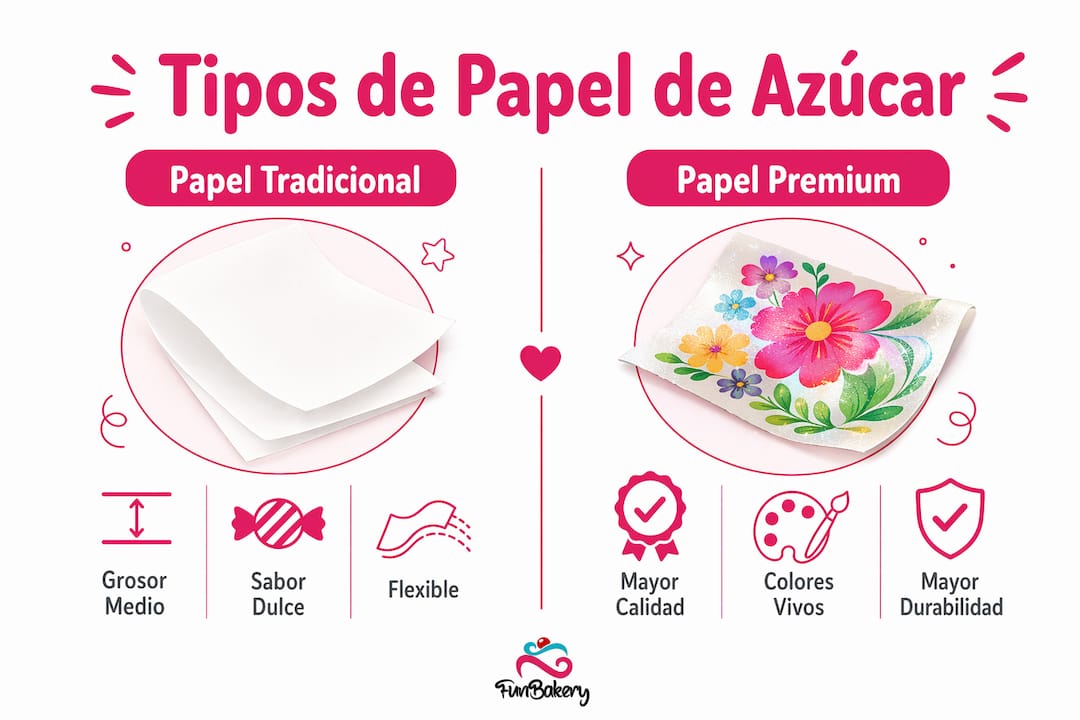
Traditional sugar paper
Traditional sugar paper, also called fondant paper in professional settings, is the most widespread variant in decorative baking. It is made with sugar, cornstarch, and glycerin, and is produced on acetate sheets to make it easier to handle and cut. This composition gives it a remarkable flexibility that distinguishes it from wafer paper, which is more fragile and brittle. Its greater thickness makes it easier to handle even for inexperienced bakers.
Premium sugar paper
Premium sugar paper shares the same base ingredients as traditional, but incorporates a more controlled manufacturing process that results in an even smoother and more uniform surface. That surface directly improves the quality of the edible print: colors come out more vivid and fine details remain sharper. Sugar paper offers vibrant colors and high definition thanks to its non-porous surface, and the premium version takes that feature to the maximum. It is the right choice when the design includes photographs, gradients, or small text.
Sugar paper versus other edible sheets
Wafer paper (wafer paper) is neutral in flavor and thinner, making it ideal for three-dimensional decorations such as flowers or butterflies. Sugar paper, on the other hand, has a slightly sweet flavor with notes of vanilla that complements any cake well without altering its flavor profile. That difference in flavor is relevant when the sheet covers a large surface of the dessert.
The following table summarizes the practical differences between the most common formats:
| Feature | Traditional sugar paper | Premium sugar paper | Wafer paper |
|---|---|---|---|
| Flexibility | High | High | Low |
| Print quality | Good | Very high | Medium |
| Flavor | Sweet, vanilla | Sweet, vanilla | Neutral |
| Thickness | Medium | Medium | Thin |
| Best use | Cakes covered in fondant or buttercream | Photographs and detailed designs | 3D decorations and flowers |
Professional tip: If you are going to print a photograph with many colors, always choose premium sugar paper. The difference in sharpness is visible to the naked eye.
How is sugar paper applied to cakes and desserts?
The correct application of sugar paper makes the difference between a smooth, professional finish and a wrinkled or peeling one. The process is not complicated, but it does require following a specific order.
-
Let the print dry. After printing with edible inks, let the paper dry completely before handling it. Wet ink runs upon contact and ruins the design.
-
Prepare the cake base. Sugar paper adheres without additional glue to fresh fondant or buttercream. Place it on damp bases such as freshly applied fondant or buttercream to achieve perfect adhesion.
-
Apply the paper to buttercream before it dries. When decorating with buttercream, place the paper before the cream dries to prevent it from peeling or wrinkling. Once the cream dries, the adhesion fails.
-
Smooth it from the center toward the edges. Use the pad of your fingers or a clean silicone spatula to remove air bubbles. Always work from the center outward so as not to trap air underneath.
-
Carefully remove the acetate. The paper arrives attached to a protective acetate sheet. Remove it slowly and at a flat angle so as not to lift the design.
-
Let the cake rest. After application, leave the cake in a cool, dry place for at least 15 minutes before handling or cutting it.
Professional tip: In humid climates, sugar paper sticks to the acetate and is difficult to peel off without breaking. Put the sheet in the freezer for 15 seconds to harden it slightly, and the peeling will be clean and without breaks.
For a more detailed guide on the complete process, see how to apply sugar paper to cakes step by step.
How is sugar paper stored to preserve its quality?
Incorrect storage ruins sugar paper before use. Moisture and sunlight are its two worst enemies.
The ideal storage conditions are:
- Airtight cellophane bag or zip bag. The paper must be stored in an airtight package so that ambient moisture does not affect its structure or the quality of the print.
- Away from direct sunlight. Light degrades the printed colors and dries out the sheet, making it brittle.
- Stable room temperature. Avoid storing the paper near heat sources such as the oven or refrigerator without proper protection.
- Horizontal position. Storing the paper vertically for a long time can slightly deform the edges.
When stored correctly, sugar paper has a shelf life of up to one year. That means you can buy it in advance without losing quality, as long as you respect the storage conditions.
Professional tip: If you open a package and do not use the entire sheet, reseal it with adhesive tape or transfer the remaining sheets to a zip bag. Contact with air for hours changes its texture and makes application difficult.
What advantages does sugar paper offer over other decoration methods?
Sugar paper is not the only method for decorating cakes, but it is the one that best combines visual quality, ease of use, and an edible final result. These are its concrete advantages over other techniques:
- High-definition printing. The smooth and non-porous surface of sugar paper reproduces photographs, logos, and text with a sharpness that other edible sheets do not achieve. It is the standard for quality prints in decorative baking.
- Adhesion without glues. It does not need royal icing or other adhesives on fresh fondant or buttercream. That simplifies the process and reduces the risk of mistakes.
- Integrated flavor. Its slight sweet flavor with notes of vanilla blends with the cake without adding a strange taste, something that does not happen with some sugar modeling decorations or gum paste.
- Design versatility. It accepts any digital image: from a birthday photograph to a corporate logo or a cartoon character. That flexibility makes it useful for decorating cakes at children's parties and events of all types.
- Ease for beginners. Unlike modeled fondant or a piping bag, sugar paper does not require special manual skill. Anyone with basic instructions achieves a presentable result.
The main limitation of sugar paper is its sensitivity to moisture. In cakes with a lot of cream or fresh fruit, the paper can soften and lose definition. The solution is to apply it at the last moment before serving or use a fondant base that acts as a barrier.
You can expand the comparison between methods in this guide on edible paper for cakes.
Key points
Sugar paper is the most versatile edible medium for cake decoration because it combines high-definition printing, glue-free adhesion, and a sweet flavor that does not interfere with the dessert.
| Point | Details |
|---|---|
| Basic composition | Sugar, cornstarch, and glycerin on acetate give the paper flexibility and resistance. |
| Premium paper for photographs | Choose the premium version when the design includes photos, gradients, or small text. |
| Application on a damp base | Place the paper on fresh fondant or buttercream for perfect adhesion without adhesives. |
| Airtight storage | Store the paper in an airtight bag, away from light and heat, to preserve it for up to one year. |
| Trick for humid climates | Freeze the sheet for 15 seconds before peeling off the acetate to avoid breaks. |
What no one tells you about sugar paper until you use it
I have been working with sugar paper for a while, and the most frequent mistake I see has nothing to do with the print or the design. It has to do with the cake base. Success in decoration depends on how the paper interacts with the base and the level of moisture at that specific moment. People buy the best paper available and then apply it over dry buttercream or dried-out fondant. The result is paper that peels at the edges after two hours.
My recommendation for beginners is this: do not focus so much on the type of paper as on preparing the surface well. A standard sugar paper well applied on a base at the right moisture point always beats a premium paper poorly placed. Once you master the base, then it makes sense to invest in the premium version for more demanding designs.
The other point that almost everyone underestimates is the drying time after printing. Printing and applying immediately is the most common mistake and the easiest to avoid. Let the printed sheet rest for at least 10 minutes on a flat surface before handling it. That time makes the difference between a sharp design and one with ink smudges.
For those who already have experience, the freezer tip changes the rules in summer or in kitchens without air conditioning. Those 15 seconds in the freezer do not cool the cake or alter the ink. They only harden the sugar layer enough so that the acetate comes off clean.
— David
Custom sugar paper for your next celebration
Funbakery designs and prints custom sugar paper with photographs, names, ages, and any theme you need, from superheroes and children's characters to designs for adults and corporate events.

The process is simple: you choose the design or send your photograph, and the Funbakery team prepares the sheet ready to place on your cake. Every order goes through a print quality control to guarantee vivid colors and sharp edges. Check the complete collection of custom cake decorations and find the design that best fits your celebration. If you are looking for something specific for a themed party, the custom Stumble Guys sugar paper with photo and name is one of the most requested options.
Frequently asked questions
What is sugar paper and what is it made of?
Sugar paper is an edible sheet made with sugar, cornstarch, and glycerin, produced on acetate to make it easier to handle. Its composition gives it flexibility and a smooth surface ideal for edible prints.
What is the difference between sugar paper and wafer paper?
Sugar paper is thicker, flexible, and has a sweet flavor with notes of vanilla. Wafer paper is thinner, neutral in flavor, and is mainly used for three-dimensional decorations such as edible flowers.
On what surfaces can sugar paper be applied?
Sugar paper adheres without glue to fresh fondant and buttercream. It also works on cookies with wet icing. Avoid applying it on completely dry surfaces or with a lot of free moisture, such as fresh fruit without coating.
How long does sugar paper last unused?
Stored in an airtight bag, away from sunlight and heat, sugar paper preserves its quality for up to one year. Once the package is opened, reseal the leftover immediately to prevent it from absorbing ambient moisture.
Can sugar paper be used on cupcakes and muffins?
Yes. Sugar paper is easily cut into circles or custom shapes to cover cupcakes and muffins. Apply it over fresh buttercream and press gently from the center to avoid air bubbles.