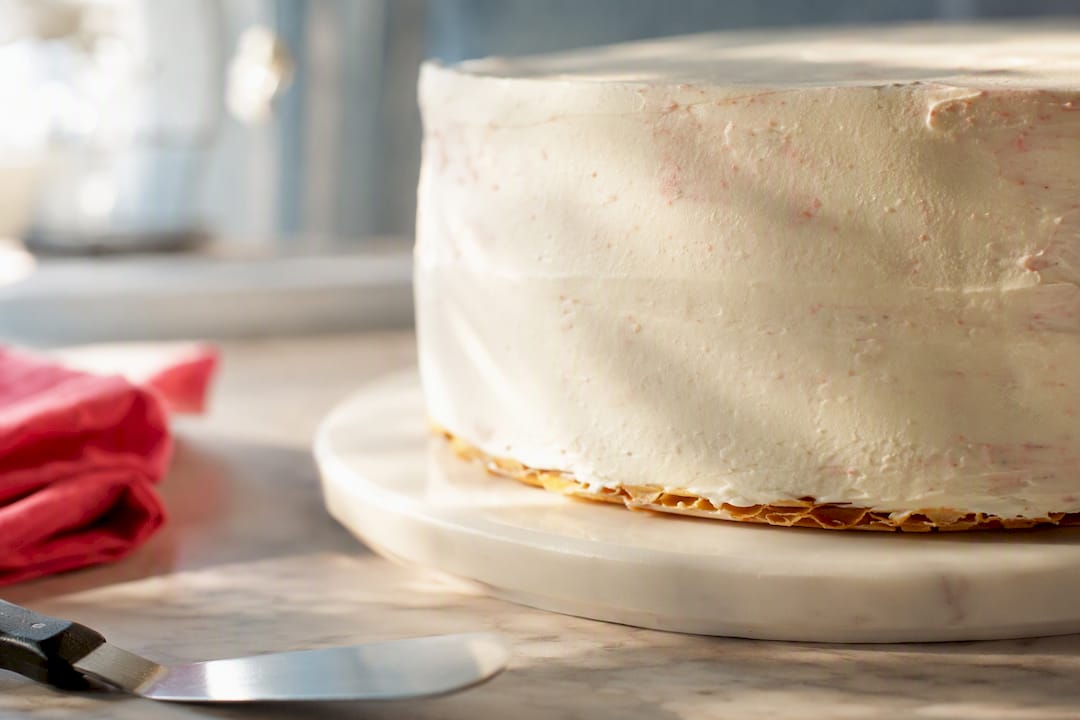
For a drip cake with a custom image, sugar paper usually gives an impression with more vivid colors and better image definition. Wafer paper comes into play when you need more rigidity or moisture resistance. Always confirm with the supplier that the inks and adhesives comply with food contact standards before ordering the design, to ensure safety.
In summary:
- Sugar paper offers more vibrant colors and greater sharpness for detailed prints, suitable for photographs and logos on decorated cakes.
- Wafer paper is more moisture-resistant, ideal for cut-out pieces or with reliefs in high-humidity environments.
- Hybrid sheets combine ease of handling with definition close to that of sugar paper, being useful when the final conditions of the cake are still uncertain.
- For dry or firm surfaces, sugar paper works best, while wafer paper is preferred for moist toppings or relief applications.
- Orders should include files with a minimum resolution of 300 dpi, PNG or TIFF format, and be made in advance to avoid inaccuracies in the final result.
Index
- Sugar paper, wafer paper, or hybrid sheet: what's the difference?
- How to choose the right edible paper for your drip cake
- How to apply edible paper to a drip cake, step by step
- What to ask the supplier about safety and regulations
- How to store edible paper until the day of the cake
- Who guarantees the quality of the custom print
- The most common mistakes in printing and applying edible paper
- Is it always worth personalizing the design of a drip cake?
- How to order custom edible paper at Funbakery
- Sources
Sugar paper, wafer paper, or hybrid sheet: what's the difference?
The choice of material determines the final result as much as the design itself. Each type of edible paper behaves differently in the printer, on the cake frosting, and in the hands of the person applying it.
Sugar paper (also called frosting sheet) has a thin sugar base on an edible plastic support, which gives it flexibility and a smooth surface ideal for color printing. According to a technical guide from Scoolinary on the differences between rice paper and sugar paper, this material produces more vibrant colors and greater image sharpness, suitable for drip cakes with photographs or characters that need to stand out.
Wafer paper, also known as rice paper or wafer paper, is lighter, translucent, and has no plastic support. It offers greater resistance to relative humidity variations, being recommended for relief decorations, 3D flowers, or elements that overlap the drip cake's drip.
Hybrid sheets, such as those known as Revoprint, combine the ease of handling of wafer paper with a print definition closer to that of sugar paper, according to an analysis by Mundo Repostería.
In practice:
- Sugar paper: best for photographs, logos, and fine text.
- Wafer paper: best for cut-out pieces, reliefs, and more humid environments.
- Hybrid sheet: intermediate option when you don't know exactly the final conditions of the cake.
How to choose the right edible paper for your drip cake
Before finalizing the order, it's worth going through a quick checklist. The surface where the image will sit changes everything: smooth fondant accepts either material well, but ganache or fresh buttercream requires more attention to humidity because the sheet can soften if left in direct contact for too long.
- Check the final frosting. Fondant and firm buttercream work well with sugar paper; fresh cream or very liquid ganache favor wafer paper or a last-minute application.
- Choose wafer paper when you need extra rigidity — for example, in pieces that sit loose over the drip and cannot completely stick to the surface.
- Confirm the file requirements: minimum resolution of 300 dpi for photographs, final format in centimeters with a safety margin (bleed) of 3 to 5 mm, and a PNG file without compression or TIFF whenever possible, as recommended by the Funbakery custom design studio.
- Place the order in advance. Events with a fixed date (birthdays, weddings) need room for design and production revisions.
Professional tip: always send a reference photo of the actual color of the cake to the designer — the phone screen tends to show more saturated tones than the final print on edible paper.
How to apply edible paper to a drip cake, step by step
Correct application separates a professional drip cake from one with visible bubbles and folds. The right tools make all the difference: sanitized scissors and utility knife, a small spatula, and a clean, dry silicone brush.
- Cut with the plastic protector still on, in the case of sugar paper. This gives firmness to the material and allows for cleaner cuts, a practice confirmed in the Funbakery guide on the use and cutting of edible paper.
- Align the piece over the cake without removing the protector. Adjust the position while you still have that room to maneuver.
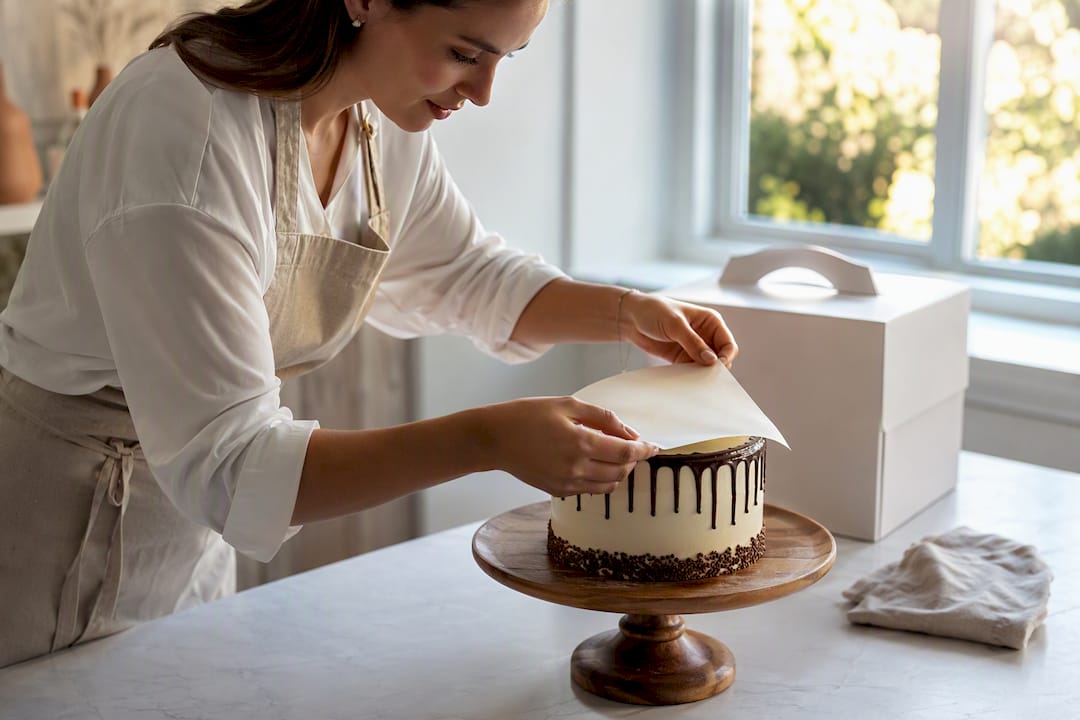
- Remove the protector slowly, applying the sheet from the center to the periphery, to prevent an air bubble from forming in the middle of the image.
- Smooth it with the palm of your hand or with the spatula, always from the center outward, and finish with the dry silicone brush to eliminate residual micro-bubbles.
- Decide on the adhesive according to the frosting: buttercream or ganache that is still soft usually provides enough moisture to fix the paper; on drier surfaces, a thin layer of edible glue or a touch of syrup solves it.
Professional tip: on fresh buttercream frostings, applying a thin layer of melted white chocolate between the cake and the paper can work as a barrier and help preserve the print — as indicated by Scoolinary.
The ideal time to apply is as close as possible to the time of serving, especially on cakes with creamy frostings. Leaving the sheet exposed to humid environments for hours is the most common way to see it lose definition before the cake reaches the table.
What to ask the supplier about safety and regulations
Custom edible paper is not just a beautiful image: it is also a material that comes into direct contact with food, and this implies legal obligations for those who produce it. The Regulation (EC) No. 1935/2004 requires that any material in contact with food does not transfer components in quantities that could endanger health. It is the legal basis that any edible paper supplier in the European Union must respect.
Regarding good manufacturing practices, Regulation (EC) No. 2023/2006 establishes quality system requirements for manufacturers of inks and adhesives used in this type of material.
There is no single and specific European standard for food inks and adhesives; compliance is based on Regulation 1935/2004, good manufacturing practices, and sectoral technical guidelines, such as those from EuPIA and FEICA, according to an analysis by ITENE by Fedacova.
Before ordering, it is worth asking the supplier directly:
- What inks they use in printing and if they comply with recognized sectoral guidelines.
- If they have a safety data sheet or declaration of conformity available.
- If the production process follows good manufacturing practice principles.
How to store edible paper until the day of the cake
Store the printed sheets in a sealed bag, in a dry place and away from direct light. The refrigerator should only come into play if the supplier expressly indicates it, because condensation when removing the paper from the cold usually harms more than helps.
- Avoid direct sunlight and environments with high humidity.
- On very moist frostings (cream, liquid ganache), apply the paper as late as possible, ideally just before serving.
- Signs of deterioration include dark spots, an abnormally sticky surface, or an acidic smell — in that case, do not apply the piece.
- For events with a set date, order with enough lead time to receive, store correctly, and still have room for unforeseen events, as suggested by the DulceMisu guide on the differences between sugar paper and wafer paper.
Who guarantees the quality of the custom print
There are suppliers that produce custom wafer paper and sugar paper for cakes, cupcakes, and cookies, with design services that work directly with photographs, names, and dates sent by the client. The practical guides published on the Funbakery blog about edible photo paper detail safety and application care that complement this checklist. For specific questions about wafer paper, the article on how to apply rice paper to cakes delves into the step-by-step process.

The most common mistakes in printing and applying edible paper
The most frequent mistake is sending files with low resolution, which results in blurry or pixelated photographs on the cake. An image taken with a phone in a poorly lit room rarely has enough quality for large-format printing.
Another recurring problem is cutting the sugar paper without the plastic protector, which leaves the material soft and prone to tearing at the most delicate contours. Applying the sheet too early, especially over moist frostings, is also a typical mistake: the image loses definition hours before the cake is served.
Gluing with too much edible glue or syrup is another common slip-up. The excess liquid creates visible bubbles and can partially dissolve the print. Finally, ignoring the supplier's production deadline forces rushed last-minute decisions, exactly the type of rush that leads to positioning errors on the cake. Planning the order in advance and following the sequence of cutting, aligning, and smoothing avoids most of these setbacks.
Is it always worth personalizing the design of a drip cake?
Not all cakes need a custom design, but when the occasion deserves it, the visual difference is immediate: a sharp photograph or a name well integrated into the drip transforms the cake into a unique object, not a generic decoration. Memorable birthdays, weddings, and corporate events with their own visual identity fully justify the extra investment of time and cost. When ordering the design, be specific: send color references, the desired style, and the exact dimensions of the cake. A vague brief requires more revisions and delays delivery.
— David
How to order custom edible paper at Funbakery
Ordering is simple: choose the product (wafer paper or sugar paper), send the photograph or design idea, confirm the proof with the designer, and wait for delivery at home.
Some suppliers work with designers who adjust color, resolution, and framing before printing, which saves the customer the technical work of preparing the file. For a drip cake with a custom photograph, the custom design studio allows you to send names, ages, and your own images and receive a proof before final production. Those who need a concrete example can see the result on a real product, such as this custom wafer paper with photo and name for cakes and cupcakes. For cupcake or muffin orders in quantity, there is also a design service dedicated to muffins. Reserve the order with some lead time relative to the event date: this gives room to review the proof and ensure the print arrives in time to be applied calmly to the drip cake.
Sources
- Regulation (EC) No. 1935/2004 (DOUE)
- Regulation (EC) No. 2023/2006 (BPF)
- Differences between rice paper and sugar paper - Scoolinary