


Every special celebration in Central Europe deserves a cake that catches everyone's eye and surprises the guests. The search for new ideas leads parents and bakers to explore creative options, such as edible paper, which allows unique images and designs to be printed using ingredients safe for human consumption. This innovation turns decoration into a visual and personal experience, perfect for birthdays and events that require an exclusive touch.
Table of Contents
- Definition and purpose of edible paper
- Key differences between the most commonly used types
- How it is printed and applied to desserts
- Regulations and food safety in Central Europe
- Common mistakes and practical recommendations
Key Points
| Point | Details |
|---|---|
| Definition of Edible Paper | Edible paper is a safe and versatile material for decorating desserts, made with ingredients such as starches and sugars. |
| Types of Edible Paper | The two main types are rice paper, ideal for delicate designs, and sugar paper, excellent for high-definition images. |
| Printing Process | Printing requires specialized equipment and certified inks, as well as proper preparation of the dessert's surface. |
| Food Safety Regulations | In Central Europe, strict regulations are applied to ensure the safety of edible paper, including certifications and quality controls. |
Definition and purpose of edible paper
Edible paper is an innovative and versatile material designed specifically for decorating and embellishing desserts and baked goods. According to sources specializing in creative gastronomy, this material is made from ingredients that are completely safe for human consumption, such as starches and sugars, allowing highly precise decorative designs to be created.
The main purposes of edible paper are:
- To add completely edible decorative elements to cakes and desserts
- To personalize designs with unique images, shapes, and textures
- To offer an enriched visual and taste experience
- To allow photographs, illustrations, and graphics to be printed directly on the dessert
In technical terms, edible paper works as a thin and delicate canvas that can be printed with special food-safe inks. Sustainable materials used in its production may include rice paper, starches, and other natural compounds, making it an innovative and eco-friendly option for modern baking.
Professional tip: To get the best results with edible paper, make sure to use specialized printers and inks certified for food use.
Key differences between the most commonly used types
In creative baking, there are mainly two types of edible paper that stand out for their unique characteristics: rice paper and sugar paper. According to decoration technique specialists, each offers specific properties that make it ideal for different decorative applications.

Main characteristics of each type:
Rice Paper:
- More translucent and thinner texture
- Greater flexibility for three-dimensional modeling
- Ideal for delicate designs and complex structures
- Natural roughness that allows for better artistic finishes
Sugar Paper:
- More opaque and uniform texture
- Greater sturdiness and printing capacity
- Perfect for high-definition images
- Excellent adhesion on wet surfaces
The choice between rice paper and sugar paper will depend on the decorative effect you want to achieve. Modern edible materials allow true culinary works of art to be created using increasingly sophisticated techniques.
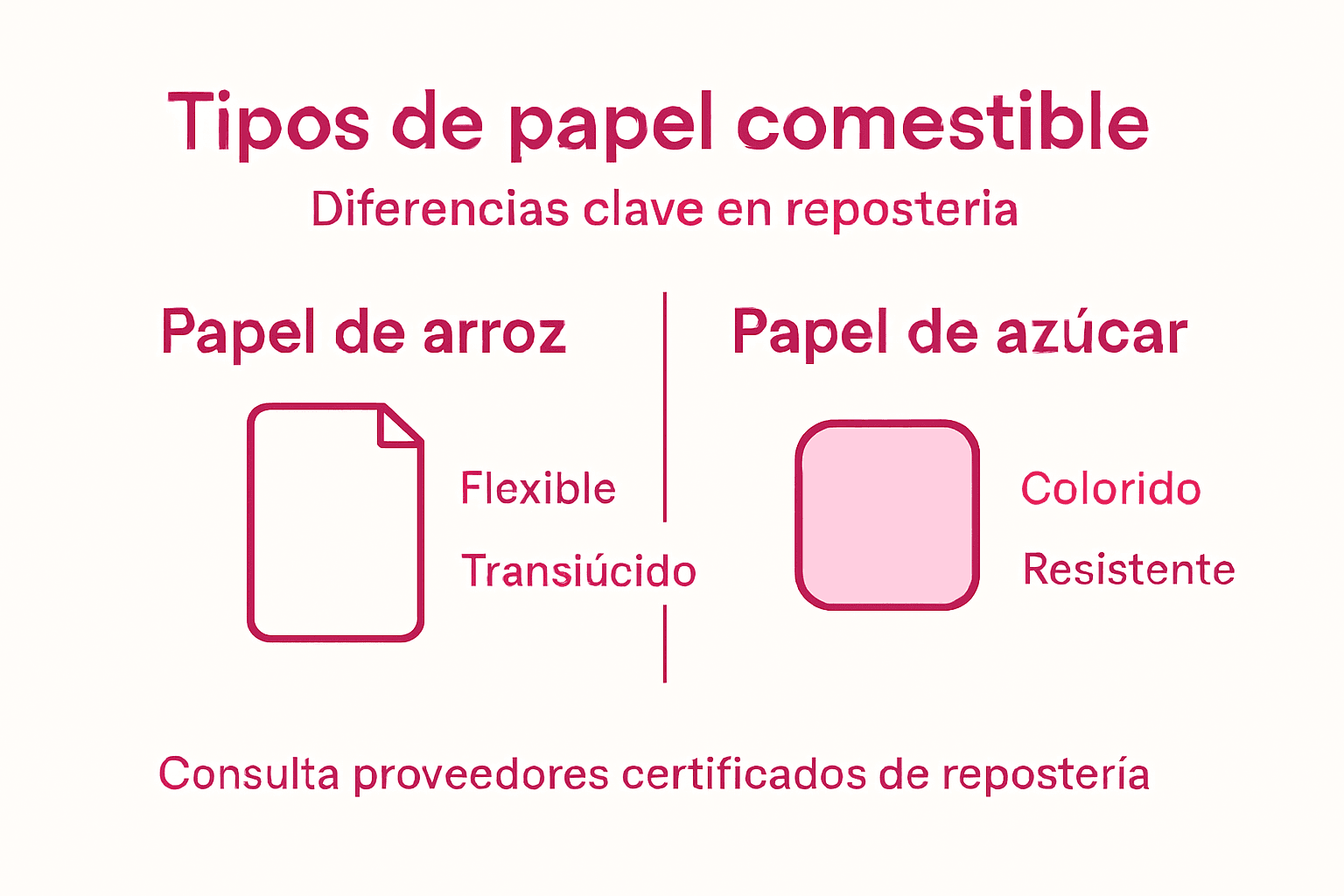
Below is a structured comparison to help you choose the ideal type of edible paper for your project:
| Selection criterion | Rice paper | Sugar paper |
|---|---|---|
| Level of graphic detail | Low to medium | Medium to high |
| Recommended for 3D figures | Yes, very flexible | No, less flexible |
| Durability on moist desserts | Lower resistance | Quick adhesion |
| Preferred for children's events | For delicate shapes | For colorful photos |
The versatility of these edible papers has revolutionized dessert decoration, allowing cakes to be transformed into genuine artistic creations.
Professional tip: Experiment with both types of edible paper to discover which one best suits your creative baking projects.
How it is printed and applied to desserts
Printing edible paper is a technical process that requires specialized equipment and specific knowledge. Food printing techniques allow digital designs to be transformed into unique and personalized culinary decorations.
Printing and application process:
- Select the edible paper
- Choose between rice paper or sugar paper
- Check compatibility with the printer
- Check the quality of the substrate
- Prepare the printer
- Use inks certified for consumption
- Calibrate the printer for edible paper
- Clean the rollers before printing
- Application techniques on desserts:
- The surface must be smooth and moist
- Place the paper using gentle movements
- Press gently to set the design
- Avoid wrinkles or creases
Specialized printers guarantee high-definition reproduction of images and designs, allowing professional results in baked goods decoration.
Precision in printing and application determines the final quality of the decorative design.
Professional tip: Practice with test papers before working with your final design to master the printing and application technique.
Regulations and food safety in Central Europe
The food safety of edible paper in Central Europe is subject to extremely strict regulations that guarantee consumer protection. Food safety standards establish exhaustive controls to ensure that materials in contact with food meet the highest levels of quality and safety.
Key regulatory requirements:
- Certification of materials safe for food contact
- Control of substances used in inks and papers
- Complete traceability of the manufacturing process
- Strict migration limits for components
- Detailed documentation of each component
The Regulation (EU) No 10/2011 establishes the specific parameters for materials in contact with food. European regulations are particularly specific regarding:
The following summary shows the essential aspects to verify to comply with European food safety regulations:
| Regulatory aspect | Main requirement | Importance |
|---|---|---|
| CE certification | Tested and approved materials | Protects public health |
| Ink control | Only food ingredients | Avoids toxic risks |
| Labeling | Clear and visible information | Guarantees traceability |
| Process audit | Periodic verification | Legal compliance |
- Authorized substances
- Specific migration limits
- Good manufacturing practices
- Labeling requirements
- Quality controls
European regulations are considered worldwide as the most demanding standards in food safety.
Professional tip: Always request European certificates of conformity when buying edible paper to guarantee its food safety.
Common mistakes and practical recommendations
Working with edible paper requires precision and technical knowledge. Correct handling processes are essential to obtain professional results in creative baking.
Most frequent mistakes to avoid:
- Using inks not certified for food use
- Applying paper on improperly prepared surfaces
- Exposing the paper to excessive moisture
- Storing materials incorrectly
- Not controlling the ambient temperature and humidity
Handling recommendations:
- Select only authorized food inks
- Prepare smooth and slightly moist surfaces
- Control storage conditions
- Handle the paper with clean tools
- Perform preliminary compatibility tests
Professional hygiene techniques are crucial to prevent contamination and guarantee food safety.
Error prevention begins with training and attention to detail.
Professional tip: Keep a detailed record of your materials, expiration dates, and storage conditions to ensure maximum quality.
Discover how edible paper can transform your desserts into genuine works of art
If you have encountered the challenges of choosing between rice paper or sugar paper, or are looking to ensure the best print with certified inks for your designs, at Funbakery we understand your needs. We know how important it is to guarantee food safety and quality in every detail so that your creations are surprising and safe.

Explore our specialized catalog where you will find a wide variety of edible papers and personalized wafers for cakes and cupcakes with unique themes that will make your desserts stand out. You can also create your own images or photos with personalized text and receive advice on how to correctly apply each design following best practices. Do not miss the opportunity to elevate your creative baking with certified and high-definition products visit Funbakery and start bringing your ideas to life today.
Frequently Asked Questions
What is edible paper and what is it used for in creative baking?
Edible paper is a safe material for consumption that is used in dessert decoration, allowing designs to be personalized with unique images and textures.
What are the differences between rice paper and sugar paper in baking?
Rice paper is thinner and more flexible, ideal for delicate designs, while sugar paper is sturdier and suitable for high-definition printing.
How is edible paper printed on desserts?
To print edible paper, a special printer with food-certified inks must be used, ensuring image quality and application on a moist surface.
What food safety regulations apply to edible paper?
Edible paper must comply with strict regulations that guarantee its safety, including material certification and ink control, in accordance with European standards.

