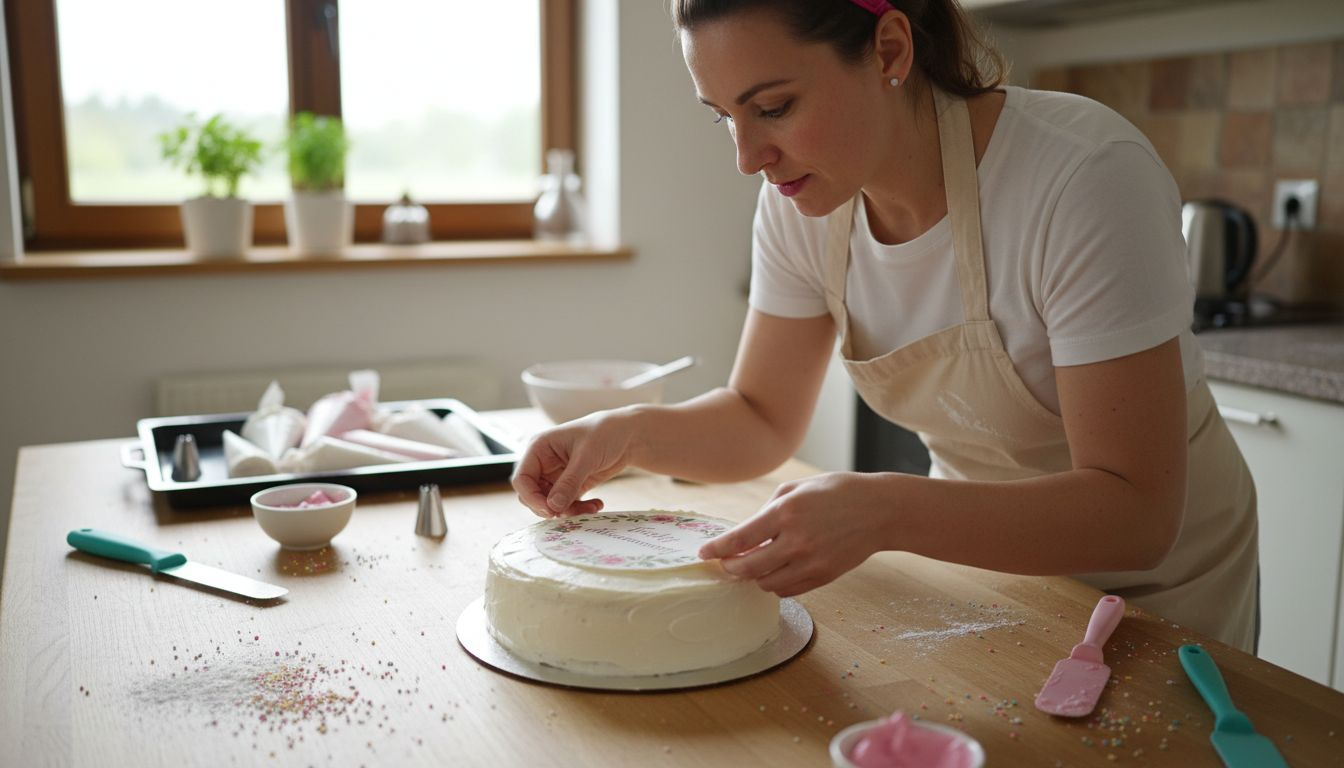
Every family knows that a beautifully decorated cake can be the center of attention at any children's birthday party, making the little ones feel like the stars. Parents in Central Europe are constantly looking for safe and visually striking options to surprise at their celebrations. Choosing the ideal edible paper design transforms desserts into unique creations, allowing you to reflect each child's personality and tastes with personalized details and professional results.
Table of Contents
- Step 1: select the ideal edible paper design
- Step 2: prepare the cake surface correctly
- Step 3: cut the edible paper according to your decoration
- Step 4: place and adhere the edible paper precisely
- Step 5: check the finish and preserve the decoration
Quick Summary
| Key Point | Explanation |
|---|---|
| 1. Select the right design | Consider the theme, age, and tastes of the birthday child to choose a design that reflects their personality. |
| 2. Prepare the cake surface | Make sure the surface is smooth and slightly damp so that the paper adheres correctly. |
| 3. Cut the paper precisely | Use the right tools and measure twice before cutting to avoid design errors. |
| 4. Apply with technique and patience | Place the paper from the center toward the edges using gentle movements to avoid bubbles. |
| 5. Check the final finish | Review any imperfections and correct them immediately to ensure a flawless presentation. |
Step 1: Select the ideal edible paper design
Choosing the perfect edible paper design is essential to turn an ordinary cake into a visual masterpiece. Every celebration deserves a special touch, and edible paper can completely transform the presentation of your dessert.
When selecting the ideal design, you should consider several important aspects. Specialized creative baking stores recommend taking the following criteria into account:
- The theme of the celebration
- The age and interests of the birthday child
- The overall style of the cake
- The existing color palette
Designs should be sharp and high-resolution to ensure a professional decoration. Look for prints with precise details that withstand the moisture of the cake and are completely safe for consumption.
Remember that edible paper not only decorates, it tells a visual story!
You can opt for classic designs such as children's characters, superhero themes, sports motifs, or even personalized images with special photographs. The important thing is that the design reflects the personality and tastes of the person celebrating.
Here is a comparison of the most common types of edible paper and their applications:
| Type of edible paper | Main characteristics | Recommended uses |
|---|---|---|
| Sugar paper | Flexible, vibrant colors, sweet | Children's cakes, cupcakes |
| Wafer paper | Delicate, matte, very light | Traditional cakes |
| Rice paper | Translucent, resistant, neutral flavor | Fine and edible decoration |
| Chocolate paper | Intense flavor, ideal for finishes | Premium decorations |
Professional tip: Test the edible paper on a small section of the cake before covering the entire surface to check its adhesion and final appearance.
Step 2: Prepare the cake surface correctly
Preparing the surface of your cake is a crucial step to achieve a perfect decoration with edible paper. A uniform and well-prepared base will ensure that the paper adheres correctly and looks flawless.
Following the recommendations of professional decorating techniques involves several important steps. The cake surface must meet specific characteristics:
- Be completely smooth and soft
- Free of crumbs or irregularities
- Slightly damp to facilitate adhesion
- Covered with a thin layer of fondant or cream
Preparation method:
- Completely smooth the surface of the cake
- Apply a thin and uniform layer of fondant
- Smooth out any wrinkles or bubbles
- Verify that the surface is completely flat
The key is to create a perfect base that looks like a blank canvas.
Texture is essential. An irregular surface can cause unwanted wrinkles or folds in the edible paper, ruining the visual effect you are looking for.

Professional tip: Use a soft smoother or spatula to remove any imperfections from the surface before placing the edible paper.
Step 3: Cut the edible paper according to your decoration
Cutting the edible paper precisely is essential to achieve a professional and attractive result on your cake. A clean and precise cut can make the difference between an amateur decoration and a truly impressive one.
Following the techniques of precise cutting in cake decorating requires attention to detail and the right tools. Keep these important aspects in mind:
- Measure twice before cutting
- Use a clean cutting surface
- Select sharp and precise tools
- Calculate the exact size of the area to cover
Recommended tools:
- Pastry cutter
- Metal ruler
- Special cutting board
- Fine kitchen scissors
A millimeter-precise cut can completely transform the presentation of your cake.
The key is to be meticulous and patient. Remember that edible paper is delicate and requires careful handling to avoid tears or imperfections.
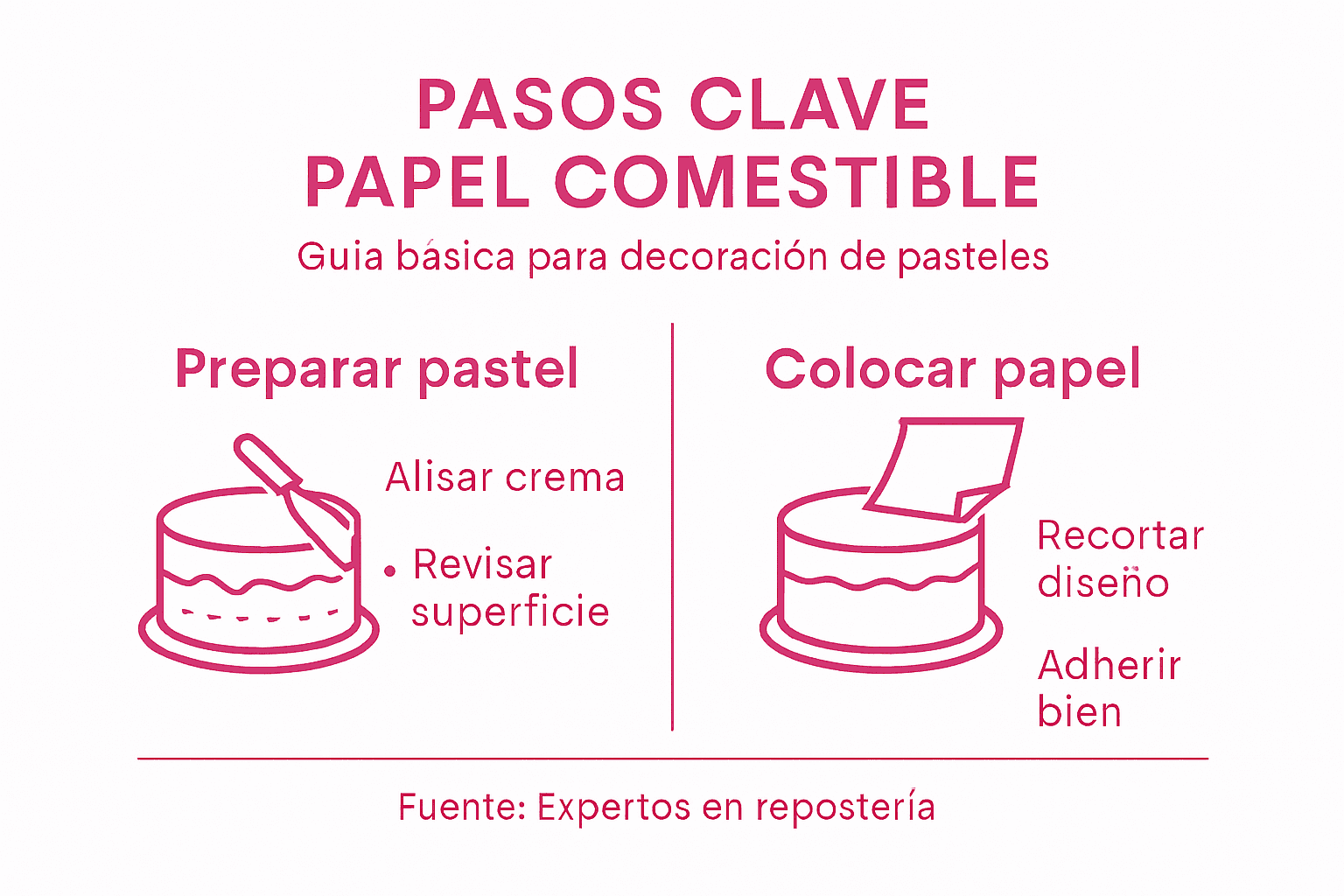
Professional tip: Make a test cut on an extra piece of edible paper to calibrate your technique before working on the final design.
Step 4: Place and adhere the edible paper precisely
Placing and adhering the edible paper is a delicate process that requires patience and technique. One wrong move can completely ruin the decorative effect you have planned so carefully.
Experts in professional decorating techniques recommend following a precise method to achieve a flawless result:
- Work in a clean and dust-free space
- Use gloves to avoid marks or stains
- Keep your hands completely dry
- Apply the paper with smooth and constant movements
Adhesion steps:
- Center the paper on the surface
- Start from the center toward the edges
- Smooth with delicate movements
- Remove any air bubbles
The key is delicacy and millimeter precision.
Some professionals use special techniques such as the use of steam for perfect adhesion, which allows for a completely professional finish without imperfections.
Professional tip: Keep a spray bottle with water nearby to slightly dampen the paper if necessary, but without saturating it.
Step 5: Check the finish and preserve the decoration
Once the edible paper is applied, it is essential to perform a final check that guarantees a professional and lasting result. The last step will determine the quality of your decoration and its preservation.
Professionals in cake decorating recommend a detailed review process:
- Examine the surface for wrinkles or bubbles
- Check the complete adhesion of the paper
- Verify that there are no raised or irregular areas
- Correct any imperfection immediately
Preservation techniques:
- Keep the cake in a cool environment
- Avoid direct light
- Protect from moisture
- Store in a closed container
Perfection is in the details and in taking care of your masterpiece after decorating it.
Some additional tricks include using a soft spatula to smooth out any small imperfection or applying light steam to correct problematic areas.
This summary shows the frequent errors and solutions when applying edible paper:
| Frequent error | Common cause | Practical solution |
|---|---|---|
| Wrinkles on the surface | Irregular surface | Smooth with a soft spatula |
| Air bubbles | Poor adhesion | Press gently from the center |
| Moisture stains | Excess water on the paper | Use less water or steam |
| Faded design | Exposure to direct light | Store in a dark place |
Professional tip: If you notice any imperfection, don't panic. A gentle movement with a spatula can fix most small defects.
Transform your cakes with professional-quality edible paper
Want to achieve a flawless decoration without complications? Start your creations using the most vibrant and resistant designs offered by Funbakery. Our selection of Superhero and Disney Wafer Paper for Cakes | Funbakery guarantees sharp colors and perfect details that tell unique visual stories for every event

Don't waste time preparing paper that does not adhere well or that wrinkles. Funbakery offers options that perfectly complement the smooth and well-prepared surface recommended by experts. Also discover our line of children's designs such as Roblox or Stumble_guys to surprise and delight young and old. Visit now https://funbakery.es and take your cakes to the next level of creativity and professionalism
Frequently Asked Questions
What is the best type of edible paper to use on cakes?
The best type of edible paper depends on the design and application. For children's cakes, sugar paper is ideal for its vibrant colors. If you are looking for a more delicate decoration, rice paper offers a transparent and light finish.
How is the cake surface correctly prepared before applying the edible paper?
To prepare the cake surface, make sure it is completely smooth and free of crumbs. Apply a thin layer of fondant or cream so that the edible paper adheres better, smoothing out imperfections with a spatula.
What is the best way to cut the edible paper?
Cut the edible paper using sharp tools, such as a pastry cutter and a metal ruler. Carefully measure the area to cover to ensure that the paper fits perfectly to the shape of the cake.
How is the edible paper effectively adhered to the cake?
To adhere the edible paper, place it gently on the cake, starting from the center toward the edges. Use delicate movements to remove air bubbles and ensure proper adhesion.
What should I do if bubbles or wrinkles appear on the edible paper?
If bubbles or wrinkles appear, use a soft spatula to carefully smooth them out. In some cases, you can apply a little steam to help correct imperfections and improve the adhesion of the paper.
How can I preserve a cake decorated with edible paper?
Keep the cake in a cool environment, away from direct light and moisture. Store it in a closed container to maintain its freshness and prevent the edible paper from deteriorating.