TL;DR:
- Choosing between sugar paper, wafer paper, or Revoprint depends on the design, print quality, and flexibility needed for the decoration.
- Humidity and timing are crucial for maintaining adhesion and preventing warping, so it is recommended to plan ahead and store the edible paper correctly.
- For children's parties, sugar paper is recommended for detailed photos, while wafer paper or Revoprint is best for 3D shapes or simple illustrations.
Organizing a children's birthday party involves a thousand details, but few cause as much confusion as knowing how to choose cake paper. Sugar paper or wafer paper? Are they the same? Which one prints your child's photo better? Many parents go to the bakery or an online store without knowing that this decision directly affects the visual result of the cake. This article gives you a practical guide to understanding the differences, avoiding common mistakes, and achieving a personalized decoration that will leave everyone speechless.
Table of Contents
- Types of edible paper for cakes and their characteristics
- How humidity affects the application and storage of edible paper
- Optimization and planning to print and use edible paper efficiently
- How to choose the right paper according to your party and custom design
- Why time and humidity management are hidden keys to the success of edible paper
- Discover our custom edible paper options for children's parties
- Frequently Asked Questions
Key Points
| Point | Details |
|---|---|
| Different edible papers | Sugar paper is ideal for sharp photos and vivid colors, while wafer paper is better for 3D decorations and shapes. |
| Humidity control | Application and storage without excessive humidity prevent warping and ensure the sharpness of the design. |
| Digital planning | Designing and organizing the designs digitally maximizes the use of paper and reduces waste. |
| Choice according to design | The type of paper should be chosen according to the type of decoration and quality desired. |
| Expert management | Planning printing, drying, and gluing times is key to professional results at children's parties. |
Types of edible paper for cakes and their characteristics
Not all types of edible paper are the same, and choosing the wrong one can cost you a dull decoration or a design that doesn't look the way you expected.
Sugar paper
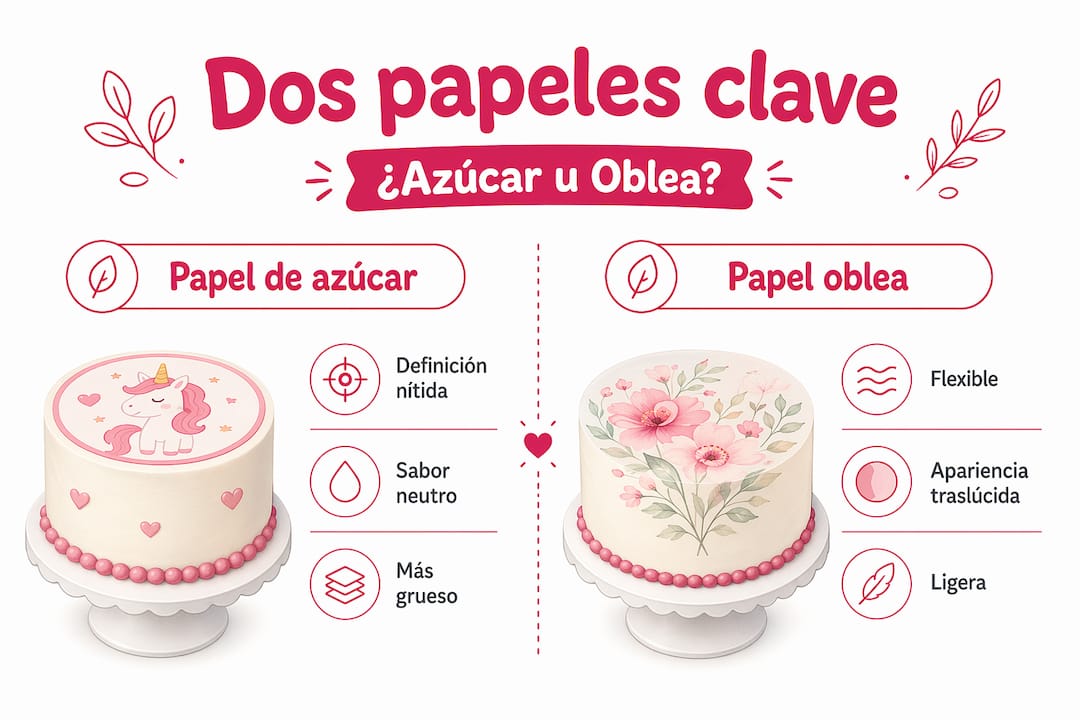
It is the favorite for printing photos and designs with a lot of detail. It is made from sugar and starch, which gives it a smooth and white surface almost like photographic paper. That surface allows food colorings to adhere precisely, creating vivid colors and sharp details that cannot be achieved with other formats. If you want to put your child's face on the cake, this is your paper.
Wafer paper
Thinner and more flexible than sugar paper. It is made from potato or rice starch and has a translucent texture that makes it ideal for three-dimensional artistic work: flowers, butterflies, bows, or sculptural decorations. According to industry comparisons, wafer paper is lightweight and flexible for 3D structures, while sugar paper delivers higher print quality. If the design you are looking for does not include a photo but rather cut-out shapes or elements that stand out from the cake, wafer paper wins.
Revoprint edible sheets
They are a more recent innovation. They combine the flexibility of wafer paper with a surface that accepts printing better than traditional wafer paper. They work well on irregular surfaces and are more resistant to handling. They do not achieve the photographic definition of sugar paper, but for designs with illustrations or simple graphics, they offer a very attractive balance.
Here is a quick comparison so you don't have to guess:
| Feature | Sugar paper | Wafer paper | Revoprint sheets |
|---|---|---|---|
| Print quality | Very high (HD photos) | Medium | High |
| Flexibility | Low | High | Medium |
| Ideal for | Photos and flat designs | 3D decorations | Illustrations and graphic designs |
| Moisture needed to stick | Little | None | Little |
| Taste when eating | Neutral, sweet | Neutral, tasteless | Neutral |
In summary, choose according to your goal:
- Birthday child's photo: sugar paper.
- Flowers, butterflies, or shapes with volume: wafer paper.
- Illustrated designs or characters with defined lines: Revoprint sheets.
How humidity affects the application and storage of edible paper
Humidity is the number one enemy of edible paper. Most of the problems you see on social media, warped papers, blurred designs, or images that peel off, originate here.
Application on the cake
The surface on which you stick the paper must be slightly damp, not soaked. With fondant, the ideal is to smooth it just before placing the paper, taking advantage of the natural moisture of the freshly rolled fondant. With buttercream, apply a thin layer and let it lose its shiny shine but retain some stickiness before placing the paper. Ganache needs to be at room temperature to have that adhering texture without excess moisture. As recommended by practice in bakeries, a slightly damp surface guarantees adhesion without blurring the print.
What you should avoid
- Storing the decorated cake in the refrigerator without protection: the temperature change creates condensation.
- Storing it in damp cardboard boxes or in environments with a lot of humidity.
- Freezing the cake once the paper is placed, because moisture causes warping and completely blurs the printed design.
- Handling the paper with damp or wet hands.
Storage before use
Unused edible paper should be stored in its original closed bag, away from heat sources, humidity, and direct light. A dry cabinet is enough. If you live in an area with a lot of ambient humidity, add a desiccant packet inside the bag.
Professional tip: If the sugar paper has stuck to the plastic backing and does not come off cleanly, freeze the sheet for 60 seconds. The dry cold of the freezer makes the paper contract slightly and come off without breaking.
Ink drying
Before applying any printed paper, make sure that the edible printing ink is completely dry. Under normal conditions, about two hours are enough. If the paper arrives freshly printed or has been in a damp environment, wait longer or let it rest on a dry surface before handling it. You can find more about common mistakes with edible paper and how to avoid them before you start.
Optimization and planning to print and use edible paper efficiently
One mistake many parents make when ordering custom paper is not making good use of the available space. The standard format is A4, and every centimeter you waste is money that could have been turned into another decoration for the cupcakes or the party cookies.
How to plan your design in A4 format:
- Define all elements before ordering the print. Do you need a large image for the main cake, circles for the cupcakes, and strips for the side? Write them all down before you start.
- Use a digital design tool (Canva, for example) to arrange everything on an A4 page. You will see exactly how much space each element takes and you can rearrange them so they fit together.
- Group elements from similar projects. A single A4 sheet can include the cake topper, twelve circles for cupcakes, and four decorative strips for the side, all in the same print.
- Save the leftover cutouts. The leftover pieces of sugar paper can be stored in an airtight bag and used to decorate cookies, chocolates, or even as small details on the sides of the cake at another time.
- Always cut on a firm surface and with a precision cutter, not with scissors, to get clean edges on circles and irregular shapes.
Professional tip: When cutting the sugar paper, leave it on its protective plastic sheet until the last moment. The plastic acts as a support and prevents the paper from breaking or curling while you handle it. Only remove the backing just before sticking it on the cake.
Planning the design digitally before printing helps make the most of every sheet and save cutouts for future uses. This step, although it seems obvious, is skipped in 80% of improvised orders. You can learn more about how to use edible paper to make the most of it in your decorations.
How to choose the right paper according to your party and custom design
You already have the theory. Now apply it to the specific case of your child's party.
If your party is for a children's character with a real photo (the birthday child in costume, a family image, the pet), sugar paper is the only option. Choosing according to the design goal makes all the difference: for high-definition photos, sugar paper is unbeatable; for 3D decorations, wafer paper is the right tool.
Selection criteria according to the type of decoration:
- Photos and recognizable faces: sugar paper, no question.
- Cartoon characters with clean lines (Spiderman, PAW Patrol, Frozen): sugar paper or Revoprint sheets.
- Flowers, butterflies, bows, and elements that stand out from the cake: wafer paper.
- Wrapping side decoration around the cake: thin sugar paper or Revoprint, which adapt better to curves.
- Cakes with buttercream or cream without fondant: sugar paper, more resistant to the slight moisture of the cream.
Taste and texture when eating
One question that few parents ask but everyone should: how does it taste? Sugar paper has a neutral, slightly sweet taste that goes unnoticed. Wafer paper is also neutral but with a slightly crunchier texture when dry. Neither should alter the taste of the dessert.
The base surface matters more than you think
It is not just the paper, it is what is underneath. Fondant is the simplest base and is more forgiving of mistakes. Buttercream requires more care with moisture. The naked cake (uncovered cake) is not a suitable support for edible paper because it does not have enough adhesion.
| Type of party | Recommended paper | Why |
|---|---|---|
| Birthday child's photo | Sugar paper | Maximum definition |
| Superheroes / characters | Sugar paper or Revoprint | Vivid colors and sharp lines |
| 3D artistic decoration | Wafer paper | Flexibility and volume |
| Wrapping side design | Revoprint or thin sugar paper | Adapts to the curvature |
Why time and humidity management are hidden keys to the success of edible paper
Here is something that most guides do not tell you: choosing the right paper is only half the work. We have seen terrible results with top-quality sugar paper and excellent results with basic paper, and the difference is almost always the same: who controlled the time and humidity during the process.
The paper is applied at the last minute, sometimes with the stress of the party looming, in warm and humid kitchens with boiling pots. That context is the worst possible. Planning the cuts and assembly in advance, minimizing exposure to the air, improves the quality of the finish and eliminates the most common failures such as warping and tearing.
What we recommend from experience: print or order the paper at least 48 hours in advance. Cut it carefully and store it in the bag. Decorate the cake the day before, apply the paper, and store it in the refrigerator well covered with plastic wrap without the film touching the edible paper. The next day, take it out 30 minutes before serving.
Professional tip: At children's parties with many children running around, the heat and ambient humidity rise. If you decorated the cake the night before and the refrigerator did its job, the paper will be perfectly settled and will not peel off even if the party lasts for hours.
Ignoring the timing has real consequences: a warped design that is not understood, colors that blur, and a cake that does not produce the effect you expected. Also check how to avoid common mistakes with edible paper to review the most frequent failures before your next party.
Discover our custom edible paper options for children's parties
Now that you know exactly what paper you need and how to use it, the next step is to get it with the quality and personalization your party deserves. At Funbakery we design and print sugar paper and edible wafers with your children's favorite characters: superheroes, princesses, sports, animals, and much more.

Want something unique? You can order your custom wafer with photo, name, and age so that the cake has exactly what you imagine. And if you need a design that does not exist, our custom design studio creates any custom image, with vivid colors, high-resolution printing, and a taste suitable for the little ones.
Frequently Asked Questions
What is the main difference between sugar paper and wafer paper?
Sugar paper offers higher print quality with vivid colors for sharp photos, while wafer paper is more flexible and is designed for three-dimensional artistic decorations.
How to prevent edible paper from wrinkling or blurring on the cake?
Apply the paper to slightly damp surfaces, let the ink dry completely before using it, and remember that freezing the cake with the paper on is the most common cause of wrinkling and blurring.
How long does sugar paper last if stored correctly?
Sugar paper lasts approximately one year if kept in a sealed airtight bag, away from heat and direct light.
Can I use edible paper to decorate other desserts besides cakes?
Yes, it works perfectly on cupcakes, cookies, and chocolates. Sugar paper is ideal for toppers and decorated cookies, while chocotransfer is designed to personalize chocolates and chocolate bars.
Which edible paper is best for customizations with detailed photos?
Sugar paper is the best option for high-resolution photos thanks to its smooth surface and the ability of food colorings to reproduce very fine details.