TL;DR:
- Preparing and selecting materials is key to professional cake decorating results.
- Techniques and trends vary by occasion, such as fondant for weddings and buttercream for children's birthdays.
- Personalizing with edible images and accepting minor imperfections makes a cake memorable.
You want the celebration cake to be spectacular, but when you get started, doubts arise: fondant or buttercream? How do I attach the edible image without it wrinkling? What if something goes wrong right before the party? This is a very common frustration, both for parents organizing a child's birthday and for adults planning a wedding or anniversary. This guide takes you step by step through the complete cake decorating workflow, from gathering the materials to achieving a professional bakery-worthy finish, with practical solutions for the most common mistakes.
Table of Contents
- What You Need Before You Start: Materials, Tools, and Planning
- Step by Step: Universal Workflow for Decorating a Cake
- Common Mistakes and How to Fix Them in Cake Decorating
- How to Achieve Perfect Finishes and Professional Results
- Our Experience: What Really Makes a Decorated Cake Unique
- Personalize Your Cake with Unique Edible Designs and Images
- Frequently Asked Questions About Cake Decorating
Key Points
| Point | Details |
|---|---|
| Essential materials | Gathering the right tools and materials is key to an organized workflow and spectacular results. |
| Follow structured steps | A clear workflow helps you tackle any design and avoid last-minute mistakes. |
| Creative personalization | Take advantage of trends and techniques so your cakes reflect the event and surprise your guests. |
| Solve mistakes with confidence | Common problems have solutions; knowing them makes it easier to achieve professional finishes. |
What You Need Before You Start: Materials, Tools, and Planning
To achieve professional results, everything starts with good preparation. Before touching the cake, you need to be clear about the materials, tools, and design you want to achieve. Improvising at this point is the number one cause of disappointing results.
Essential tools:
- Angled spatula and straight spatula for smoothing frosting
- Piping bags with various tips (star, round, petal)
- Fondant smoother
- Non-stick rolling pin and silicone mat
- Shape cutters and modeling tools
- Pastry brush for fine details
- Kitchen thermometer (essential in warm climates)
As for ingredients, the three main options are fondant, buttercream, and edible paper. Each has its ideal moment. Fondant dominates 71% of use in event cakes thanks to its versatility for covering, modeling, and creating three-dimensional figures. Buttercream, on the other hand, is tastier and easier to dye, but requires refrigeration. Edible paper is the fastest and most precise solution for adding photographs, illustrations, or personalized text.
The choice also depends on the type of event. For a wedding, fondant offers a smooth and elegant finish. For a child's birthday, buttercream with bright colors and fun textures usually works better. If you want to explore more about how to decorate personalized desserts according to the type of celebration, there are specific resources that can guide you.
Current trends in pastry point toward minimalism, floral motifs, geometric designs, marble-like textures, and, above all, personalization. Knowing these trends before designing your cake helps you create something that looks current and special.

Before you start decorating, always sketch the design. It doesn't need to be perfect, just a visual guide with colors, the position of elements, and text. This avoids rushed decisions and allows you to calculate how much material you need.
| Material | Best for | Difficulty |
|---|---|---|
| Fondant | Weddings, formal events | Medium |
| Buttercream | Children's birthdays, homemade cakes | Low |
| Edible paper | Photos, detailed designs | Very low |
Professional tip: Store fondant wrapped in plastic wrap inside an airtight bag at room temperature. Buttercream, on the other hand, needs refrigeration, but take it out 30 minutes before using it so it regains its ideal texture. Never leave them exposed to the air: fondant dries out and buttercream forms a crust.
If you want to delve deeper into advanced pastry techniques, there are specialized courses that cover everything from glazing to sugar sculpture. For those looking for practical tips on how to personalize cakes for events, you will also find ideas adapted to each occasion.
Step by Step: Universal Workflow for Decorating a Cake
Once everything necessary is ready, it's time to get started. Following a clear order makes the difference between a chaotic result and one that impresses.
- Level and fill the cake. Cut equal layers with a cake leveler or serrated knife. Apply the filling with a piping bag for greater uniformity.
- Apply the crumb coat. A thin layer of buttercream seals the crumbs and creates the perfect base for the final frosting. Refrigerate for 20 minutes.
- Cover with the chosen frosting. If you use buttercream, apply a generous second layer and smooth with a spatula. If you use fondant, roll it out to a thickness of 4 mm and cover carefully from the center to the sides.
- Add the main decoration. This is where modeled figures, sugar flowers, painted details, or edible paper come in.
- Place the edible paper or wafers. Apply them over a slightly damp surface of buttercream or frosting. Press gently from the center to the edges to avoid bubbles.
- Add the final details. Letters, sprinkles, edible pearls, glitter, or candles. These small elements notably elevate the visual result.
- Review and correct. Observe the cake from different angles before declaring it finished.
The choice between techniques depends on the result you are looking for and the time available. Buttercream is tastier but less resistant to heat, while fondant gives a professional finish and holds up better in warm environments.
| Technique | Flavor | Heat resistance | Ease of use | Visual personalization |
|---|---|---|---|---|
| Buttercream | Excellent | Low | High | Medium |
| Fondant | Sweet | High | Medium | High |
| Edible paper | No effect | Medium | Very high | Very high |
To learn more about how to decorate desserts for parties with different techniques, there are specific tutorials that cover everything from simple cakes to elaborate designs. If this is your first time working with printed images, the guide on how to use edible paper will answer your most common questions.
Professional tip: When placing edible paper, do not dampen it excessively. A slightly cool buttercream surface is enough for it to adhere well. If the paper wrinkles, carefully lift it and reposition it before it dries completely.
Common Mistakes and How to Fix Them in Cake Decorating
Even with a clear guide, difficulties can arise. Knowing them beforehand allows you to react quickly and save the cake without drama.
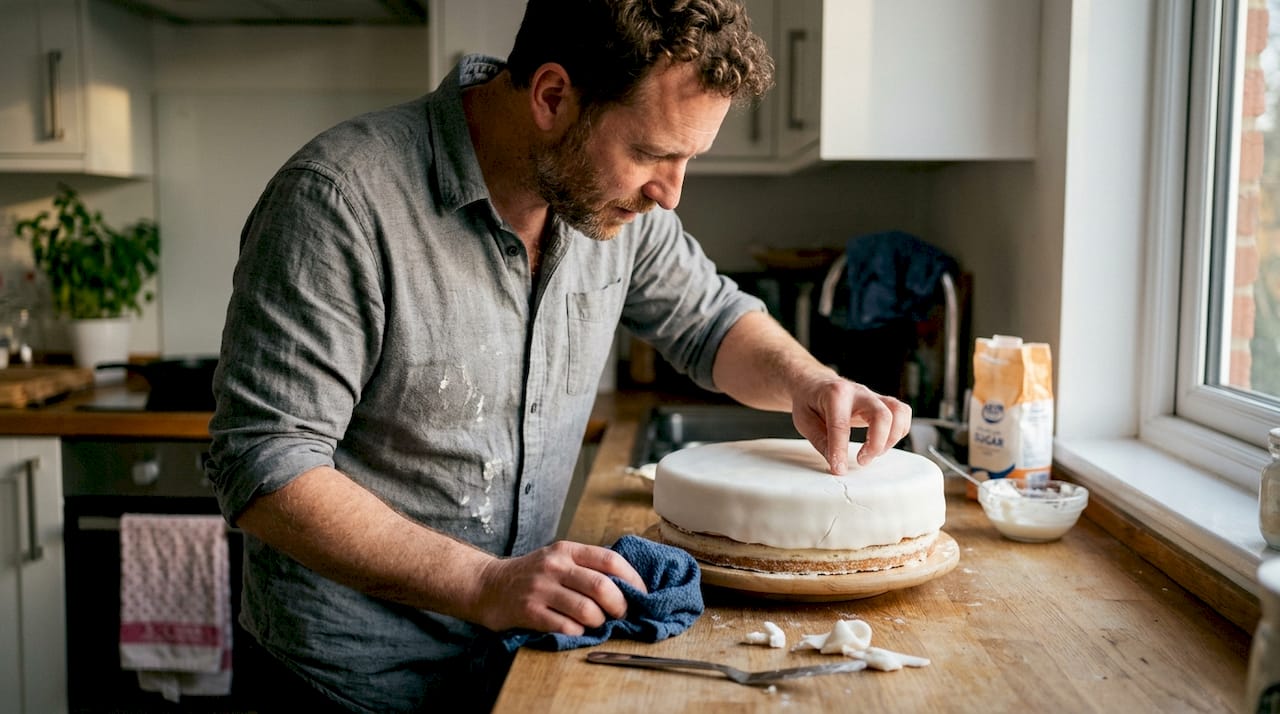
Dry or cracked fondant. This happens when the fondant loses moisture during kneading or rolling. Solution: knead a few drops of vegetable glycerin or vegetable shortening directly into the fondant until it regains elasticity. If it is already placed on the cake, use a brush with warm water to soften the cracks with very gentle circular motions.
Melted buttercream. Buttercream can melt in warm climates, ruining the presentation. If this happens, refrigerate the cake for 15 minutes and smooth it again. For summer or outdoor events, opt for Swiss or Italian buttercream, which are more stable thanks to their meringue base.
Edible stickers that do not adhere or wrinkle. This usually happens when the surface is too dry or too wet. Compare the differences between edible paper vs. fondant to choose the right base according to your frosting. If the wafer wrinkles, apply a very thin layer of diluted glucose syrup before placing it.
Last-minute mishaps. The cake falls, a figure breaks, or the color didn't turn out as you expected. In this case, improvise with additional elements: edible natural flowers, fresh fruit, or sprinkles can cover imperfections and add an elegant touch. Also check this resource on fixing common decorating mistakes for quick and effective ideas.
“The perfect cake does not exist, but the cake that tells a story does.”
To get inspired with visual solutions, the tutorial on decorating birthday cakes with edible paper shows how to turn small mistakes into creative details.
How to Achieve Perfect Finishes and Professional Results
Once mishaps are overcome, it's time to give the cake the finishing touch. Finishes are what separate a homemade cake from one that looks like it came from a luxury bakery.
Techniques for professional finishing:
- Smooth the edges of the fondant with the smoother using firm and continuous circular motions
- Use a hot spatula (dipped in hot water and dried) to smooth the buttercream and remove marks
- Correct small imperfections with a drop of fondant in the same color pressed with your finger
- Apply pearl dust or edible luster with a dry brush to add shine without altering the texture
- Use a ruler or cake level to check that the layers are perfectly horizontal
Advanced techniques include mirror glazing, airbrushing, texturing, edible flowers, and chocolate structures. You don't need to master them all, but knowing them allows you to choose the one that best fits your skill level and the time available.
As for trends, the marble style remains very popular: it is achieved by mixing white fondant with veins of gray or black fondant without fully kneading it. The floral effect, with sugar flowers or edible natural flowers, adds elegance to weddings and anniversaries. And minimalism, with smooth surfaces and a single central decorative element, is perfect for those looking for sophistication without complications.
Featured fact: Fondant represents 71% of use in cake decorating globally, confirming that it remains the preferred option when looking for a flawless finish.
To take your creations to the next level, the guide on how to decorate cakes with wafers shows you how to combine traditional techniques with printed decorations. And if you are looking for ideas to surprise at birthdays with unique designs, you will find proposals for all ages and themes.
Our Experience: What Really Makes a Decorated Cake Unique
After reviewing techniques and tricks, it is worth reflecting on something that manuals rarely mention: technical perfection is not what makes a cake memorable.
We have seen flawless cakes that did not move anyone, and cakes with small imperfections that brought tears of joy. The difference lies in the story behind it. A cake with the birthday person's childhood photo, the couple's name on their anniversary, or a child's favorite character communicates something that no technique can replace: that someone thought of that person in a special way.
Small mistakes, that flower that turned out a little crooked or the edge that is not completely straight, sometimes make the cake more human and more personal. Creativity and personalization are what make the real difference in any celebration. If you want ideas for wedding cakes that combine technique and emotion, there are proposals that go much further than the conventional.
Personalize Your Cake with Unique Edible Designs and Images
If you want your cake to truly stand out and reflect the spirit of your event, there is a simple and creative solution.

At Funbakery, we create personalized wafers with photographs, names, ages, and custom text, ready to place on any cake in minutes. Our catalog of personalized edible decorations includes superheroes, animals, floral motifs, designs for weddings, anniversaries, and much more. If you are looking for something specific, such as a personalized birthday wafer with your child's favorite character, we have it. Applying our edible image is as easy as placing it on buttercream or fondant and you're done: professional result without effort.
Frequently Asked Questions About Cake Decorating
What frosting technique is best for a child's birthday?
Buttercream and rosettes are ideal for children's birthdays because they are easy to work with, allow for bright colors, and create fun textures that children enjoy. According to recommendations for special occasions, this combination is the most versatile for this type of event.
Why choose fondant for a wedding?
Fondant is perfect for weddings because it is durable, provides a smooth and elegant finish, and allows for sophisticated designs such as marble textures or modeled flowers. Its durability and professional finish make it the preferred choice for formal events.
What are the most popular trends in cake decorating?
Current trends include minimalism, floral motifs, geometric designs, and marble textures, with a strong emphasis on personalization for each celebration.
Does fondant affect the taste of the cake?
Fondant allows for very professional finishes, but it can be less palatable than buttercream and tastes sweeter. Many people remove it before eating.
What percentage of the cake decorating market does fondant hold?
Fondant accounts for 71% of the global cake decorating market for events, establishing itself as the most widely used icing technique for celebrations.