TL;DR:
- Nutritional values in wafers vary significantly by type, so they should always be compared per 100 g for an informed choice.
- Decorative wafers provide minimal nutrition and should not be considered part of the calorie or nutritional content of a menu.
Nutritional values in wafers indicate the amount of calories, fats, sugars, proteins, and other nutrients they provide per serving or per 100 grams. Knowing this nutritional profile is key when planning an event and you want to offer options that look after the health of your guests. Not all wafers are the same: there are rice, vanilla, chickpea, or matcha wafers, and each type has a very different impact on the diet. Reading the label carefully before choosing makes the difference between an occasional treat and a conscious choice.
What nutritional values should you analyze on wafer labels?
The standard nutritional table presents the values per 100 g, allowing you to compare any product regardless of the serving size declared by the manufacturer. This data is the starting point for any serious analysis of the nutritional content of wafers.
The European traffic light system classifies four key nutrients as low, medium, or high. The thresholds to consider them low are as follows:
- Total fats: 3 g or less per 100 g
- Saturated fats: 1.5 g or less per 100 g
- Sugars: 5 g or less per 100 g
- Salt: 0.3 g or less per 100 g
If a product exceeds these values, the traffic light marks it in orange or red. For events with guests who control their diet, prioritizing those that are green in sugars and salt is a solid strategy.
Fiber and proteins do not appear on the traffic light, but they do matter. A wafer with more fiber generates greater satiety and has a more moderate glycemic impact. Proteins are especially relevant if you are looking for more nutritious options for celebrations with children or athletes.
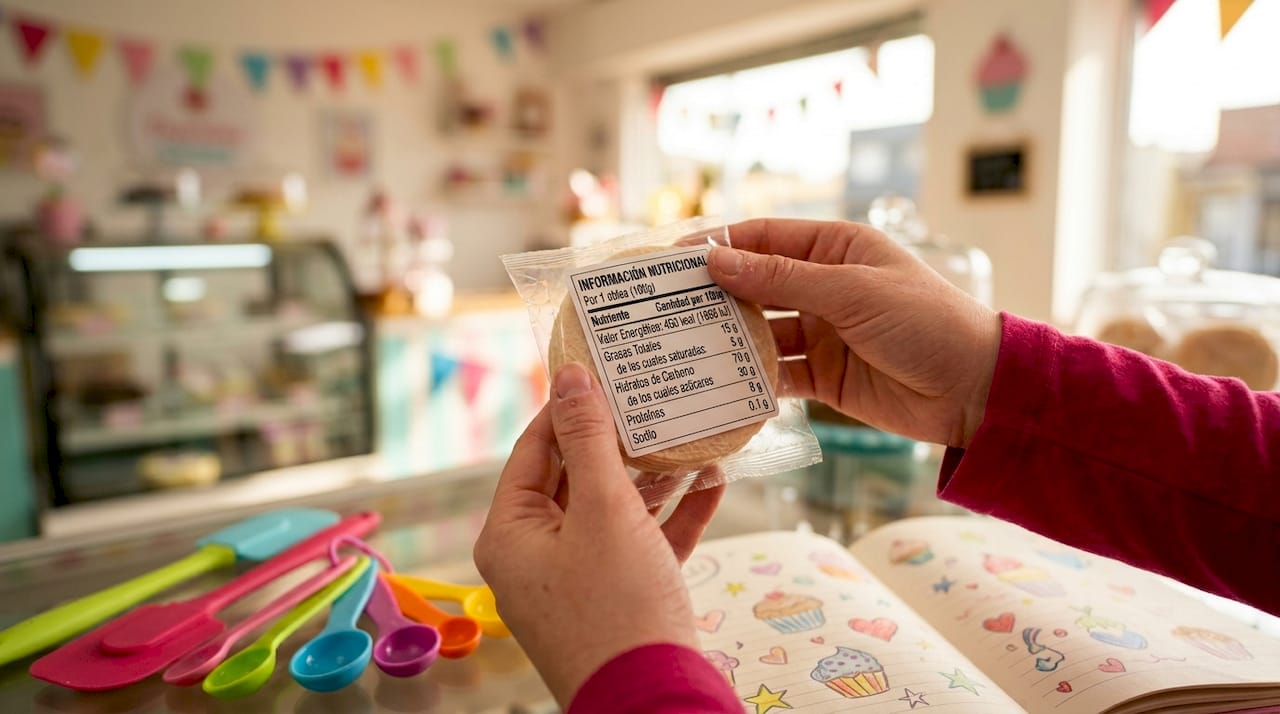
Professional tip: Always compare the values per 100 g, not per serving. Manufacturers declare very different servings, which makes direct comparisons between products misleading if you do not use the same base.
How do different types of wafers compare by their nutritional content?
The type of wafer radically determines its nutritional profile. Below, four representative varieties are compared with their data per 100 g:
| Wafer type | Calories | Total fats | Sugars | Carbohydrates | Salt / Sodium |
|---|---|---|---|---|---|
| Rice (Carrefour) | 347 kcal | 0.5 g | 0.5 g | 83 g | 1.7 g salt |
| Sugar-free vanilla (Gullón Diet Nature) | 431 kcal | 22 g | 0 g | 63 g | low |
| Chickpea with chocolate (Byodo) | 450 kcal | 20 g | 24 g | variable | 0.49 g salt |
| Matcha (Sanamania) | 390 kcal* | 0.6 g | 0.6 g | 52 g | 24 mg sodium |
Estimated value per 100 g based on the data per 60 g serving.
Carrefour rice wafers have very little fat and sugar, but their carbohydrate load is 83 g per 100 g and the salt exceeds 1.7 g, which makes them a product to watch out for people with hypertension. Gullón Diet Nature wafers without sugar seem like a light option, but they contain 22 g of fat and 63 g of carbohydrates. This confirms that the “sugar-free” label does not equate to low in calories or carbohydrates.
Byodo chickpea wafers are the most caloric of the group, with 450 kcal and 24 g of sugars, but they also provide 13 g of protein and 4.9 g of fiber per 100 g. For events where a more nutritionally complete snack is sought, this variety has clear advantages over purely starchy options. The Sanamania matcha wafer stands out for its very low sugar content (0.6 g) and zero saturated fats, which positions it as one of the most balanced options on the current market.
How to choose healthy wafers for events according to your diet?
Choosing wafers well for an event is not reduced to looking at calories. Sodium, carbohydrates, and the type of fat weigh as much as the total calories, especially if among your guests there are people with diabetes, hypertension, or weight control diets.
Follow this process to make informed decisions:
- Always read the values per 100 g. Comparing by serving leads to errors because the weight per unit varies greatly between products.
- Check sodium before sugar. Rice wafers, for example, have very little sugar but more than 1.7 g of salt per 100 g, which exceeds the low threshold of the European traffic light.
- Do not rely only on the “sugar-free” claim. Products like Gullón Diet Nature have 0 g of sugars but 63 g of carbohydrates and 22 g of total fats. The complete nutritional panel is the only reliable data.
- Calculate the real serving. If each wafer weighs 10 g, multiply the values per 100 g by 0.1 to know the real contribution per unit. This is especially useful in events where several units are served per person.
- Look for fiber and protein when you can. Wafers with whole ingredients or legumes, such as chickpea, provide nutrients that rice or vanilla varieties do not have.
Professional tip: For events with diabetic people, the diabetes food label reading checklist resource from KomaDose AI offers a practical checklist to evaluate the glycemic impact of any food, including wafers.
A frequent error in event planning is choosing decorative wafers thinking they have the same nutritional value as cookie-type wafers. They are different categories, and confusing them can alter the dietary calculations of the menu.
How do decorative wafers differ from wafers for eating?
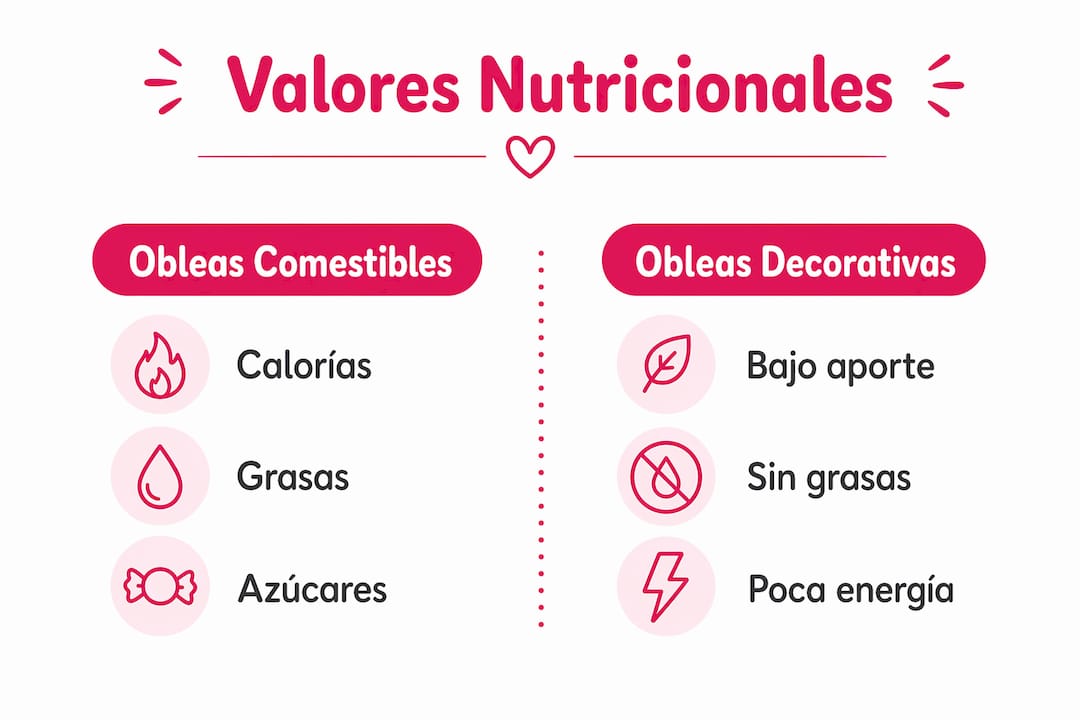
This distinction is one of the most ignored and has direct consequences on the nutritional planning of events. Decorative wafers, also called wafer paper or sugar paper, are thin sheets of potato or rice starch that are used as toppers for cakes and muffins. Their nutritional contribution is minimal because they are consumed in very small quantities, from one to two grams per serving.
Wafers for direct consumption, on the other hand, are cookie or snack type products with a complete and relevant nutritional profile. This is where the values of calories, fats, and sugars have a real impact on the diet. You can delve deeper into the composition differences in this article about what edible wafers contain.
Key points not to confuse both types:
- Decorative wafers are identified because they come in printed sheets or sheets, not in snack packages.
- Their nutritional label, when it exists, shows very low or zero values in all macronutrients.
- They should not be used as a snack substitute or counted as a significant caloric contribution in the event menu.
- Cookie-type wafers have a detailed nutritional label with values per serving and per 100 g, just like any packaged food product.
Clear manufacturer labeling is the most reliable tool to distinguish both categories. If the label does not specify macronutrients clearly, ask for the product technical sheet before including it in your menu. For children's events, where ingredient control is especially sensitive, knowing this difference is essential. You can see more about the use of wafers in celebrations with children in this article about wafers in children's events.
Key points
Nutritional values in wafers vary radically depending on the type: always compare per 100 g and check fats, sugars, salt, and carbohydrates is the only way to choose with criteria for events and diets.
| Point | Details |
|---|---|
| Comparison base | Always use the values per 100 g to compare products with different servings. |
| Hidden salt in rice wafers | Rice wafers have very little sugar but can exceed 1.7 g of salt per 100 g. |
| The “sugar-free” myth | Sugar-free wafers can have up to 63 g of carbohydrates and 22 g of total fats. |
| Legume wafers | Chickpea wafers provide 13 g of protein and 4.9 g of fiber, more than any rice or vanilla variety. |
| Decorative wafers | Decorative wafers have minimal nutritional contribution and should not be counted as a snack in the menu. |
What no one tells you about wafer labels
I have been helping people choose wafers for all types of events for years, from children's birthdays to celebrations for adults with specific dietary needs. And the error I see repeating the most is not choosing the wrong flavor. It is trusting the product name without opening the label.
The case of “sugar-free” wafers is the clearest. Most people choose them thinking they are the lightest option, when in reality they can have more calories and fats than a standard wafer. Gullón Diet Nature is a perfect example: zero sugars, but 431 kcal and 22 g of fats per 100 g. No one would say it looking only at the front of the package.
My practical recommendation is this: before closing the order for an event, take five minutes to compare the nutritional panels of the options you are considering. You do not need to be a nutritionist. You just need to look at fats, sugars, salt, and carbohydrates per 100 g, and contrast them with the thresholds of the European traffic light. With that you have enough to make an informed decision. Flavor and presentation matter, but the health of your guests matters more.
— David
Custom wafers for your event with Funbakery
Funbakery specializes in edible wafers and custom sugar paper for cakes, cupcakes, and muffins. Each design is adapted to the event: from superheroes and children's characters to themes for adults, with photographs, names, and custom texts.

If you are looking for wafers for a special celebration, at Funbakery you will find options designed for all types of events. The catalog includes ready-to-use designs and a complete customization service. Explore the cake and muffin decorations and choose the option that best fits your menu and your guests.
Frequently asked questions
How many calories do wafers have per 100 g?
Calories in wafers vary depending on the type: rice wafers have about 347 kcal, sugar-free vanilla reaches 431 kcal, and chickpea with chocolate reaches 450 kcal per 100 g. Decorative wafers have minimal caloric contribution because they are consumed in quantities of one to two grams.
Are sugar-free wafers healthier?
Not necessarily. Sugar-free wafers can have up to 63 g of carbohydrates and 22 g of total fats per 100 g, as happens with Gullón Diet Nature. Reviewing the complete nutritional panel is essential before considering them a healthier option.
What nutrients should I look at on a wafer label?
The most relevant are total fats, saturated fats, sugars, salt, and carbohydrates, all compared per 100 g. Fiber and protein also provide useful information, especially if you are looking for more satiating or nutritious options for your event.
Do decorative wafers have relevant nutritional values?
No. Decorative wafers are edible paper that is used in very small quantities as a topper for cakes. Their macronutrient contribution is practically zero and should not be confused with snack or cookie-type wafers.
How do I calculate the real calories of a wafer per unit?
Divide the weight of each wafer in grams by 100 and multiply the result by the nutritional values declared per 100 g. If a wafer weighs 10 g and has 347 kcal per 100 g, each unit provides 34.7 kcal.