In summary:
- Sugar paper toppers are edible sheets printed with food-grade inks that personalize cakes and desserts. Applying them correctly to flat, dry surfaces prevents the design from wrinkling or losing sharpness. They are ideal for detailed and creative decorations at events such as weddings and birthdays.
Sugar paper toppers are printed edible sheets with food-grade inks that are placed on cakes and desserts to personalize them visually. They are made from a thin sheet of fondant that reproduces photographs, illustrations, and text with great color fidelity. Their use has expanded to birthdays, weddings, and corporate events because they allow any cake to be transformed into a unique piece without the need for advanced decorating skills. They adhere to surfaces such as fondant, buttercream, or ganache, and the result is always clean and professional.
How sugar paper toppers are used on cakes and desserts
Correct application makes the difference between a flawless finish and one with bubbles or wrinkles. Following the step-by-step process ensures that the topper adheres properly and retains its appearance for hours.
- Prepare the surface. Smooth the fondant or buttercream thoroughly before placing the topper. An uneven base causes bubbles and creases that ruin the design.
- Remove the plastic backing. Do this carefully in a dry environment. If the paper sticks to the plastic, let it rest for a few minutes at room temperature.
- Apply edible glue. Use a fine brush to apply a very light layer of water or edible gel to the surface of the cake. Do not wet the topper directly.
- Place the topper precisely. Position it from the center toward the edges to prevent air pockets from getting trapped underneath.
- Smooth gently. Use a silicone spatula or the pad of your finger to press from the center outward. Work slowly and apply even pressure.
The quality of the result does not depend solely on the printing, but on the moisture level during application and the preparation of the surface. A well-smoothed, dry base is just as important as the printed design.
Professional tip: Place the topper on the cake at the last moment before serving. The longer it remains on a moist surface, the greater the risk that the paper will soften or warp.
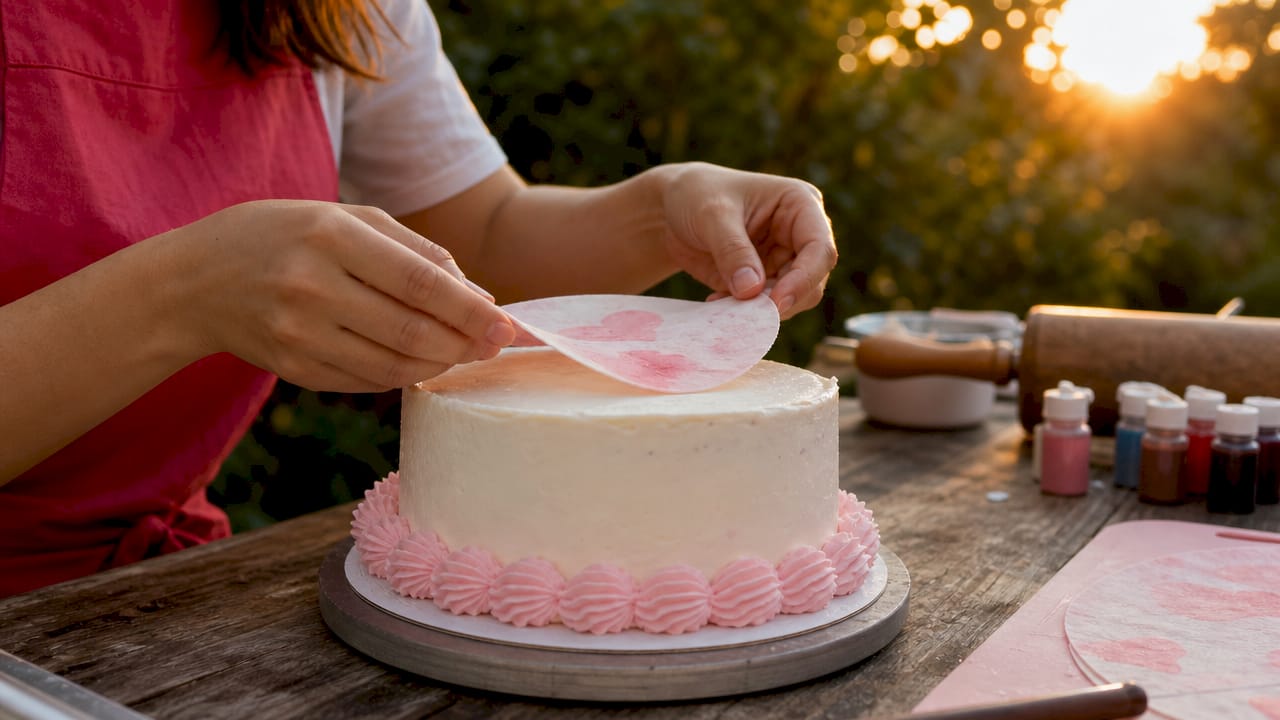
For more details about the complete process, Funbakery's guide on how to apply sugar paper covers every step with visual examples.
Sugar paper versus other edible materials: which one to choose?
Not all edible paper toppers are the same. The material determines the color quality, eating texture, and ease of application. The three most commonly used formats are sugar paper, wafer paper, and chocotransfer.
Sugar paper offers the best print quality with vibrant colors and sharp details, has a sweet taste, and adapts well to curved surfaces. Wafer paper is thinner and more porous, has a neutral taste similar to rice, and absorbs moisture more quickly. Chocotransfer is applied directly to melted chocolate and produces a very striking glossy effect, although its use is limited to chocolate coatings.
| Feature | Sugar paper | Wafer paper | Chocotransfer |
|---|---|---|---|
| Color quality | Very high | Medium | High |
| Taste | Sweet | Neutral | Neutral |
| Flexibility | High | Low | Very low |
| Moisture resistance | Medium | Low | High |
| Best use | Cakes with fondant or buttercream | Light decorations | Chocolate coatings |
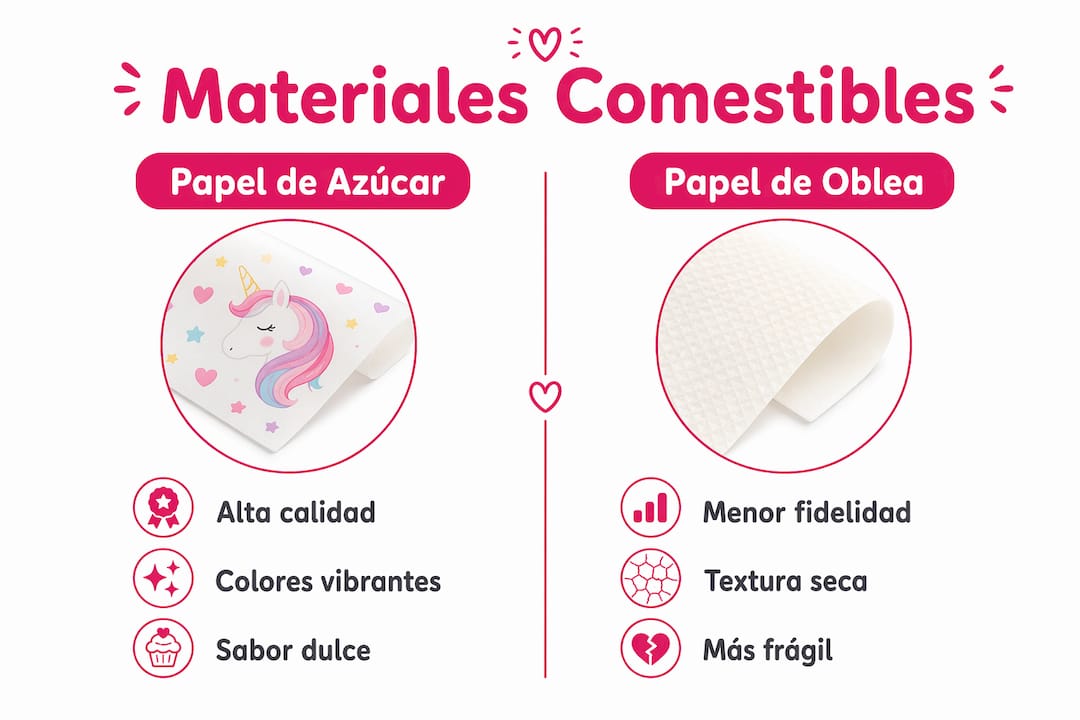
Sugar paper is the preferred option when maximum color and detail fidelity is desired, compared to wafer paper, which is more suitable for texture effects or lighter decorations.
Professional tip: If your cake has a very moist whipped cream or frosting coating, wafer paper is not a good option either. In that case, opt for molded sugar or separate fondant decorations.
Sugar paper care and limitations: mistakes you should avoid
Sugar paper is sensitive to moisture. Knowing its limitations prevents unpleasant surprises on the day of the event.
- Do not use it on whipped cream. Sugar paper deteriorates quickly on surfaces with very moist creams. Moisture softens the paper in minutes and the design loses sharpness.
- Do not put the decorated cake in the refrigerator. The condensation that forms when taking the cake out of the cold damages the paper irreversibly. If you need to refrigerate the cake, do so before placing the topper.
- Keep the topper in its airtight packaging until the moment of use. Ambient moisture also affects the paper if you leave it exposed for too long.
- Do not handle it with wet hands. Direct contact with moisture leaves marks and can tear the paper.
- Avoid placing it on surfaces with excess grease. Oil prevents the topper from adhering correctly and causes it to peel off.
Storing the decorated cake in the refrigerator creates high humidity that damages the paper. Ideally, place the topper just before presenting the cake. This single habit change solves most of the problems that baking enthusiasts encounter with these materials.
For a complete review of the most common mistakes, Funbakery has an article dedicated to common failures with edible paper that is worth reading before your first application.
Personalization and creative uses at special events
Sugar paper allows photographs and custom designs to be printed with high fidelity, making it the most versatile resource for celebrations with a specific theme. A family photo on the birthday cake, a company logo at a corporate event, or a portrait of the newlyweds at a wedding are common applications that create an immediate visual impact.
The creative possibilities go far beyond the main cake:
- Themed cupcakes. Place round or square toppers on cupcakes to create a uniform tray with the same image or variations of the same design.
- Decorated cookies. Custom-cut sugar paper adheres perfectly to royal icing and turns simple cookies into personalized keepsakes for the guests.
- Tiered cakes. Each tier can feature a different design that tells a story or follows a color palette coordinated with the event decoration.
- Toppers combined with other decorations. Sugar paper works very well with fondant flowers, sugar pearls, or sprinkles. The topper provides the graphic element, and the three-dimensional decorations add depth.
- Corporate events and weddings. Sugar paper for celebrations such as weddings allows monograms, dates, and floral designs to be reproduced with a precision that no manual technique can match.
To choose the right design, first think about the dominant color of the event decoration. A topper with a white or transparent background blends better with light-colored cakes, while designs with a colored background work on dark fondant or neutral buttercream.
Funbakery also offers the advantages of edible paper at children's parties, where superhero, animal, and animated series characters are the most requested designs.
Key points
Sugar paper toppers are the most direct way to personalize a cake with high visual quality, as long as they are applied to the correct surface and at the right time.
| Point | Details |
|---|---|
| Material definition | Sugar paper is a sheet of fondant printed with food-grade inks, edible and flexible. |
| Recommended surface | Works best on fondant, buttercream, and ganache; not suitable for whipped cream. |
| Application time | Place the topper just before serving to prevent moisture from damaging the paper. |
| Advantage over other materials | Offers greater color and detail fidelity than wafer paper or chocotransfer. |
| Creative uses | Applied to cakes, cupcakes, cookies, and desserts for weddings, birthdays, and corporate events. |
What no one tells you about sugar paper toppers
I have spent years seeing the same mistake repeated: someone buys a beautiful topper, places it on a cake fresh out of the refrigerator, and twenty minutes later the paper looks like a damp rag. The fault is not the product. It is the timing of application.
Sugar paper is a material that respects the conditions in which you use it. If the surface is cold and moist, the paper notices it immediately. If the base is at room temperature and well-smoothed, the result is flawless for hours. That detail, which seems minor, separates those who get professional results from those who get frustrated with the material.
Another point that enthusiasts underestimate is the choice of material according to the coating. Many arrive with a cream cake and want to put sugar paper on top. It does not work. The cream releases constant moisture and the paper dissolves. In those cases, the solution is to use a fondant base over the cream or change the coating. The topper is not the problem; the combination of materials is.
Finally, the design matters as much as the technique. A topper with very saturated colors on dark fondant loses contrast. One with a light background on white buttercream disappears visually. Thinking about the combination before ordering the design saves time and money.
— David
Custom Funbakery toppers for your next celebration
Funbakery designs and produces custom edible wafers and sugar paper for cakes, cupcakes, and muffins. The catalog includes designs of popular characters such as Stumble Guys and Roblox, with the option to add the photo, name, and age of the guest of honor.

For events with their own design, Funbakery's custom design studio creates any custom image from a photograph or concept. The designers adapt colors, fonts, and composition so that the result matches the event decoration. Shipping is fast and the product arrives ready to place directly on the cake.
Frequently asked questions
What exactly is sugar paper for cakes?
Sugar paper is a thin sheet of fondant printed with food-grade inks that adheres to the surface of the cake. It is completely edible and has a sweet, mild taste.
On what surfaces does sugar paper work well?
Sugar paper works best on fondant, buttercream, and ganache. It is not recommended for whipped cream or very moist creams because the paper softens and loses its shape.
When should I place the topper on the cake?
Place the topper just before serving the cake. Keeping it in its airtight packaging until that moment prevents ambient moisture or condensation from damaging the paper.
Can I put a cake with a sugar paper topper in the refrigerator?
No. The condensation that forms when taking the cake out of the cold damages the paper irreversibly. Refrigerate the cake without the topper and place it at the last moment.
What is the difference between sugar paper and wafer paper?
Sugar paper offers greater color fidelity and a sweet taste, and it is more flexible. Wafer paper has a neutral taste and is more porous, which makes it more vulnerable to moisture and less suitable for designs with many details.