TL;DR:
- Wafer terminology can be confusing due to the different types and uses in baking. Rice paper and wafer paper are distinct products with opposite reactions to moisture, which determines their proper application. Understanding these differences helps prevent mistakes and ensures professional results in edible decorations and prints.
If you have ever ordered “rice paper” to decorate a cake and received something completely different from what you expected, you are not alone. Basic wafer terminology is frequently confusing, even for people who have been baking for years. Wafer, wafer paper, rice paper, sugar paper: all these terms circulate in recipes and stores, and they are not always used accurately. This guide brings order to that wafer glossary, explaining what each concept means, how the types differ, and what you need to know before buying or using any of them.
Table of Contents
- Key Points
- What They Are and How the Types Differ
- Physical Properties and Reaction to Moisture
- Most Common Culinary and Decorative Uses
- Glossary of Key Wafer Terms
- How to Choose the Right Wafer for Your Project
- My Opinion After Working with Wafers
- Quality Custom Wafers from Funbakery
- Frequently Asked Questions
Key Points
| Point | Details |
|---|---|
| Not all papers are the same | Rice paper and wafer paper have completely different ingredients, textures, and uses. |
| Moisture changes everything | The reaction to water is the most important criterion for correctly choosing and handling each type of wafer. |
| The term has a history | The word “wafer” comes from the religious host and has evolved to encompass very different products. |
| The choice depends on the project | Wafer paper is used for prints; rice paper is used for rolls and crinkled textures. |
| Knowing the terminology prevents mistakes | Understanding the differences between wafer types prevents waste and failed decorating results. |
What They Are and How the Types Differ
The word “wafer” does not describe a single product. In baking, it encompasses at least two distinct materials with opposite behaviors. Before discussing techniques or decorations, it is necessary to be clear about what each thing is.
In its most classic sense, wafers are thin sweets that can have a filling. In Colombia, for example, the typical filling is dulce de leche. But in the world of modern decoration, the word has acquired a more technical meaning.
The two main types are rice paper and wafer paper (also called wafer paper). Although they sound similar, they are products with very different compositions and uses.
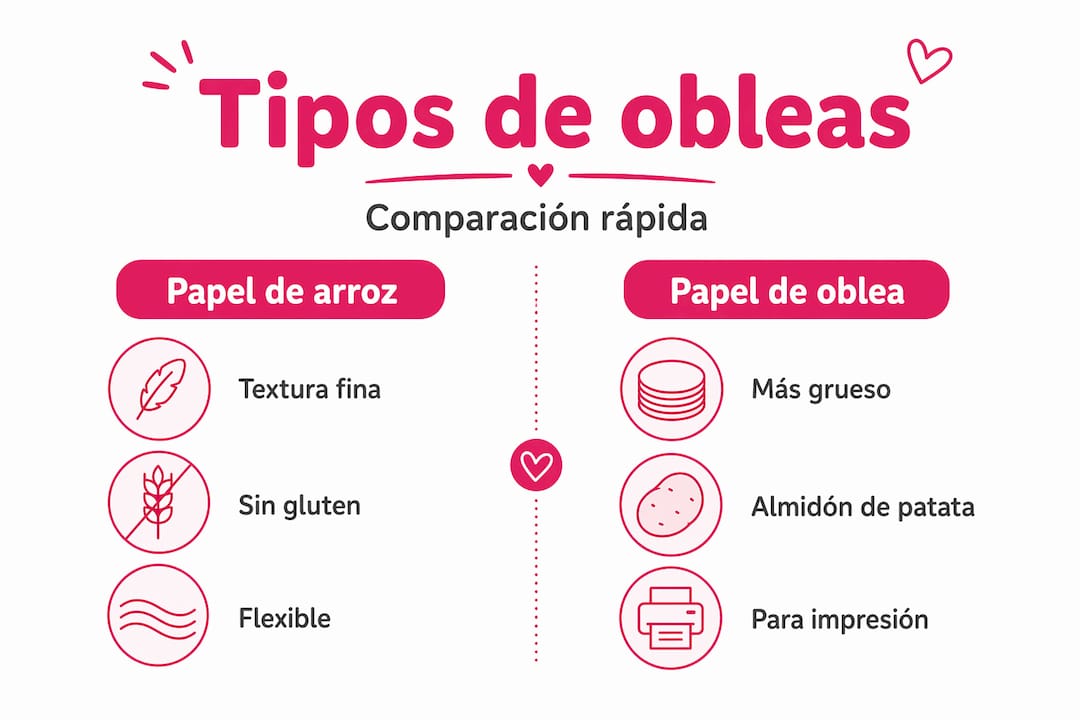
| Characteristic | Rice Paper | Wafer Paper (wafer paper) |
|---|---|---|
| Main Ingredients | Rice flour, water, salt | Potato starch, water, vegetable oil |
| Dry Texture | Rigid, brittle | Flexible, semi-transparent |
| Reaction to Moisture | Becomes gummy and flexible | Easily crumbles or wrinkles |
| Appearance | Translucent | Opaque or semi-transparent |
| Main Application | Rolls, wraps, crinkled textures | Edible prints, wafer flowers |
Knowing this table saves you many mistakes. Texture and reaction to water are the two factors that determine what each is used for, and they are not interchangeable.
Physical Properties and Reaction to Moisture
This is where most mistakes occur. Many people treat both types with the same techniques, and the result is disastrous: wrinkles, tears, or a decoration that falls apart before the cake is served.
Rice paper is naturally gluten-free. It is made with rice flour, water, and salt, and in its dry state, it is quite rigid. When moistened, it transforms completely: it becomes gummy, flexible, and manageable. That transformation is not a defect; it is exactly how it is supposed to work.
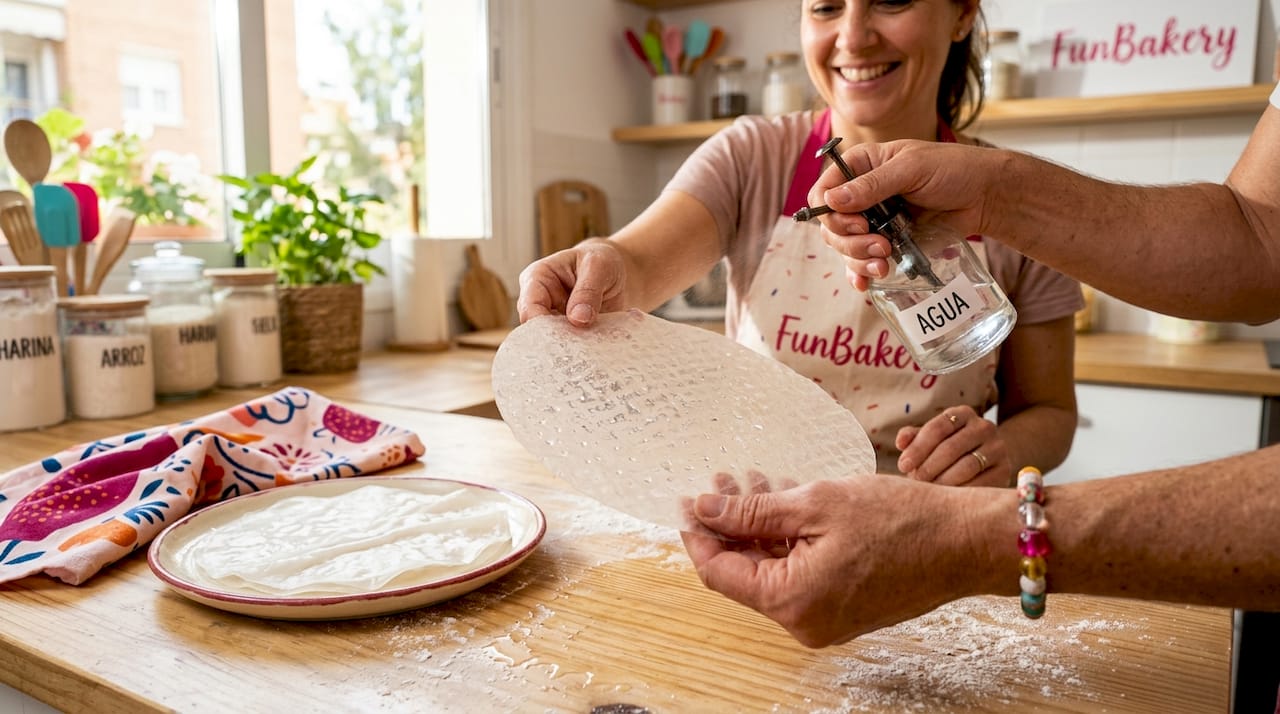
Wafer paper, on the other hand, works the opposite way. It is more stable when dry and can be handled and printed without problems. But excess moisture destroys it. A cream that is too liquid or a very humid environment can wrinkle or dissolve the printed image before it reaches the table.
Here are the most common mistakes and how to avoid them:
- Do not soak wafer paper. Never hydrate it as if it were rice paper. It is applied directly onto surfaces such as royal icing or slightly moistened fondant.
- Soak rice paper for just the right amount of time. Brief and correct hydration is key: 10 to 15 seconds in warm water is enough to use it as a wrap. Any longer and it breaks.
- Avoid direct cold. Condensation in the refrigerator can moisten the wafer paper and wrinkle the printed image.
- Handle with dry hands. Any residual moisture on the hands transfers moisture to the paper and creates stains or deformations.
Professional tip: If you are going to apply wafer paper over very soft whipped cream or buttercream, leave the surface in the refrigerator for a few minutes to harden before placing the wafer. This reduces the risk of moisture rising and damaging the image.
Most Common Culinary and Decorative Uses
Once you are clear on the types, the logical question is: when do I use each one? The answer depends on the effect you are looking for and the type of project.
Wafers for cake decoration are made primarily with wafer paper. Edible images with food-safe dyes are printed on this material, allowing the reproduction of photographs, illustrations, and custom designs with very high visual quality. It is the standard in modern creative baking.
Rice paper, on the other hand, has a long history in Asian cuisine as a wrapper. It is also used in baking to create texture effects, such as crinkled flower petals that imitate organic materials.
These are the most common applications for each type:
- Photographic prints on cakes. It is printed on wafer paper and applied over fondant, firm buttercream, or royal icing.
- Three-dimensional flowers and decorations. Wafer paper can be colored, cut, and molded to create realistic edible flowers.
- Cupcake and muffin decoration. Wafer paper discs with an image are placed directly on the frosting. You can see examples of edible wafers with photos for cakes and cupcakes.
- Summer rolls and Asian wraps. Hydrated rice paper is used to wrap vegetables, shrimp, and noodles in savory cuisine.
- Crinkled decorative textures. Moistened rice paper applied to a cake creates an irregular texture effect that is highly valued in certain styles.
- Themed children's cakes. Wafers for children's cakes with characters, superheroes, or animals are one of the most popular uses for celebrations.
Rice wafers and wafer paper are used for completely different techniques: rice paper for organic textures and wafer paper for rigid edible prints. Knowing this beforehand prevents you from buying the wrong product.
Glossary of Key Wafer Terms
This is the section that is most needed when you start researching wafers in baking. The same concepts appear with different names depending on the country, tradition, or context. Here are the most relevant definitions:
| Term | Definition |
|---|---|
| Wafer | Thin and edible sheet used in baking or decoration. It can refer to different products depending on the context. |
| Wafer paper | English name for wafer paper. It is used specifically for decoration and edible printing. |
| Host | Thin sheet of unleavened bread of liturgical origin. It is the historical antecedent of the modern wafer. |
| Unleavened bread | Flatbread without yeast, flat and dry. Historically related to the host and, by extension, to the wafer. |
| Rice paper | Sheet made with rice flour, used in Asian cuisine and in baking for textures. |
| Sugar paper | Thicker edible material, with greater color contrast, as an alternative to wafer paper for printing. |
| Gluten | Wheat protein. Rice paper is gluten-free; wafer paper may contain traces depending on the manufacturer. |
The origin of the word “wafer” helps explain why there is so much confusion. The term comes from the religious host, a thin sheet of unleavened bread. Over time, the concept extended to thin and filled pastries, and later to any thin edible sheet used in cooking or baking.
Another point that generates frequent doubts is the difference between wafer paper and sugar paper. Although both are used for edible prints, sugar paper has greater opacity and more vivid colors. Wafer paper is thinner and more translucent. Neither is better in absolute terms: it depends on the finish you are looking for.
How to Choose the Right Wafer for Your Project
With all this information on the table, it is time to make practical decisions. Choosing well from the beginning makes the difference between a professional result and a disappointing one.
These are the criteria you should apply:
- Define the use before buying. Do you want a printed image on the cake? You need wafer paper or sugar paper. Do you want 3D flowers or textures? Unprinted wafer paper. Rolls or wraps? Rice paper.
- Check the ingredients on the label. If you have guests with gluten intolerance, check that the wafer paper is certified gluten-free. Rice paper is usually naturally gluten-free.
- Check the rigidity of the product. For prints, the wafer paper must arrive without folds or cracks. If it arrives folded, the image may crack when applied.
- Check the surface you are going to apply it to. Whipped cream, fondant, buttercream, or royal icing have different moisture levels. That directly affects the behavior of the wafer.
- Store the wafers in a dry place. Ambient moisture deteriorates them even inside the original packaging if it is not well sealed.
Professional tip: Before placing a printed wafer on the final cake, practice first with a leftover piece on the same surface. This way you check the reaction without risking the final decoration.
Confusing the types of wafers creates concrete problems: wrinkles, tears, and colors that do not look as they should. It is not a matter of bad luck but of incorrect technique applied to the wrong material. The solution always starts by correctly identifying what product you have in your hands.
My Opinion After Working with Wafers
When I started working with wafers in decoration, I made exactly the most common mistake: I treated wafer paper as if it were rice paper. I moistened it thinking it would adhere better, and the result was a wrinkled and discolored image after ten minutes.
What I learned from that experience is that terminology is not a technical detail for experts. It is practical information that changes the result of your work. If you do not know that wafer paper is applied dry over a slightly moist surface, you will make that same mistake.
I also realized that many sellers use the terms imprecisely, sometimes calling “rice paper” what is actually wafer paper. Always asking for the ingredients or the product data sheet before buying has been the habit that has saved me the most trouble. Knowing wafer and its terminology well does not make you a professional pastry chef, but it does put you in a position to achieve results that look professional.
— David
Quality Custom Wafers from Funbakery
If you already know what type of wafer you need, the next step is to get one with a professional design and quality materials. Funbakery specializes in wafers for cakes and muffins that are customized, with a huge variety of designs: superheroes, children's characters, sports, themed celebrations, and much more.

In addition, Funbakery offers a custom design service where designers create personalized images with photographs, names, ages, and specific texts. If you are looking for something unique for a birthday or special event, you can explore options such as the custom wafers with photos for rectangular cakes, or browse the full catalog to find the design that best fits your celebration.
Frequently Asked Questions
What is the difference between rice paper and wafer paper?
Rice paper is made with rice flour and becomes flexible when moistened. Wafer paper uses potato starch, is rigid when dry, and deteriorates with excess moisture.
Does wafer paper contain gluten?
It depends on the manufacturer. Rice paper is naturally gluten-free, but wafer paper may contain traces. Always check the label if there are allergies at the table.
Why are these materials called “wafers”?
The term “wafer” comes from the liturgical host, a thin sheet of unleavened bread. Over time, it extended to describe any thin edible sheet used in baking or cooking.
Can I put a cake with a wafer in the refrigerator?
You can, but with caution. Condensation can moisten the wafer paper and wrinkle the image. It is better to refrigerate the cake without the wafer and place it just before serving, or use a well-dried fondant surface.
What is sugar paper and how does it differ from wafer paper?
Sugar paper is thicker and more opaque, with more intense colors. Wafer paper is thinner and translucent. Both are used for edible prints, but sugar paper gives a more vivid finish, especially on dark surfaces.