For most cakes, a 15 to 19 cm circular topper covers the center well without leaving too much or too little image. If you need to cover the entire side or a large rectangular design, the usual sizes are approximately 28×20 cm or 26×18 cm. The key is the A4 sheet: it measures 21×29.7 cm, but the maximum round diameter that can actually be printed within it is around 19 cm. For cupcakes or cookies, look for 5 to 8 cm discs.
In summary:
- Most circular cake toppers measure between 15 and 19 cm in diameter, which is the ideal size to cover the top without overhang.
- On an A4 sheet, the useful printable area for a circular design is close to 27.5 × 18 cm, with the maximum recommended diameter for circles being 19 cm.
- To cover the side or large rectangular designs, the most common sizes are approximately 28×20 cm or 26×18 cm, which usually come on A4 sheets.
- The standard thickness of icing sheets on an A4 base is close to 0.55 mm, although some manufacturers offer thinner versions for delicate designs.
- For cakes with a diameter greater than 19 cm, it is recommended to order a slightly smaller size and center the design to avoid unwanted cropping.
Table of contents
- Common icing sheet sizes and printable formats
- What really fits on an A4 sheet (printable area and bleed)
- How to measure your cake before ordering the icing sheet
- Icing sheet or sugar paper: which is best depending on the finish
- How to prepare the file so the print turns out well
- Tips for making the most of every A4 sheet without waste
- When customization is worth it and when standard is enough
- Order your icing sheet in the exact size at Funbakery
- Fonts
- Frequently asked questions
Common icing sheet sizes and printable formats
Edible icing sheets are almost always sold on an A4 sheet base, the same format you would use in an office printer. That sheet measures 21 × 29.7 cm and usually comes with a standard thickness close to 0.55 mm, although some manufacturers offer slightly thinner versions for delicate designs.
Based on that base sheet, the sizes you will see most frequently in stores and catalogs are these:
- Small circles (5 to 8 cm): designed for cupcakes, muffins, and individual cookies.
- Medium circles (15 to 19 cm): the most ordered range for single-tier cake toppers.
- Large discs (18 cm) and rectangles such as 28×20 cm or 26×18 cm, common for covering rectangular cakes or entire sides.
- Full A4 sheet (21×29.7 cm): the option when the design needs to make use of all available space, although the final cut always reduces that measurement slightly.
Suppliers usually label their products as "standard A4" or "disc", and that nomenclature helps compare different catalogs without getting confused by the exact measurements of each store. It is always advisable to check the product sheet before ordering, because the thickness and finish (matte, glossy, firmer) change depending on the manufacturer.
What really fits on an A4 sheet (printable area and bleed)
No printer uses 100% of an A4 sheet. Commercial equipment leaves a safety margin so that the edible ink does not run or lose definition at the edges, and that reduces the actual useful area.
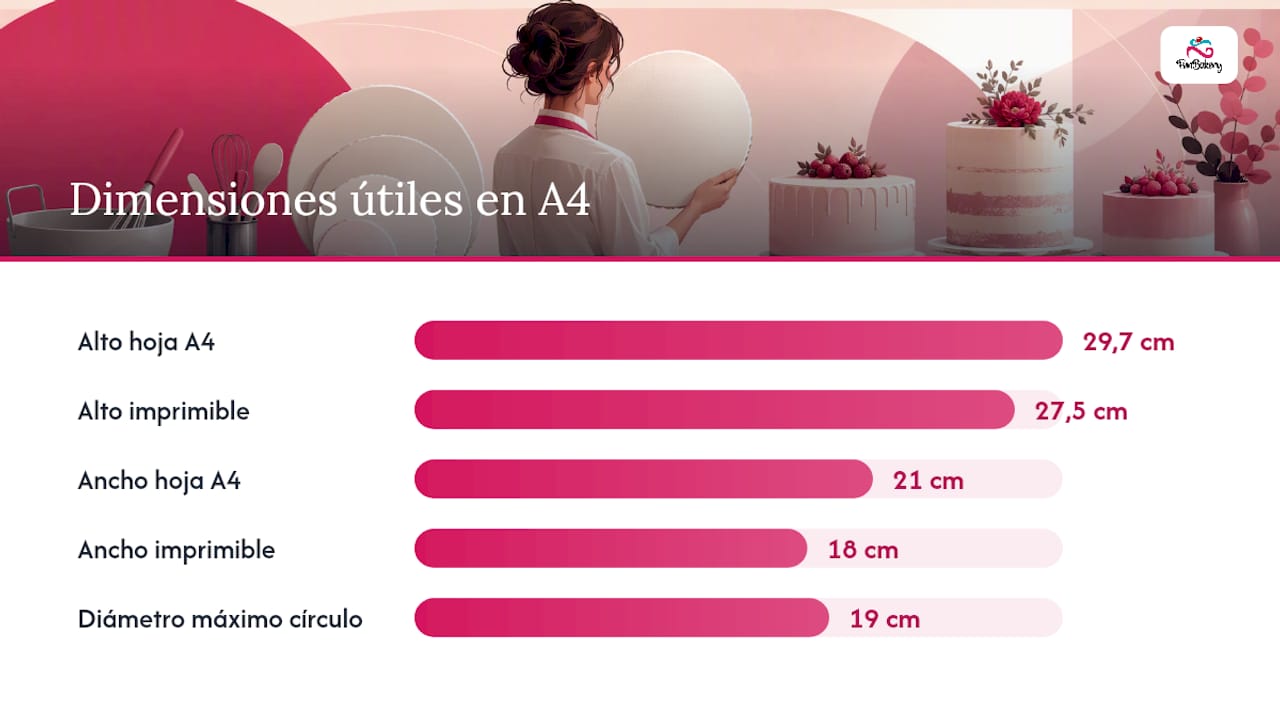
In practice, the final printable area is around 27.5 × 18 cm within a 29.7 × 21 cm sheet. That margin is also the reason why the maximum diameter of a usable circle on A4 is close to 19 cm: no matter how large the sheet is, a circle cannot touch the discarded edges without losing part of the design.
Some practical recommendations to avoid losing image when ordering:
- If your design is a circle, always order a diameter equal to or less than 19 cm.
- If you need a complete image without cropping at the edges, the rectangular format makes better use of the sheet than the circular one.
- When the design is not centered, notify the supplier so they can adjust the cut guide and you do not lose part of the photo or text.
How to measure your cake before ordering the icing sheet
Measuring the cake incorrectly is the most common error when ordering an icing sheet. Follow these steps:
- Measure the diameter of the mold with a measuring tape, from edge to edge, not the container but the assembled cake.
- Measure the height if you are going to cover the entire side, because it determines how many A4 sheets you need to go around it.
- Calculate the circumference with the formula circumference = π × diameter. A cake with a diameter of 20 cm has a circumference of approximately 63 cm, so you will need several strips or a sheet wide enough.
- Check with the visual method: wrap the mold with an A4 sheet before printing anything, to see by eye how many sheets you will need for the side.
- Decide the final format: a central disc if you only want to decorate the top, or several pieces if you also want to cover the contour.
Professional tip: if your cake measures more than 19 cm in diameter and you want a complete circular topper without seams, order a slightly smaller size and center the design; it is better to lose a few millimeters of edge than to force a diameter that the printer cannot reproduce entirely.
Icing sheet or sugar paper: which is best depending on the finish
They are not the same material, although they are often confused. The icing sheet is thinner and translucent, and works better on dry surfaces such as fondant or set buttercream. The sugar paper is more flexible and offers more saturated colors, which makes it preferable when the coating is wet.
Key fact: for cakes covered with freshly applied cream or chocolate, the sugar paper adheres better than the icing sheet, which tends to wrinkle on damp surfaces.
- Choose icing sheet for thin toppers, delicate designs, and dry surfaces.
- Choose sugar paper for wet coatings, very bright colors, or when you need it to stick without lifting.
- Consult the guide on sugar paper thicknesses if you are unsure between the two materials for a specific project.
How to prepare the file so the print turns out well
A perfect design can be ruined by a poorly prepared file. Before sending it, check these points:
- Work at a resolution of 300 dpi, the standard used by most edible printers so that the result comes out sharp.
- Send the file in PDF whenever possible; it preserves colors better and avoids quality loss compared to compressed formats.
- Add 3 to 5 mm of bleed around the design, especially if the final cut is circular.
- Mark a visible cut guide if the image is not perfectly centered, so the supplier knows exactly where to cut.
Professional tip: if you send a rectangular image but the final cut will be a circle, adjust the framing yourself before sending it. Letting the supplier decide the center can crop out exactly the part of the photo or text that matters most to you.
Tips for making the most of every A4 sheet without waste
Planning the design before printing saves sheets and money, especially if you need several small pieces in addition to the main topper.
- Organize the file by layers in a program like Canva, Photoshop, or Word before sending it to print, placing several figures within the same A4.
- Use a die-cutter to cut small circles from the leftover areas around the main design.
- Apply the wrapped mold method as a physical template to check measurements before generating the digital file.
- Reuse templates with the same layout when repeating similar orders, so you save layout time every time.
A well-planned A4 can yield a large disc and several small cupcake circles in the same run, instead of printing each element separately.
When customization is worth it and when standard is enough
If you only need a simple circular topper, a standard catalog size covers the need at no extra cost. Customization makes sense when the design requires a specific cut, includes complex photos, or the cake has an unusual shape. My recommendation: measure first, choose the closest format in the catalog, and only if it does not fit, order a custom proof before confirming the large order.
— David
Order your icing sheet in the exact size at Funbakery
There are round, rectangular formats and discs already prepared in the usual sizes, in addition to a design service where you can upload photos, names, or text and adjust the cut to the exact cake.

Ordering is easy: upload your image, choose the format (round, rectangle, disc, or strips), and confirm the cut guide if your design is not centered. You can start with the custom design studio if you are looking for an exact fit for photos or text, or directly review the options for custom disc or rectangle if you already have clear measurements of your cake. For muffins and cupcakes, the muffin design studio allows you to order several small circles in the same order. Confirm the design proof before going to production and you will avoid surprises in the final cut.
Sources
- Edible Prints – Casa Rex
- Todoconfiteria
- How to Decorate a Mercadona Cake with Sugar Paper Tutorial 2026
- How to decorate a cake with sugar paper - COMO HE PUESTO LA COCINA
Frequently asked questions
How big is a standard edible icing sheet?
The base sheet measures 21 × 29.7 cm (A4 format), although the final design is cut according to use: circles of 15 to 19 cm for toppers or discs of 5 to 8 cm for cupcakes.
What is the maximum diameter of a circle on an A4 sheet?
The maximum round diameter that can be printed without losing quality at the edges is around 19 cm, due to the print safety margins.
What size are the usual cakes I buy?
The most common commercial formats are around 18 to 20 cm in diameter for individual cakes, so a topper of 15 to 19 cm usually fits without the need to crop the image.
What type of icing sheet is suitable for cake?
It depends on the finish: the icing sheet works well on dry surfaces such as fondant, while the sugar paper adheres better to wet coatings such as cream or freshly applied chocolate.
Can I order an icing sheet in a size that does not appear in the catalog?
Yes, through a custom design service you can adjust the cut to specific measurements, always within the physical limit allowed by the A4 sheet.