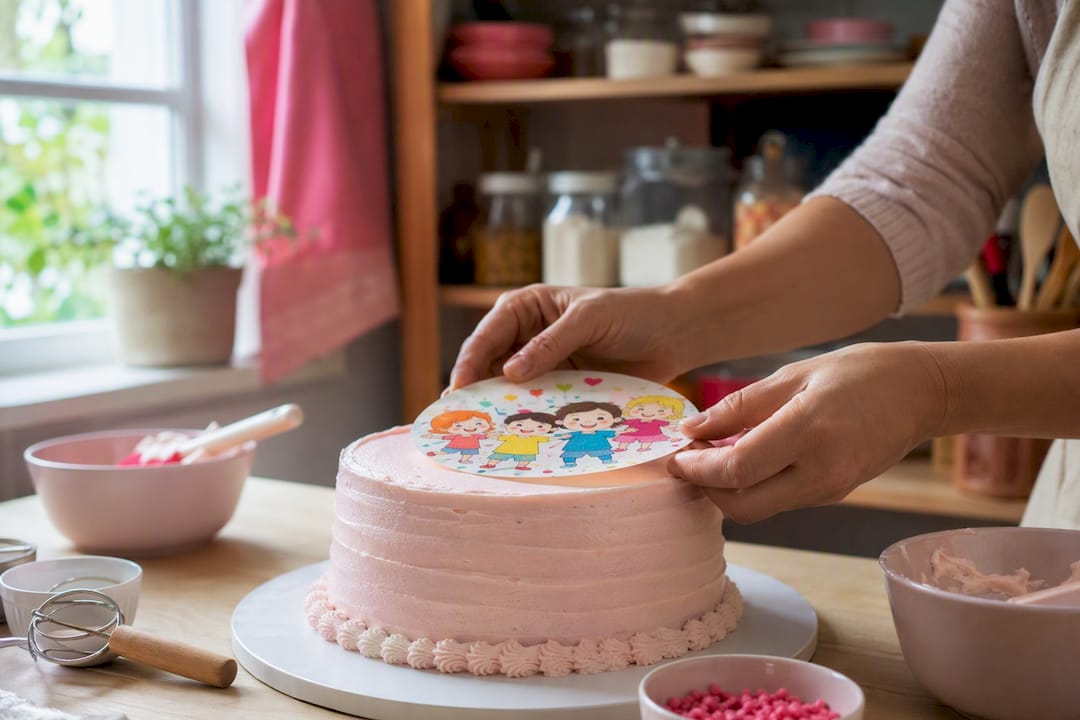
Decoration at a girl's party communicates identity, protection, and belonging. It is not an aesthetic detail: it is the visual language that announces who the birthday girl is, what she likes, and how the family sees her at that moment in life. Before choosing balloons or a theme, three factors weigh more than any trend: the child's age and developmental stage, the cultural and family context in which the party takes place, and the specific tastes of the person celebrating, not those of the adult organizing it.
- Age and stage: what works at 2 years rarely works at 8.
- Cultural context: grandparents and family traditions have their own symbolic weight.
- Real protagonist: the decoration should speak of the child, not the current Pinterest trend.
The following sections contain more detailed explanations about each decorative element and a practical checklist to apply at the next party.
Main conclusions
The meaning of decorations at girls' parties rests on three pillars: identity, protagonism, and coherence between age, culture, and the child's personal taste.
| Point | Details |
|---|---|
| Cake as a symbolic center | The cake and the "happy birthday" moment concentrate most of the visual attention at the party, so they deserve more care than any other element. |
| Colors with intention | Apply the 60-30-10 rule and adjust the saturation to the child's age to avoid visual overstimulation. |
| Theme faithful to the child | Choose the theme based on the birthday girl's real interest, not just the current trend. |
| Checklist before deciding | Confirm age, cultural context, budget, and logistics before finalizing any decorative element. |
| Edible personalization | Funbakery creates personalized wafers and sugar paper with a name, photo, or character to reinforce the birthday girl's protagonism on the cake. |
Table of Contents
- Why decoration matters: the meaning of decorations at girls' parties goes beyond aesthetics
- Meaning of colors at children's parties: how to create an intentional palette
- Popular themes for girls' parties and what each one symbolizes
- Cake, candles, balloons, and party favors: the meaning behind each element
- How to choose decorations that convey the right meaning
- Personalized edible images: a practical example of applied meaning
- History and origin of decorations at girls' children's parties
- Symbolism associated with specific characters beyond themes
- Impact of decorations on children's emotional and psychological experience
- What I learned to value more at a girl's party
- How a personalized edible image reinforces the meaning of the party
- Sources
- Frequently asked questions
Why decoration matters: the meaning of decorations at girls' parties goes beyond aesthetics
The birthday party works as a rite of passage. It marks the transition from one age to another and reaffirms the child's place within the family and group of friends. An academic work on the symbolism of birthday celebrations describes the party as a moment of renewal and restoration of collective balance, where the decoration serves precisely to focus attention on the birthday child and the parents.
This explains why the cake, candles, and central table receive so much care. A study that analyzed photographic records of children's parties concluded that the cake and the "happy birthday" moment are the visual focal points of the celebration, with the cake table acting almost as an untouchable symbolic space until the right time.
The symbolic reading changes from family to family. Some traditions place more weight on cutting the cake, others on the birthday child's entrance or a grandparent's blessing before happy birthday.
Professional tip: Before finalizing any public symbol such as the candle, the cake-cutting moment, or the display of photographs, ask grandparents and other close relatives what expectations they have. Avoid unnecessary surprises and tensions on the day.
Meaning of colors at children's parties: how to create an intentional palette
Each color carries associations that guests instinctively read, even without realizing why.
- Pink: affection, tenderness, and delicacy, the color most culturally associated with girls' parties.
- Lilac and purple: imagination, fantasy, and a touch of mystery.
- Gold: celebration, distinction, and a sense of special occasion.
- Green: nature, growth, and freshness, widely used in forest or garden themes.
- Blue: calm and confidence, increasingly present at girls' parties without stereotypical intent.
- Yellow: joy and energy, ideal for sunny or summer themes.
- Red: enthusiasm and intense celebration, works better as an accent than as a dominant color.
- White and neutral tones: purity, elegance, and visual balance between stronger colors.
- Pastel pink and soft tones: serenity, recommended for babies and to reduce visual overstimulation.
A practical rule from interior design adapts well to parties: the 60-30-10 ratio, with 60% of a soft dominant color, 30% of a secondary color, and only 10% of a vibrant accent. This avoids the visual excess common in parties overloaded with fluorescent pink.
The choice of tones should also follow the age. A guide on colors for children's spaces recommends softer and cooler tones for babies, because they promote rest, and reserves stronger saturations for school-aged children, who already tolerate and seek more visual stimulation.
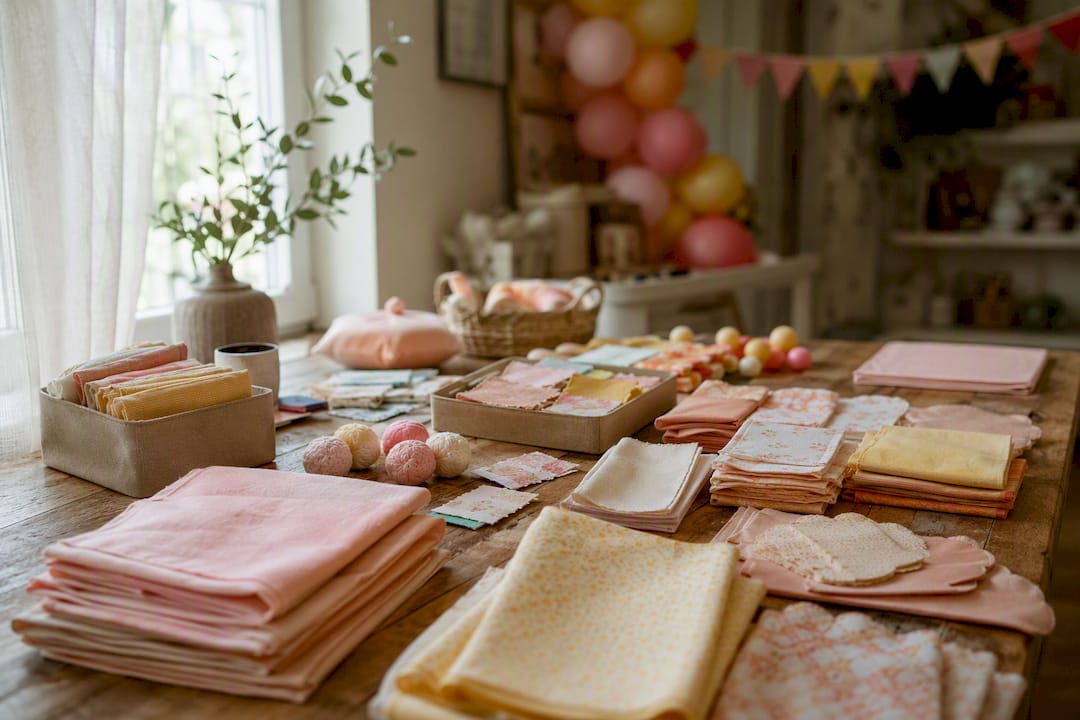
Professional tip: Ask the child herself what her favorite color is before automatically assuming pink. Combining that color with a theme of her choice avoids reinforcing gender stereotypes and makes the party more faithful to her personality.
Popular themes for girls' parties and what each one symbolizes
Each theme works as its own symbolic vocabulary, chosen not by chance but because it communicates something about the child or what the family wants to celebrate.
- Princess: social recognition and fantasy of protagonism, a classic that rarely fails with children between 3 and 7 years old.
- Unicorn: magic, uniqueness, and a touch of genderless fantasy.
- Ballerina: discipline, grace, and delicacy, popular among children who already practice dance.
- Mermaid: adventure, mystery, and connection to the aquatic world, ideal for summer.
- Floral and garden themes: growth, softness, and a more sophisticated aesthetic, common at older girls' parties.
- Rainbow: diversity, joy, and inclusion, increasingly chosen for uniting several colors without sticking to a single stereotype.
- Super-heroine: strength, courage, and autonomy, an alternative that breaks with the traditionally feminine imagination.
- Animals and safari: curiosity and connection to nature, works well at any age.
These themes help communicate who the child is, or who they are becoming, much more than a simple decorative choice. It is worth taking care with symbols linked to specific cultures, such as crowns or traditional clothing from other peoples: adapting instead of copying avoids unnecessary appropriation. A clear trend is also noticed for smaller and more careful parties, where a well-executed theme with few elements surpasses the excessive production of previous years.
Cake, candles, balloons, and party favors: the meaning behind each element
The cake works as the symbolic center of the party, almost a visual substitute for the birthday child herself. The candles physically mark the counting of time, one year at a time, and the moment of blowing them out concentrates all the guests' attention for a few seconds.
It is no coincidence that photographic records confirm this: analyses of party photographs show that the cake and the "happy birthday" concentrate most of the visual attention of the entire celebration, more than any other decorative element.
- Cake table or backdrop: works as the visual icon of the party, the point everyone photographs first.
- Balloons and arches: signal celebration from a distance and bring a sense of lightness and dreaminess to the space.
- Party favors: represent reciprocity, a symbolic thank you for the presence of each guest, and reinforce the chosen theme.
Therefore, personalizing the cake with the name, age, or an image of the birthday child has a greater symbolic weight than decorating any other area of the room.
How to choose decorations that convey the right meaning
Before buying whatever it may be, it is worth answering five simple questions:
- Has the child already shown clear interest in this theme, or am I choosing based on what is trending?
- Does her age match the visual language of the theme (more childish or already more sophisticated)?
- Are there cultural or family sensitivities to respect before finalizing colors or symbols?
- Does the available budget allow for quality in the central elements, even reducing the secondary ones?
- Does the space logistics allow setting this up without complicating the children's circulation?
After answering, it is worth confirming that none of these warning signs are present:
- Decoration designed for a much younger or older age than the actual one.
- Images or elements that occupy so much space that they prevent children from playing freely.
- Excess of disposable items without any function after the party.
Combining meaning with practicality usually gives a better result than pursuing the most elaborate decoration: biodegradable balloons, reusable elements, and a well-chosen centerpiece communicate as much as an entire room decorated in detail.
Personalized edible images: a practical example of applied meaning
An edible image on the cake is probably the most direct way to apply everything that has been said so far.
- Define the central message: name, age, favorite character, or a photograph of the birthday child herself.
- Choose the format and position: a round wafer in the center of the cake has more impact than several small pieces scattered around.
- Coordinate the palette: the image should follow the same colors as the rest of the decoration, not compete with them.
A name and age printed on a wafer, a photograph of the birthday child as the protagonist of the cake, or a theme symbol such as a crown or a unicorn work as three quick and effective applications. It is precisely here that personalized edible images concentrate meaning: they place the child, literally, in the center of the table.
History and origin of decorations at girls' children's parties
Children's birthday parties, as they exist today, are a relatively recent phenomenon. Celebrating a child's birthday with cake, guests, and decoration became a common custom in most Western homes only from the second half of the 20th century.
Decoration specifically designed for girls, with pink palettes and princess themes, gained strength especially from the 1980s and 1990s, driven by the children's entertainment industry and licensed character marketing. Before that, children's parties tended to be less segmented by gender, with more neutral decorations centered on traditional games.
A study on experience design at children's parties notes that these celebrations are today material and immaterial artifacts loaded with symbolic content linked to the affirmation of identities, shaped by both popular culture and a specific market of products and services for parties.
In the last two decades, personalization has become the central axis of this evolution. Instead of buying a generic kit with the same theme for all children, families increasingly seek to adapt colors, characters, and messages to the individual taste of the birthday child, a movement that follows the broader valuation of the child's identity within the contemporary family.
Symbolism associated with specific characters beyond themes
Within the same theme, different characters carry distinct meanings worth distinguishing. A classic fairy tale princess communicates something different from a warrior princess: the first suggests delicacy and rescue, the second suggests autonomy and strength. Choosing one or the other says a lot about the image the family wants to project of the child.
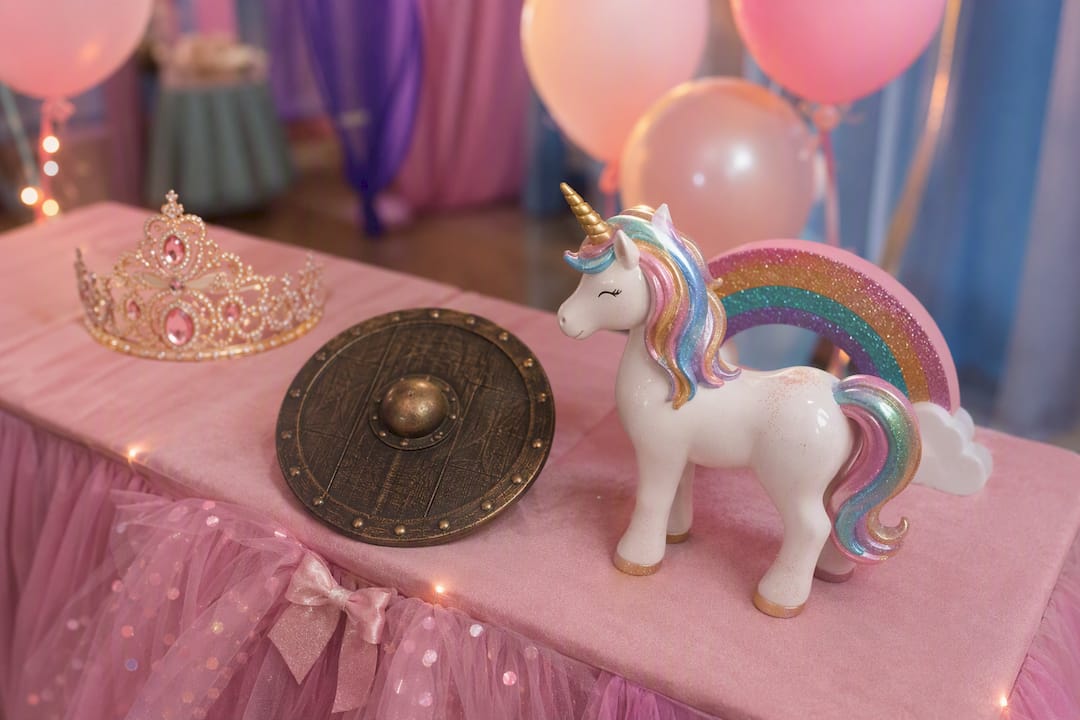
The unicorn, for example, became a symbol of uniqueness and acceptance of difference, precisely because it is a creature that does not exist and therefore does not impose a single model of beauty or behavior. The mermaid, on the other hand, carries an interesting duality: she belongs to two worlds, land and sea, and is usually associated with children with an adventurous or curious spirit.
Female superhero characters, increasingly present at girls' parties, deliberately break with the traditional imagination of fragility. Choosing this symbolic line usually reflects a family desire to value courage and independence from an early age.
Even within floral or animal themes, the symbolism varies: a butterfly suggests transformation and lightness, while a lion or a fox communicates curiosity and energy. Understanding these nuances helps choose not just a generic theme, but the right character within it.
Impact of decorations on children's emotional and psychological experience
Decoration is not just a photographic backdrop: it directly influences how the child experiences the day itself. A visually coherent environment, with colors and themes that the child recognizes and likes, reinforces the feeling that the party is truly theirs, not a generic reproduction of some trend.
Excess visual stimulation, on the contrary, can have the opposite effect. Practical recommendations about color in children's spaces indicate that excessive vibrant tones tend to overstimulate young children, while more balanced combinations favor calm and concentration, something especially relevant at long parties or those with many guests.
There is also a dimension of memory and belonging. Children remember, years later, details such as the cake with their name or a decoration that matched their favorite stuffed animal. These details become part of the personal narrative of childhood, much more than the exact number of balloons or the size of the backdrop.
Finally, involving the child in choices, even small ones, such as the color of the napkins or the type of party favor, has a simple but effective psychological effect: it reinforces their sense of control and ownership, exactly what a birthday party should convey.
What I Learned to Value More in a Girls' Party
The temptation to fill the room with items is strong, but experience shows that fewer, well-chosen pieces communicate more meaning than excessive decoration. A personalized cake with the right name, in a thoughtfully chosen color palette, is usually worth more than ten generic balloons bought in a hurry.
It is also worth questioning the idea that following the latest trend guarantees a memorable party. Trends change every year, as can be seen in analyses of cake trends for girls, but what stays in the child's memory is always something more personal than a passing visual pattern.
How a Personalized Edible Image Reinforces the Meaning of the Party
At Funbakery, we work exactly with this idea: take a name, an age, a photograph, or a favorite character and transform it into a professional-quality edible image, ready to place on the cake. The choice of format and position has already been discussed in the previous sections, and the color coordination with the rest of the table is what makes the image look like part of the whole, not an afterthought.
The catalog includes everything from popular character themes, such as personalized ROBLOX options, to designs created entirely from scratch by our designers, with custom photos, names, and text. If you already know the theme but haven't yet chosen the right image, it is worth exploring the available designs and requesting a personalized version before finalizing the cake order.
Sources
- The symbolism of birthday celebrations: a design perspective on children's parties
- Choosing Keepsakes: Reading the birthday party ritual through the guests' photographic record
- Design for experiences in the planning of children's birthday parties
- Colors for a Children's Room: A Complete Guide to Choosing Without Making Mistakes
Frequently Asked Questions
What is the general meaning of decorations at girls' parties? They communicate identity, ownership, and belonging, focusing attention on the birthday girl through elements such as the cake, the chosen colors, and the party theme.
What color should I choose if I want to move away from traditional pink? Blue, yellow, or rainbow work well and communicate joy without being tied to gender stereotypes, especially when combined with the child's favorite theme.
How do I know if a theme is appropriate for my daughter's age? Themes such as princesses and unicorns work well for children between 3 and 7 years old, while more sophisticated themes, such as floral or adventure themes, tend to appeal more from age 8 onward.
Is it worth investing in a personalized edible image? Yes, because it concentrates meaning exactly on the most photographed and observed element of the party, the cake, reinforcing the child's ownership without requiring excessive decoration in the room.