


In summary:
- Edible customization allows designs to be printed on certified edible supports to decorate desserts. It is essential to choose the right support and check the safety documentation before purchasing it. Printing is carried out with modified printers and specific inks that guarantee safety and quality.
Edible customization consists of printing images, photographs, or designs on an edible support, whether sugar paper or wafer paper, using inks suitable for human consumption. The result is placed directly on the cake, cupcake, or cookie, and eaten along with the dessert. If you want to decorate a birthday cake with a photo of your child or their favorite character, this is exactly what you need.
When to choose wafer paper and when sugar paper? Wafer paper is thinner and translucent, ideal for surfaces with their own color (dark fondant, chocolate). Sugar paper is more opaque and white, perfect when you want the colors of the image to stand out clearly. Before buying any print, look for three basic safety signs: that the supplier provides a certificate of conformity (DoC or COC), that the inks are specifically edible, and that the support complies with European regulations on food contact materials.
- Printing on sugar paper or wafer paper with certified edible inks.
- Main uses: cakes, cupcakes, cookies, and chocolates for celebrations.
- Minimum safety signs: certificate of conformity, edible ink, supplier with verifiable documentation.
Table of contents
- What types of edible paper and wafer paper exist?
- How edible printing works: printers, inks, and files
- How to store prints before and after using them?
- Common mistakes when applying edible prints and how to avoid them
- What questions to ask the supplier before ordering?
- Key points
- Professional customization is worth more than it seems
- Funbakery: personalized wafer papers ready for your next celebration
- Sources and technical documentation for further reading
What types of edible paper and wafer paper exist?
Edible printing supports are not all the same, and choosing the wrong one ruins the result even if the image is perfect.
| Material | Composition | Best use | Main limitation |
|---|---|---|---|
| Sugar paper | Sugar, starch, water | Photographs with bright colors on white fondant | Dissolves with excessive moisture |
| Wafer paper (rice paper) | Potato or corn starch, water | Surfaces with their own color, chocolate cakes | Translucent; dark background colors show through |
| Plant fiber paper | Plant fiber, starch | More rustic finishes, irregular surfaces | Less available; thicker texture |
| Thick wafer paper | Starch, sugar, vegetable fats | Reliefs, flowers, and 3D decorations | More rigid; requires more moisture to adhere |
| Chocotransfer | Colored cocoa butter on acetate | Decorations on tempered chocolate | Only works with chocolate; not suitable for fondant |
Sugar paper is the most common option for personalized edibles with photographs, because its white base guarantees that colors are reproduced faithfully. Wafer paper is suitable when the cake surface already has a color you want to see through the print, or when you are looking for a more integrated finish. For curved surfaces, such as cylindrical cakes, wafer paper adapts better because it is more flexible.
- Sugar paper absorbs moisture from the fondant and adheres on its own; wafer paper may need a few drops of water or food-grade alcohol.
- Chocotransfer requires a different process: it is placed on the chocolate before it solidifies, not after.
- No material withstands direct condensation from the refrigerator well without protection.
How edible printing works: printers, inks, and files
Edible printing uses modified or specifically designed inkjet printers for edible cartridges. Printers from brands like Canon or Epson are frequently adapted for this use, replacing conventional ink cartridges with cartridges containing inks approved for consumption. There are also printers manufactured from the outset for food use, which incorporate certified food contact materials in all their internal components.
Edible inks are formulated from food colorings approved by European regulations, mainly those listed in Regulation (EC) 1333/2008 on food additives. What distinguishes a quality edible ink is not only that it is "fit to eat," but that it presents low substance migration into the food and that the supplier can prove it with documentation.
To prepare an image correctly:
- Color profile: monitors work in RGB, but edible printers print in CMYK. Convert the file to CMYK before sending it, or ask the supplier to do so with a calibrated color profile. Color management in variable printing directly affects the fidelity of the result.
Professional tip: Ask the supplier for a digital color proof (on-screen simulation with a CMYK profile) before confirming the order. A serious supplier offers it at no additional cost and saves you surprises with skin tones in photographs.
How to store prints before and after using them?
Moisture is the greatest enemy of any edible print, both before and after applying it. Storing the wafer paper properly makes the difference between a sharp design and a stained or dissolved one.
-
Before applying: keep the print in its original, sealed packaging, in a cool and dry place, away from direct sunlight. It is important to maintain appropriate temperature and humidity conditions as indicated by the supplier to keep the print in good condition.
-
After applying: the decorated cake holds up well at room temperature for 24–48 hours if the environment is not humid. If you need to refrigerate it, place it inside a closed cardboard box before putting it in the refrigerator, so that condensation does not fall directly on the print. When taking it out, let it reach room temperature inside the box before opening it.
-
What to avoid without exception: refrigerator without protection, exposure to steam (boiling kitchen), direct sunlight, and wet surfaces.
-
Signs of deterioration: dark or translucent stains on the wafer paper, colors that blend or "bleed," sticky or gummy texture. If you see any of these signs, do not use the print even if it is within its expiration date.
Common mistakes when applying edible prints and how to avoid them
Most failures have a simple solution if anticipated. These are the most frequent:
-
Applying it on wet or freshly kneaded fondant. Fondant releases moisture for hours. If you place the wafer paper too soon, it dissolves from underneath. Wait until the surface is completely dry to the touch.
-
Insufficient ink curing. Some adapted home printers do not cure the ink properly, causing the colors to run when they come into contact with the moisture from the fondant. Always ask the supplier to confirm the curing time before packaging.
-
Inappropriate paper for the surface. Using translucent wafer paper on black fondant makes the image almost disappear. Use sugar paper when you need opaque and bright colors.
-
Misalignment when placing. Once the wafer paper touches the wet fondant, it cannot be repositioned without damaging it. Practice placing the print on the cake without touching the surface before permanently adhering it.
-
Ignoring allergens. Edible inks may contain traces of soy, gluten, or colorings that affect people with intolerances. Always check the ink's ingredient list, especially if the cake is for children with known allergies. Edible decoration at children's parties requires an especially careful review of this point.
A mistake that is repeated frequently: buying wafer papers from suppliers without certification because they are cheaper. The savings of a few euros do not compensate for the risk of using inks without migration tests or a verified ingredient list. In celebrations with children, this point does not allow shortcuts.
What questions to ask the supplier before ordering?
A good supplier answers these questions without hesitation. If they dodge any, it is a red flag.
About safety and certification:
- Do you have a certificate of conformity (DoC/COC) for the inks and the supports?
- Can you provide the global and specific migration report from an independent laboratory?
- Does the ink's ingredient list include allergens? Are there traces of soy, gluten, or others?
- Do the inks comply with the food additives regulations of Regulation (EC) 1333/2008?
About the order and the file:
- Confirm the exact size in centimeters (width × height) you need for your cake or cupcake.
- Ask what file format they accept (JPG, PNG, PDF) and if you need to send it already in CMYK or if they do the conversion.
- Request a digital color proof before printing, especially if the image has skin tones or gradients.
- Indicate if you want the print cut or on a full sheet, and if you need multiple copies on the same sheet.
About packaging and delivery:
- How is the print packaged for transport? Does it go in a sealed bag with a desiccant?
- What is the delivery time and how many days in advance do you recommend before the event?
- What happens if the print arrives damaged? Is there a reshipping policy?
Professional tip: Always ask the supplier to include the manufacturing date and the expiration date on the print packaging. Without that information, you cannot know if the product arrived in optimal conditions or how much time you have to use it.
Key points
Edible customization is safe and accessible when a supplier with verifiable documentation is chosen, the right support is used for each surface, and the storage conditions are respected before and after applying the print.
| Point | Details |
|---|---|
| Definition and uses | Edible printing on wafer paper or sugar paper with inks suitable for consumption; ideal for cakes, cupcakes, and cookies at celebrations. |
| Minimum required safety | Always ask for a certificate of conformity (DoC/COC) and an independent laboratory migration report before buying. |
| Support according to surface | Sugar paper for opaque colors on white fondant; wafer paper for surfaces with their own color or translucent finishes. |
| Correct storage | Keep the print in its sealed packaging, in a cool and dry place, and protect the decorated cake from condensation in the refrigerator. |
| Funbakery | Offers wafer papers and sugar paper prints with personalized design (photo, name, age) and secure shipping for cakes and cupcakes. |
Professional customization is worth more than it seems
There is a real difference between printing a wafer paper at home with an adapted printer and ordering it from a specialized supplier, and it is not just about visual quality. To achieve a truly unique and memorable experience, check out how a restaurant in Barcelona can transform your celebrations with high-quality culinary customization. It is about traceability.
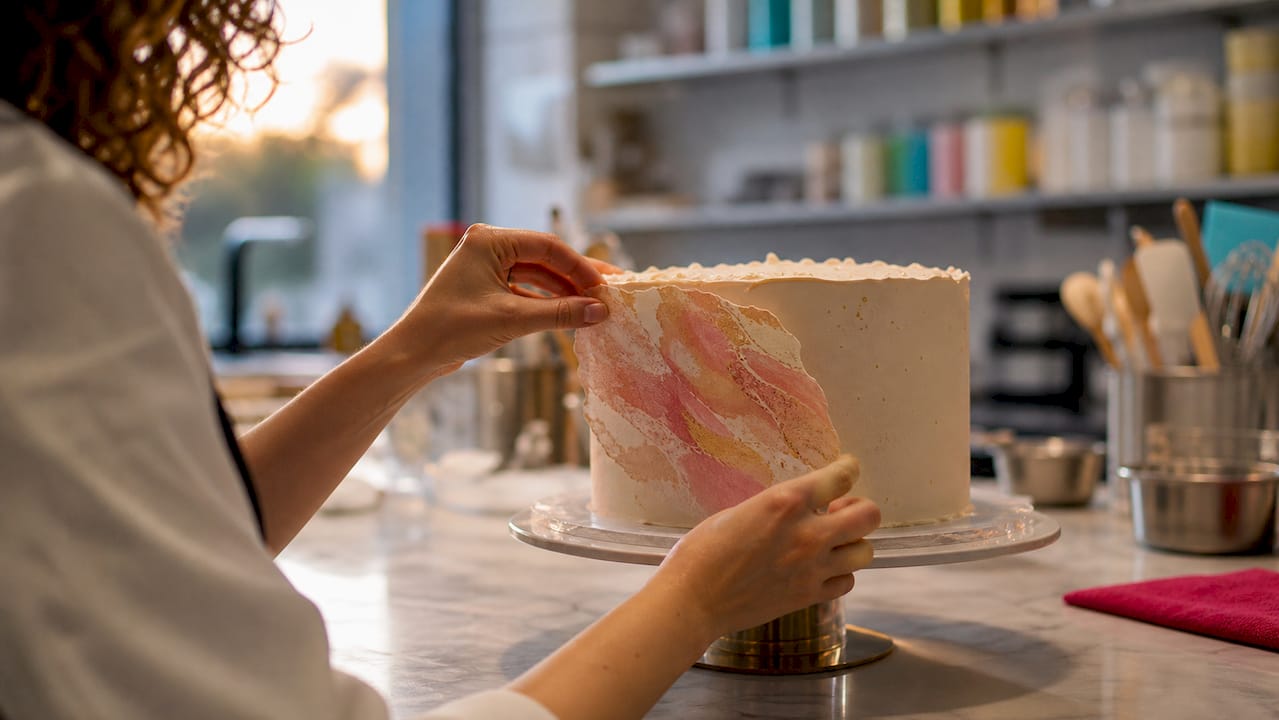
When someone prints at home, they rarely have the migration report of the inks they use, or the declaration of conformity of the support. That does not mean the result is dangerous, but it does mean there is no way to prove it. In a celebration with children, with guests with allergies, or simply when you want the result to be flawless, that uncertainty has a real cost.
What is often underestimated is the value of professional color management. A photograph that looks perfect on screen can come out dull, greenish, or with distorted skin tones if the RGB to CMYK conversion is not done properly. A supplier with experience in personalized edible printing calibrates the color profile for the specific support they use, something a home printer cannot guarantee.
The "do it yourself" argument makes sense for those who want to experiment. For those who want a specific result on a specific date, with an image that truly matters, professional service is not a luxury. It is the option that eliminates variables.
Funbakery: personalized wafer papers ready for your next celebration
If you have the image you want on your cake clear and you just need someone to print it well, Funbakery solves it without complicating the process. You send the photo, the name, and the age, and you receive the cut wafer paper or sugar paper, packaged with protection and ready to place.

The catalog includes formats for round cakes, rectangular cakes, and cupcakes, with seasonal designs and the option of completely personalized design for those who want something unique. All products comply with European regulations on food contact materials, and the design team reviews each file before printing to avoid resolution or color problems. If you are organizing a children's party and you want the cake to have a photo of your child with their favorite character, you can see it in products like the personalized Minecraft wafer paper or explore the full catalog at Funbakery to find the format that best adapts to your cake.
Sources and technical documentation for further reading
For those who want to verify the regulations directly or prepare a more detailed question checklist for their supplier:
- Regulation (EC) 1935/2004 and resources on food contact materials, EFSA: European reference point for safety criteria and migration risk assessment.
- Regulation (EC) 2023/2006 on good manufacturing practices, OJEU: full legal text with requirements for the formulation and handling of inks in materials intended to come into contact with food.
- ITENE / FEDACOVA: safety of inks and adhesives in food packaging: explains the manufacturer's responsibility and the required migration controls.
- 2025 guide to packaging ink customization without violating regulations, Bioleaderpack: details migration testing, low-migration technologies, and required documents (COC, laboratory reports).
- Complete guide to edible printing, Mundo Repostería: practical description of materials and techniques for baking.
- Edible printing decorations, Horneando Sabores: examples of creative uses and advantages in baking.
- Compliance of materials intended to come into contact with food, Avery Dennison: summary of applicable European frameworks and industry recommendations on positive lists.
- Variable data printing and color management, Roland DG: technical reference on file preparation and color control in custom printing.
| Document | Purpose |
|---|---|
| Declaration of conformity (DoC/COC) | Declares that the product complies with European food contact regulations |
| Overall migration report | Quantifies the total transfer of substances to food |
| Specific migration report | Identifies specific substances that may migrate and their limits |
| Ink ingredient list | Allows for the detection of allergens and restricted or prohibited substances |
| PFAS-free declaration | Confirms that the product does not contain regulated perfluoroalkyl compounds |
This article provides general information about edible customization and European regulations. For specific cases, especially in commercial settings or with severe allergies, consult the current regulations directly or a qualified food safety professional.
