TL;DR:
- Wafer paper has great aesthetic and sensory potential in children's decorations.
- It is recommended to use it just before serving to prevent it from deteriorating due to moisture.
- Personalization with characters, names, and photos makes it a key element of the celebration.
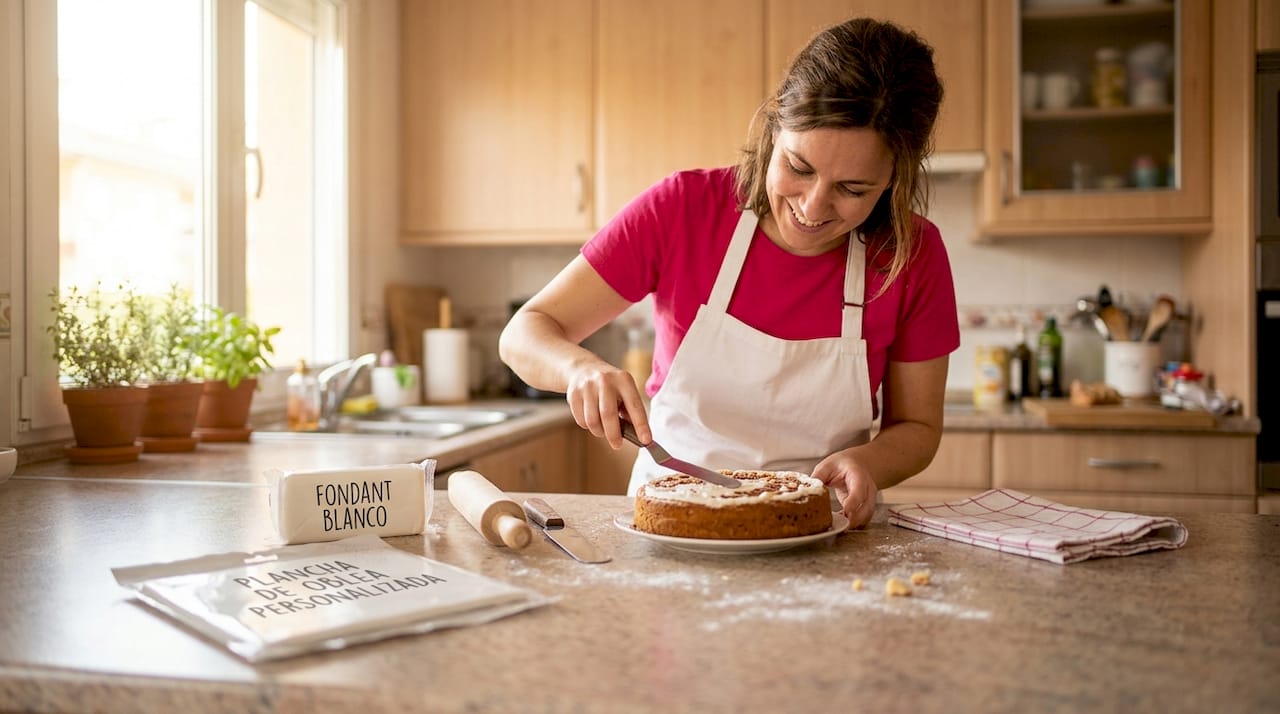
Edible wafer paper has been used to decorate cakes at celebrations for years, but most people see it as just another flat decoration to stick on top of the cake. This perception overlooks 90% of its true potential. A well-chosen and correctly placed piece of wafer paper can turn an ordinary cake into the absolute star of the party, elicit exclamations of wonder from children, and, above all, create a visual memory that guests will cherish for years. In this article, you will learn how to use wafer paper in a practical, creative, and professional way so that your next children's celebration is truly special.
Table of Contents
- What is wafer paper, and why does it make a difference at children's parties?
- Practical ideas for using wafer paper on birthday desserts
- Common mistakes and professional tips when working with wafer paper
- Quick comparison: wafer paper vs. sugar paper at children's parties
- Our experience: what really matters when using wafer paper at children's parties
- Ready to personalize your desserts? Discover the best wafer paper and designs
- Frequently asked questions about wafer paper at children's parties
Key Points
| Point | Details |
|---|---|
| Wafer paper vs. sugar paper | Wafer paper is ideal for colorful details and immediate use, while sugar paper is more durable. |
| Watch out for moisture | Avoid getting the wafer paper wet and place it just before serving to maintain its texture and color. |
| Easy cakes | You can create no-bake cakes by stacking wafer paper with fillings such as dulce de leche or cream. |
| Creative personalization | Wafer paper can be printed with photos and drawings to give your party a unique touch. |
What is wafer paper, and why does it make a difference at children's parties?
Now that we have debunked the basic perception of wafer paper, let's delve into what it really is and why it is so popular at children's celebrations.
Edible wafer paper is a very thin sheet made primarily from rice or potato flour, water, and sugar. After drying, it becomes crisp, almost translucent, and has a smooth surface ideal for receiving high-definition edible ink. The result is a delicate sheet that can be printed with any design: from your child's favorite character to a family photo with a name and age.
Wafer paper vs. sugar paper: which should you choose?
Many parents confuse wafer paper with sugar paper, and although both are edible decorating products, they have very different characteristics. According to specialized technical information, the differences between types of edible paper are clear: wafer paper comes from rice or potato and is crisp, while sugar paper is more flexible and durable, with greater resistance to moisture and the ability to withstand refrigeration.
This has direct implications for the party:
- Wafer paper is perfect for decorations that are placed just before serving, on dry surfaces at room temperature.
- Sugar paper holds up better if the cake goes into the refrigerator for several hours or if the local weather is humid.
- Both can be personalized with vivid colors, but wafer paper tends to produce a sharper finish on designs with a lot of fine detail.
The concrete advantages for a children's party
Wafer paper has one advantage that sugar paper cannot replicate in the same way: its crisp texture adds a sensory element when you bite into it. For children, that crunch is a little extra pleasure. In addition, colors printed on wafer paper usually look very saturated and vivid, making superhero, dinosaur, or princess designs eye-catching at first glance.
“A well-designed piece of wafer paper is not just a decoration: it is part of the sensory experience of the dessert. Children see it, touch it, and taste it, and that creates a much more intense memory than any plastic decoration.”
In Latin American countries such as Mexico and Colombia, wafer paper also has significant cultural value. Wafer paper filled with arequipe or dulce de leche is a traditional sweet present at fairs, markets, and family celebrations for generations. Incorporating that element into a children's party connects the modern with the familiar in a very moving way.
Practical ideas for using wafer paper on birthday desserts
We already know why wafer paper stands out in the world of desserts. Now let's look at concrete ideas to bring creativity to your next children's party.
No-bake stacked cakes
One of the most surprising and least known options is to use wafer paper as the base for a cake without needing to turn on the oven. By stacking between 12 and 24 wafer papers with creamy fillings such as dulce de leche, chocolate cream, or arequipe, you can get quick no-bake cakes with between 12 and 18 perfect portions for a children's birthday. The process is simple: alternate a layer of wafer paper with a thin layer of filling, press gently, and let it rest in the refrigerator for at least two hours so that the layers set.
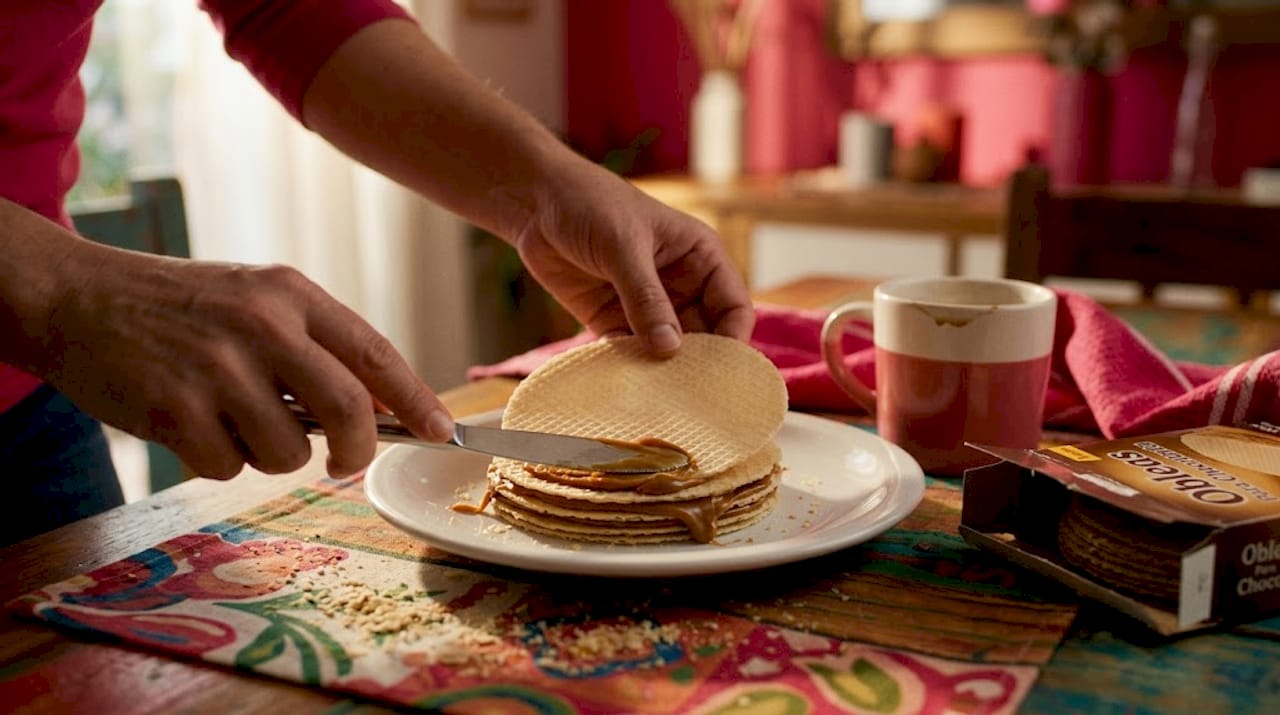
The result is spectacular both visually and in texture. You can cover the last layer with melted chocolate or jam, and finish it all off with a piece of wafer paper printed with the birthday child's name. This technique is ideal when you don't have time to bake or when you want a dessert that surprises with its originality.
Themed muffins and cupcakes
Muffins are the perfect support for small circular or custom-shaped wafer papers. To decorate children's desserts with wafer paper, the process has four clear steps:
- Bake or buy pre-made muffins.
- Cover the surface with a thin layer of buttercream or smooth fondant.
- Cut the wafer paper with clean scissors if you need to adjust the size.
- Place the wafer paper on the covered surface before it dries, pressing gently.
This method works perfectly for themed parties where each muffin features a different character or the name of a guest. It is a detail that children recognize immediately and that adults photograph non-stop.
Reinvented traditional desserts
Wafer paper on birthday cakes is not limited to the main cake. You can use it to personalize cookies, mille-feuille, individual cheesecake portions, or even chocolate lollipops. On a dessert table, having several different desserts with wafer paper that share the same themed design creates a very attractive visual cohesion without needing to be a professional pastry chef.
| Type of dessert | Recommended wafer paper type | Suggested filling | Approximate portions |
|---|---|---|---|
| No-bake stacked cake | Large round (20 cm) | Dulce de leche or arequipe | 12 to 18 portions |
| Themed muffins | Small circular (5 cm) | Vanilla buttercream | 1 per muffin |
| Decorated cookies | Custom shape | Royal icing | 1 per cookie |
| Children's mille-feuille | Rectangular | Pastry cream | 8 to 10 portions |
Professional tip: if the party is held in summer or in a warm environment, prepare the desserts with wafer paper on the same day as the event and keep them covered in a dry place until the time to serve. Heat and moisture are the worst enemies of wafer paper and can ruin hours of work in minutes.
For more inspiration on wafer paper filling options and combinations that work well, you can also explore party dessert recipes that combine creativity with products that are easy to find in any supermarket.
Common mistakes and professional tips when working with wafer paper
After learning how to use wafer paper, it is essential to anticipate common mistakes and know the secrets of the experts so that everything goes well.
The three most frequent mistakes
Working with wafer paper seems simple, but there are details that make the difference between an impeccable result and a disappointing one. These are the failures we see repeated over and over again:
- Excess moisture: is the number one mistake. The wafer paper absorbs moisture from the environment, the cream, or the refrigerator and starts to bend, wrinkle, or directly fall apart. A hydrated piece of wafer paper is impossible to recover.
- Careless cutting: trying to cut a piece of wafer paper with a knife without supporting it well on a firm surface breaks it or frays it. Clean and dry kitchen scissors are the correct tool.
- Poor adhesion: placing the wafer paper directly on cold buttercream or dry fondant can make it not stick well and lift at the edges, especially in environments with drafts.
The tricks professionals use
To avoid frequent problems with wafer paper, experienced pastry chefs follow a clear protocol. The technical keys are straightforward: avoid excessive moisture that breaks the wafer paper, use royal icing or melted chocolate on the edges for perfect adhesion, do not reuse wafer paper that has already been handled, and on fondant always apply specific edible glue.
Edible glue is a product you can find in baking stores. It is transparent, does not alter the flavor, and provides firm adhesion for hours, which eliminates the risk of the wafer paper moving or lifting during presentation.
Step-by-step protocol to place a piece of wafer paper on fondant
- Make sure the fondant is completely dry to the touch before applying anything.
- Apply a thin layer of edible glue with a clean brush over the area where the wafer paper will go.
- Wait 30 seconds for the glue to become slightly sticky before placing the wafer paper.
- Press gently from the center toward the edges to remove possible air bubbles.
- Do not move the wafer paper once placed: the glue activates with the pressure and heat of your hand.
You can also consult a checklist for decorating with wafer paper that will help you prepare all the material before starting so you don't improvise at the crucial moment.
Professional tip: never take the wafer paper out of the protective wrapper too far in advance. Contact with the air, especially on humid days, starts to degrade its texture in just 15 or 20 minutes. Prepare the wafer paper just before placing it to maintain the vivid color and crisp consistency.
Quick comparison: wafer paper vs. sugar paper at children's parties
With the practical tips in mind, let's clarify when it is best to use wafer paper and when sugar paper in children's decorations.
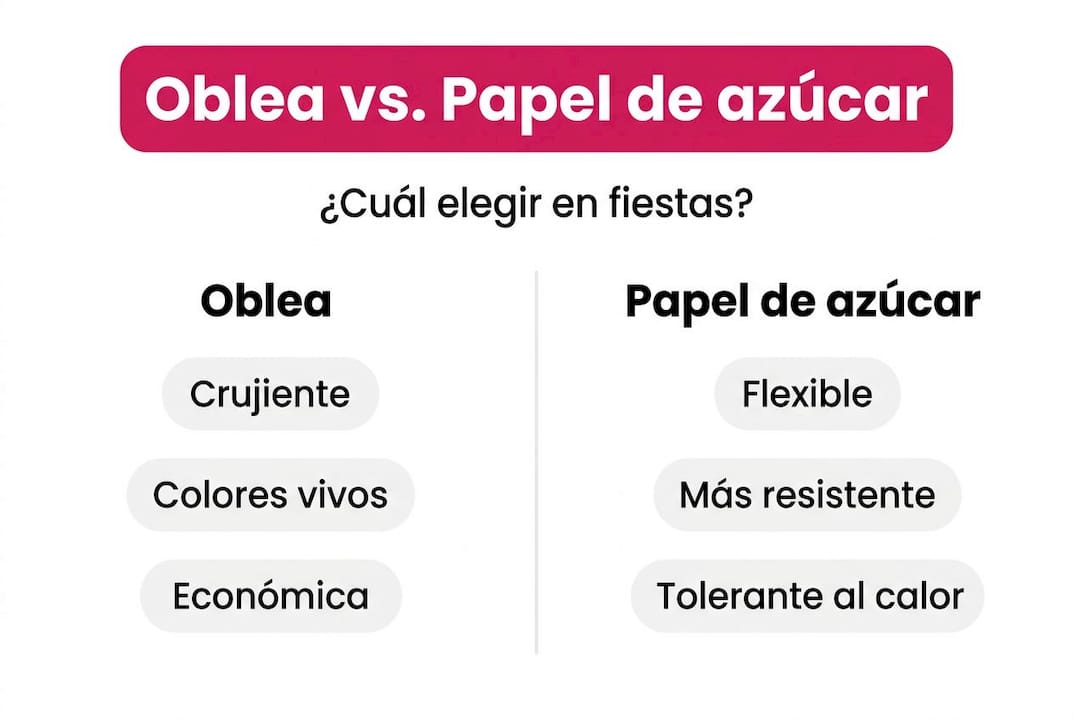
The choice between both materials depends on very concrete factors: the weather at the party venue, the type of dessert, how much time will pass between decoration and serving, and if the cake needs refrigeration.
| Characteristic | Wafer paper | Sugar paper |
|---|---|---|
| Texture | Crisp and delicate | Flexible and resistant |
| Resistance to moisture | Low, sensitive | High, tolerates refrigeration |
| Print quality | Very sharp and colorful | Good, with soft colors |
| Ease of cutting | With scissors, carefully | With scissors or a cutter |
| Ideal for | Immediate decoration, dry weather | Refrigerated cakes, humid weather |
| Adhesion on fondant | With edible glue | With water or edible glue |
| Approximate price | Slightly more economical | Something more expensive |
Wafer paper wins when you need an impactful visual result and you are going to serve the dessert at the moment. Sugar paper is the safest option if there are several hours between decoration and the party, or if the cake is going to be in the refrigerator.
For outdoor children's events in summer, where the temperature and humidity are unpredictable, sugar paper is usually more reliable. For indoor celebrations with temperature control, wafer paper offers visually superior results.
The benefits of wafer paper at parties also include its lower cost per unit, which allows decorating a greater number of desserts on a tight budget. And if you want to go further in creativity with wafer paper, the possibilities of personalization with names, characters, and photographs are practically unlimited.
Our experience: what really matters when using wafer paper at children's parties
After working with wafer paper at hundreds of real celebrations, we have learned something that no tutorial openly explains: the biggest problem is not technical, it is one of timing.
Most people who contact us after a disappointing result made the same mistake: they decorated the cake hours before the party, put it in the refrigerator, and when they took it out, the wafer paper was wrinkled, with the colors run, and without texture. No one had told them clearly enough that wafer paper and moisture are incompatible. That message needs to be stronger and clearer.
There is another lesson that we consider equally important: the most sophisticated designs are not always the ones that excite children the most. We have seen cakes with very elaborate and expensive decorations that generated less reaction than a simple round piece of wafer paper with the child's favorite character's face and their name written on top. Children respond to recognition, not to artistic complexity.
What always makes the difference is the personalized element. The birthday child's name, their age, perhaps their favorite phrase or the character they have chosen themselves. When a child sees their name on the cake, something changes. They become the real star, not just of the event but of the dessert. That is what they remember years later.
We have also discovered that involving children in creative decoration with edible images creates an additional excitement that is priceless. Letting them place their own edible image on a cupcake, under supervision, makes them feel part of something special. And when it comes time to eat, their pride is visible.
The most honest advice we can give you: do not strive for technical perfection. Strive for emotional impact. An edible image with the right character, placed at the right time, on the right dessert, does more for the party than any elaborate decoration that requires hours of preparation.
Ready to personalize your desserts? Discover the best edible images and designs
You have seen the full potential of edible images at children's parties. Now we make it easy for you to take the plunge and surprise everyone with unique personalized desserts.
At Funbakery, we have spent years helping families create memorable celebrations with edible images that combine print quality, attractive designs, and complete personalization. Our catalog includes everything from superheroes to animals, sports, and trendy characters, all available with a custom name, age, and text.

If you have a specific theme in mind, our design team can create any personalized image from a photograph or sketch. The process is simple: you choose the design, send us the details, and receive your edible image ready to place on your dessert. You can explore personalized cake edible images in our design service, find popular options such as personalized Minecraft edible images, or discover all the possibilities at Funbakery. The next step is just a click away.
Frequently asked questions about edible images at children's parties
Can you make cakes without an oven using only edible images?
Yes, you can stack edible images with creamy fillings such as dulce de leche or chocolate cream to create cakes with 12 to 24 layers and 12 to 18 servings, perfect for birthdays without having to bake anything.
How do I prevent the edible image from breaking when placing it on the cake?
Place the edible image just before serving and use royal icing or melted chocolate as an adhesive on the edges, as excessive moisture will break the edible image irreversibly.
What is the difference between an edible image and sugar paper?
An edible image is crispy and sensitive to moisture, while sugar paper is flexible and durable, with greater tolerance for refrigeration and humid conditions.
Can edible images be personalized with photos or drawings?
Yes, edible images support digital printing with photographs, names, characters, and any custom design, making them the ideal choice for themed parties with a truly unique and personal touch.