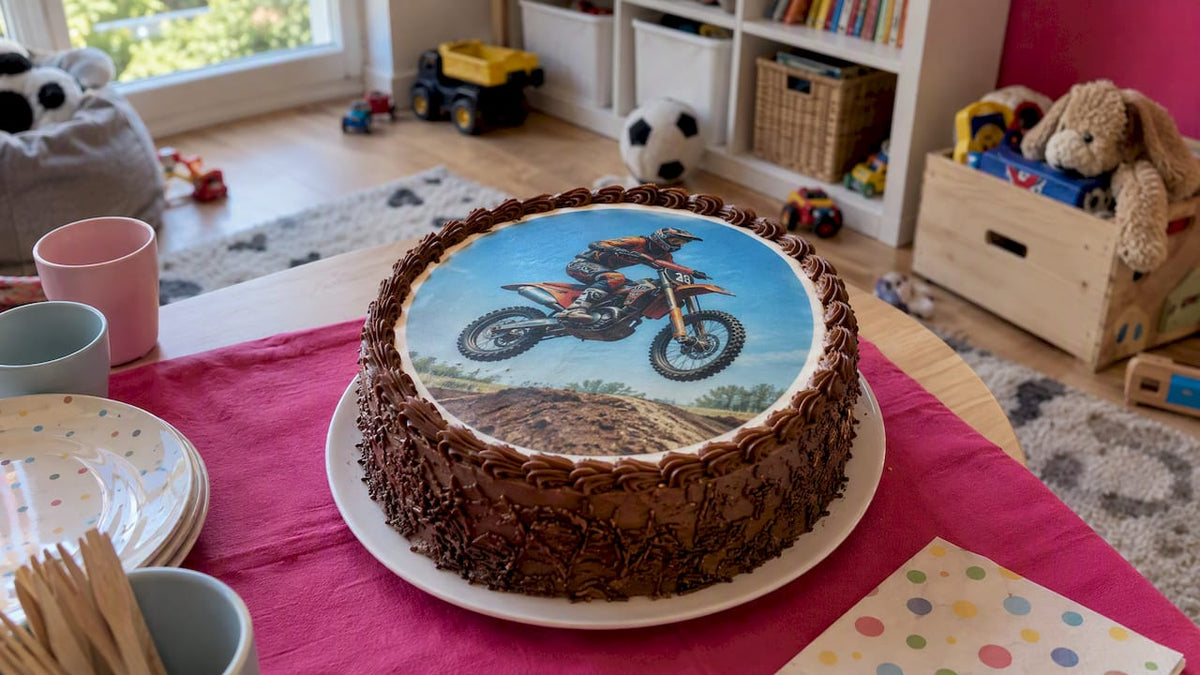
Yes, vegan sugar paper exists, and many sheets are vegan by default: the base is usually starch, sugar, glucose syrup, glycerin, and vegetable fats, printed with food-grade inks. What determines whether a particular sheet is suitable for a vegan or dairy-free cake are the details: a food-derived colourant, an emulsifier of unspecified origin, or a warning about traces of milk. In this guide, we show you what to look for on the label, what questions to ask before ordering, and how to apply the sheet to a vegan cake without ruining it.
In summary
- Most sugar paper is made with plant-based ingredients, but only the label or the manufacturer can confirm whether a particular sheet is vegan.
- There are only a few things to check: colourings such as carmine (E120), emulsifiers and fats of unspecified origin, and warnings about milk or egg.
- “Dairy-free” and “vegan” are not synonymous: a dairy-free sheet may contain another animal-derived ingredient, and a vegan sheet may have been made in a factory that handles milk.
- The whole cake counts: the sheet will only be suitable for a vegan cake if the fondant, cream, and whatever you use to stick it on are also vegan.
- Keep the sheet sealed, away from moisture and out of the fridge, and apply it just a few hours before serving.
Contents
- What is sugar paper and what is it usually made of
- Why the word “vegan” is not enough on its own
- Ingredients to check on the label
- Dairy-free sugar paper: what to look for
- How to check before ordering
- Sugar paper or wafer paper on a vegan cake
- How to apply sugar paper to a vegan cake
- How to store sugar paper until the day of the party
- Our perspective: the sheet is the easy part
- A vegan cake with the image of your choice
- Frequently asked questions
- Sources
What is sugar paper and what is it usually made of
Sugar paper is a thin, flexible sheet mounted on a plastic film, onto which an image is printed with edible inks. Once separated from the film, the sheet adapts to the surface of the cake and, in contact with the moisture of the fondant or cream, blends into it until it looks hand-painted. It has a slightly sweet taste, often enhanced with vanilla flavouring, and reproduces photographs and vivid colours in great detail.
Recipes vary from manufacturer to manufacturer, but the composition is usually based on the same families of ingredients:
- Starches and flours (from corn, potato, or rice), which give the sheet body.
- Sugars, such as sugar, glucose syrup, or maltodextrin.
- Humectants, such as glycerin or sorbitol, which keep the sheet flexible.
- Thickeners and stabilisers, such as gum arabic (E414) or cellulose derivatives.
- Vegetable fats and emulsifiers, which help prevent the sheet from cracking.
- Food-grade inks, made from water, humectants, and approved colourings.
None of these require milk, egg, honey, or gelatin to work, which is why so many sheets on the Spanish market are already listed as vegan and dairy-free on the product sheet. If you are still deciding between printed paper and other toppings, we compare the two options in sugar paper or sugar paste.
The case of titanium dioxide
For years, some sheets used titanium dioxide (E171) to make them whiter and give colours more shine. E171 is not animal-derived, but it is a good test of the product's freshness: the Regulation (EU) 2022/63 banned E171 in EU foods, with a transition period that ended in August 2022 for products manufactured under the old rules, which could only continue to be sold until their expiry date. Today, a sheet with E171 in the ingredients list is either very old or was not made for the European market. In either case, choose another.
Why the word “vegan” is not enough on its own
When a sheet says “vegan” on the packaging or product sheet, that is a claim made by the manufacturer. In Spain, Aesan reminds us that the responsibility for the accuracy of the information on the label lies with the economic operator, i.e., the person who manufactures or markets the food. In practice, this means two things:
- A reputable manufacturer will only write “vegan” if they have verified the origin of every ingredient, including the additives in the ink.
- If the sheet says nothing, that does not mean it is not vegan. Often it is simply a more understated label, and the answer is in the ingredients list or by asking the seller.
For those decorating for a party, the useful rule is simple: read the full list, both for the sheet and the printing inks, and check the few ingredients that may be animal-derived.
Ingredients to check on the label
The following list brings together the ingredients that usually raise questions about sugar paper or the ink that accompanies it. This does not mean they appear on all sheets: on most, they do not.
| Ingredient | Why it deserves attention | What to look for instead |
|---|---|---|
| Carmine, cochineal (E120) | Red colouring obtained from insects | Red colourings of plant or synthetic origin |
| Shellac (E904) | Resin produced by insects, used as a coating agent | Absence from the list |
| Gelatin | Protein of animal origin | Plant thickeners, such as starches, gum arabic, or cellulose |
| Mono- and diglycerides of fatty acids (E471) | May be of plant or animal origin | The indication “of plant origin” or confirmation from the manufacturer |
| Lecithin (E322) | Usually from soy or sunflower, but may come from egg | The indicated origin (soy, sunflower) |
| Lactose, whey, milk powder | They are milk: the sheet is neither vegan nor dairy-free | Absence from the list |
| “Fat” without further information | The origin is not specified | “Vegetable fat”, preferably with the type (palm, coconut, sunflower) |
| “May contain traces of milk or egg” | Risk of cross-contamination at the factory | It matters above all to those with allergies |
Beware of false alarms. Names such as lactate or lactic acid sound like milk, but they refer to substances that, in most cases, do not come from it. If in doubt, the right question to ask the seller is always the same: “is the origin of this ingredient plant-based?”
Dairy-free sugar paper: what to look for
Those looking for dairy-free sugar paper are usually in one of two situations, and it is best not to confuse them.
Lactose intolerance. What matters is that the sheet contains neither lactose nor dairy derivatives with lactose among the ingredients. A vegan sheet solves this case, because it contains no milk at all.
Milk protein allergy. Here, the caution is greater. In addition to the ingredients, the cross-contamination warning (“may contain traces of milk”) counts, because a minimum amount may be enough to cause a reaction. A vegan sheet may have been produced on lines shared with dairy products, and the vegan label alone does not rule this out.

In the ingredients list, allergens are usually highlighted, in bold, or in capital letters, making them quick to read. If the cake is for a child with a diagnosed milk allergy, do not rely solely on the sheet's label: confirm with the manufacturer how it is produced and, if you have doubts about what is safe for that child, speak with the pediatrician or allergist who treats them before the party.
How to check before ordering
Before clicking “buy”, it is worth following this order. It takes five minutes and avoids surprises on the day of the party.
- Read the full ingredients list. The one for the sheet and the printing inks, which sometimes appear separately.
- Look for the declaration on the product sheet. Indications such as “vegan”, “dairy-free”, or “lactose-free” are the fastest shortcut.
- Check the ingredients in the table above. If E471, E322, or “fat” without origin appears, ask.
- Check the trace warnings. If there is an allergy, this step is the most important.
- Ask the seller in writing. An answer by email or message is recorded and you can show it to whoever asks at the party.
- Keep the packaging until the end of the party. When a guest asks what the decoration is made of, you have the answer at hand.
- Review the rest of the cake. The sheet is just one layer: fondant, filling, cream, colourings, and even candles with a wax base must be considered.
For other questions to ask before choosing the sheet, such as size, shape, and finish, we have gathered tips for choosing sugar paper for parties.
Sugar paper or wafer paper on a vegan cake
The two most common printed sheets, sugar paper and wafer paper, can both work on a vegan cake, provided the ingredients confirm it. The choice depends above all on the surface you are going to decorate and the result you are looking for.
| Criterion | Sugar paper | Wafer paper |
|---|---|---|
| Texture | Flexible, blends with the icing | More rigid, holds its shape |
| Taste | Sweet, often with vanilla notes | More neutral |
| Colours | Vivid, with a finish very close to a photograph | Softer, matte finish |
| Ideal surfaces | Fondant, firm vegan buttercream, icing | Cookies, dry surfaces, free-standing decorations |
| Moisture resistance | Absorbs moisture from the icing (that is what sticks it) | Softens easily on very moist creams |
| What to check to make it vegan | Emulsifiers, fats, ink colourings | Base ingredients and ink colourings |
Wafer paper wins for cut-out figures and cookies that are going to travel in a box; sugar paper, for photographs and drawings full of colour. We explain the differences between materials in wafer paper and rice paper.
How to apply sugar paper to a vegan cake
Sugar paper behaves the same way on a vegan cake or a traditional cake. What changes is the icing underneath, which must also be vegan: fondant without animal-derived ingredients, “butter” cream made with vegetable margarine, or dark chocolate ganache with vegetable cream (confirm that the chocolate does not contain milk).
On fondant
- Measure the surface and, if necessary, cut the sheet while it is still on the film, with clean, dry scissors.
- Separate the sheet from the film. If it resists, leave it in the freezer for a few minutes or run the film over the edge of a table; as a rule, it will come off effortlessly.
- Apply a very thin layer of water with a nearly dry brush, or a little sugar syrup, over the fondant. Do not wet the sheet directly.
- Place the sheet starting from the centre towards the edges and smooth it with dry hands, without rubbing.
On vegan cream
Apply the sheet when the cream is still fresh and slightly sticky: the cream's own moisture fixes it, without extra water. It works best with firm creams, made with margarine or vegetable fat. Very aerated vegetable whipped cream with a lot of water tends to dissolve the sheet and make the colours run, so, in that case, place the sheet first on a thin disc of fondant and place the assembly on the cream.

On cookies and cupcakes
On cookies, first cover with a disc of fondant cut with the same cutter, or with royal icing made with aquafaba instead of egg white, and apply the sheet with a drop of water. On cupcakes, the printed discs sit directly on the cream or on a small disc of fondant. We have ideas for shapes in edible paper on cupcakes.
For the complete step-by-step, see our guide to using sugar paper. If you want to seal the image to give it more protection, we explain how to seal edible paper.
When to apply. Ideally, decorate a few hours before serving. On moist cream, a sheet applied the day before may start to dissolve; on fondant, it holds up much longer.
How to store sugar paper until the day of the party
The enemy of sugar paper is moisture, both too much and too little. Follow these rules:
- Keep the sheet in the original packaging, closed and flat, so it does not fold or get creases.
- Store it in a cool, dry place, away from direct sunlight, which fades the colours.
- Do not store it in the fridge or freezer. Condensation when coming out of the cold leaves the sheet sticky and can make the ink run. The freezer is only useful for a few minutes to release the film before applying.
- Do not remove the film before the time to apply. It is what protects the sheet from drying out or sticking.
- Respect the best before date indicated on the packaging.
If the sheet is brittle, the environment was too dry; if it is soft and sticking to your fingers, it has absorbed moisture. In either case, work with very dry hands on a day without steam in the kitchen.
After decorating, the cake can go in the refrigerator if the filling requires it. When removing it, leave it closed in a box for a few minutes so that condensation forms on the box and not on the image.
Our perspective: the sheet is the easy part
More and more parties have a vegan person, someone with lactose intolerance, or both, at the table. We see this in the questions we receive: people do not want to give up the cake with the birthday girl's photo or their favorite superhero just because the recipe has changed.
Our experience tells us that the printed decoration is rarely the obstacle. Sugar paper and wafer paper are, by their very nature, simple toppings, and a question before ordering usually resolves the doubt. The work that makes the difference is elsewhere: in the right frosting underneath, in the application at the right time, and in an image that says something about who is celebrating.
That is where we like to help. Our designers create custom images, with photos, names, ages, and text, for cakes, cupcakes, cookies, and side strips. And if you need to know the composition of a sheet before ordering, write to us on WhatsApp or email: customer service is available 24 hours a day, and we prefer to answer beforehand rather than see a party cake left without decoration.
David
A vegan cake with the image of your choice
At FunBakery, we print custom sugar paper and wafer paper for cakes, cupcakes, and cookies. Our custom design service costs from 6 USD for rectangular, disc, and cupcake formats, and from 10 USD for side strips, with the photo, name, and age you send us.

Orders over 25 € have free 24-hour shipping, in sturdy packaging that protects the sheet during transit. If the cake is vegan or lactose-free, talk to us on WhatsApp or email before finalizing the order and clarify your questions about the composition. You can also create your image in our custom design studio, with rectangular, round, cupcake, and strip formats.
Frequently asked questions
Does sugar paper contain milk?
In most cases, no: the base is usually starch, sugars, glycerin, and vegetable fats. Even so, each manufacturer has its own recipe, so check the ingredients list to see if there is no lactose, whey, or milk powder. If there is a milk allergy, also check the trace warning.
Can I put sugar paper on vegetable frosting?
You can, but very airy and moist frosting tends to dissolve the sheet and blur the colors. The safest solution is to place the sheet on a thin disc of fondant and place the assembly on the frosting, preferably shortly before serving.
How far in advance can I order the sheet?
With the packaging closed, in a cool and dry place, the sheet remains in good condition until the date indicated on the label. Ordering with a few days to spare gives you time to confirm the ingredients and test the application carefully. Apply it to the cake only a few hours before the party.