Yes, you can place sugar paper on cream cheese frosting, and the result is flawless when three conditions are met: the frosting is firm and smooth, the surface is only slightly damp (never wet), and the image is placed on the cake as close to serving time as possible. Cream cheese is one of the wettest and fattiest frostings out there, so it is less forgiving than fondant or butter buttercream. However, with the right preparation, the image sits flat, the colors remain vibrant, and the paper blends into the frosting as if it had been painted by hand. In this guide, we explain how to prepare the cream, how to apply the sheet step by step, how to lock in moisture, and how to store the cake until it is time to sing happy birthday.
In summary
- Sugar paper adheres well to cream cheese if the frosting is stable, smooth, and cool but not chilled.
- Moisture is its greatest enemy: frosting that is too soft or has just come out of the refrigerator with condensation will cause the image to melt, smudge, or wrinkle.
- Apply the image at the end, ideally just before presenting the cake, and remove the protective sheet only at the last moment.
- If the cake needs to wait, store it in the refrigerator without the image and add it later; cream cheese needs to be cold, but sugar paper does not like it.
- For very wet frostings or visible creamy fillings, fondant is a firmer alternative; for photos and vibrant colors, sugar paper is the best choice.
Table of Contents
- Can sugar paper really withstand cream cheese frosting?
- How to prepare cream cheese to receive the image
- Step by step: applying sugar paper to cream cheese
- Moisture: what can go wrong and how to avoid it
- How to store the cake until serving time
- Sugar paper or fondant: which to choose for cream cheese?
- Sides, bands, and cupcakes with cream cheese
- Our opinion
- An image made to fit your cake
- Frequently asked questions
- Sources
Can sugar paper really withstand cream cheese frosting?
It can, and it is a combination frequently used on birthday cakes, red velvet cakes, carrot cakes, and decorated cheesecakes. Sugar paper is a thin sheet of sugar printed with edible inks and mounted on a backing sheet. When it touches a slightly damp surface, it absorbs some of that moisture, softens, and adheres on its own. This is exactly the mechanism that makes it so easy to use.
The problem arises when there is too much moisture. Cream cheese contains a lot of water and fat, and frosting made in a hurry, with too little sugar or with over-beaten cheese, becomes soft and releases liquid. Under these conditions, the paper does not just stick: it begins to dissolve. The colors lose definition, smudges appear, and in the worst cases, the image falls apart at the edges.
Therefore, the right question is not “can it?”, but “is my frosting ready to receive the paper?”. If you answer yes to the following three points, go ahead:
- The frosting holds its shape when you pass a spatula through it and does not run.
- The surface is smooth, without visible holes or crumbs.
- When you touch it lightly with your finger, it feels cool and slightly tacky, but your finger does not come away wet or with excessive cream clinging to it.
If your cake is a cheesecake, with a baked cheese or gelled cream surface, the precautions are similar, but there are specific tricks, which we explain in our guide on sugar paper on cheesecake.
How to prepare cream cheese to receive the image
A good application begins long before you open the image packaging. The frosting is the foundation, and it is what determines whether the paper stays smooth or wrinkles.
Choose a stable frosting
To decorate with sugar paper, prefer a firm cream cheese frosting. In practice, this can be achieved with block cream cheese (which is denser than tub cream cheese), well drained and used cold, mixed with butter and powdered sugar until it is homogeneous. Beat only as much as necessary: beating the cheese for too long breaks down its structure and releases liquid. If the frosting becomes soft, put the bowl in the refrigerator for a while and stir again before using.
Make a base layer and smooth it well
Cover the cake with a first thin layer to trap crumbs, let it set in the cold, and only then apply the final layer. Smooth the top with a long spatula or offset spatula. Any irregularity will show through the paper, because the sheet is thin and copies what is underneath. A level top is also what prevents the image from being crooked or wrinkled.

Let the frosting temper before applying
After the cake has been in the refrigerator, the surface becomes hard and cold. If you apply the paper right then, the condensation that forms when the cake warms to room temperature will end up wetting the image. Therefore, let the frosting temper slightly outside the cold before placing the paper: the goal is for the surface to stop being ice-cold and free of droplets, but without softening. If you notice droplets, wait for them to evaporate or dab them with a paper towel, very carefully, before proceeding.
Step by step: applying sugar paper to cream cheese
With the frosting ready, application takes only a few minutes. Have everything at hand before you start: the image, clean scissors, a spatula, and very dry hands.
- Confirm the size. Hold the image, still on the backing sheet, against the cake to see if the size and position are correct. If you need to cut it, do so now, while the sheet is still protected. Our guide on precise cuts in sugar paper shows how to cut shapes and contours without tearing.
- Release the backing sheet. If the image does not peel off easily, place it in the freezer for a few seconds or run the sheet along the edge of a table, with the paper side up. Peel it off slowly from one corner.
- Position it all at once. Hold the image by the edges, align one side first, and lower it onto the frosting as if closing a book. Avoid placing and lifting it several times: cream cheese grabs the paper immediately, and each attempt ruins the surface.
- Smooth it from the center outward. With the palm of a clean, dry hand, or with a flat spatula, press gently from the center to the edges to push out the air. If any bubbles remain, push them toward the nearest edge. In the article on bubbles in sugar paper, you will find more solutions.
- Handle the edges. If the image covers the entire top and there is paper left on the sides, make small cuts in the excess so that it folds without tearing. You can also hide the seam with a border of cream made with a piping tip, which gives a finished look and protects the edge of the image.
- Let it settle. In a few minutes, the paper absorbs the moisture from the frosting and blends in. At this stage, do not touch the image: it is still soft and marks easily.
If the image becomes misaligned or wrinkled, do not try to pull it. In the guide on crooked or wrinkled sugar paper, we explain the most common causes and what to do in each case.
Moisture: what can go wrong and how to avoid it
Almost all sugar paper problems on cream cheese have the same origin: too much water, coming from the frosting, the refrigerator, or the environment. The table summarizes what usually happens and how to prevent it.
| What happens | Probable cause | How to avoid it |
|---|---|---|
| The colors run or become blurred | Frosting that is too soft or wet | Use well-drained block cream cheese and do not over-beat |
| The image wrinkles after being placed | Uneven surface or paper absorbing moisture unevenly | Smooth the frosting well and apply it to a uniform surface |
| Spots and droplets appear on the image | Condensation from a cake that came cold out of the refrigerator | Let the frosting temper and dry before applying |
| The edges of the image fall apart | Contact with freshly beaten cream or runny filling | Make a firmer cream border and apply the image at the end |
| The paper tears when peeling it off | Sheet that is soft due to heat or humidity in the kitchen | Keep the image closed and flat; put it in the freezer for a few seconds before peeling it off |
| The image becomes sticky hours later | Decorated cake stored in the refrigerator | Apply the paper as close to serving time as possible |
There are also two simple precautions that make a difference. The first is to keep the image tightly closed, flat, and away from heat and light until the day you use it: paper that has already gained moisture in the packaging arrives at the cake fragile. The second is not to apply anything on top of the image, such as shine gel or liquid food coloring, because any extra liquid accelerates dissolution. We explain more about this topic in the article on moisture in fondant and sugar paper.
How to store the cake until serving time
Here is the cream cheese dilemma: the frosting needs to be cold, but sugar paper suffers from the humidity of the refrigerator. The way to reconcile the two is to separate the times.
Store the frosted cake without the image. Assemble, fill, and cover the cake with the cream cheese with the lead time you need and keep it in the refrigerator, as you would with any cake with a dairy frosting. Follow the storage instructions of the cream cheese you used and do not leave the cake out of the cold for longer than necessary, especially on hot days.
Apply the image close to the time of the party. Take the cake out of the refrigerator, let the surface lose its frost and condensation, apply the paper, and serve. This way, the image keeps its colors sharp and the cake remains safe.

If you really have to refrigerate it after decorating, place the cake in a closed box, away from foods with strong odors and the back wall, where there is more humidity. When taking it out, do not open the box right away: leave it closed for a few minutes so that the condensation forms on the outside of the box and not on the image. Even so, expect some loss of shine. For a cake to transport, decorate on site whenever possible: take the image in its original packaging, flat, and apply it upon arrival.
Sugar paper or fondant: which to choose for cream cheese?
Both options are edible and print custom images, but they behave differently on a wet frosting.
| Criterion | Sugar paper | Fondant |
|---|---|---|
| Appearance | Thin, flexible, blends into the frosting, and the edge is almost unnoticeable | Firmer and opaque, with a sheet texture |
| Colors and photos | Vibrant and very defined colors, ideal for photos | Softer and matte colors |
| Reaction to moisture | Softens and adheres; with too much moisture, it dissolves | Absorbs moisture and can ripple, but does not fall apart as quickly |
| Best use on cream cheese | Smooth and well-prepared top, applied close to serving time | Toppers, cutouts, and figures that stand up or go on wetter fillings |
| Taste | Sweet, neutral | Neutral, slightly sweet |
On most birthday cakes with cream cheese frosting, sugar paper is the choice that gives the most professional finish, because it blends with the cream and reproduces photos in detail. Fondant shines on other papers: cut-out figures stuck in the cake, cupcake decorations, or surfaces where the image needs to maintain some rigidity.
Sides, bands, and cupcakes with cream cheese
The top is the easiest place, but cream cheese also accepts sugar paper on the sides and on cupcakes.
On the sides, use sugar paper bands with the height of the cake. Smooth the sides of the frosting very well, because an irregular side makes the band peel off. Start at a discreet point, roll the band around pressing with a dry hand, and close by overlapping the ends slightly. If the frosting is very soft, the band tends to slip: put the cake in the cold, let it temper, and try again.
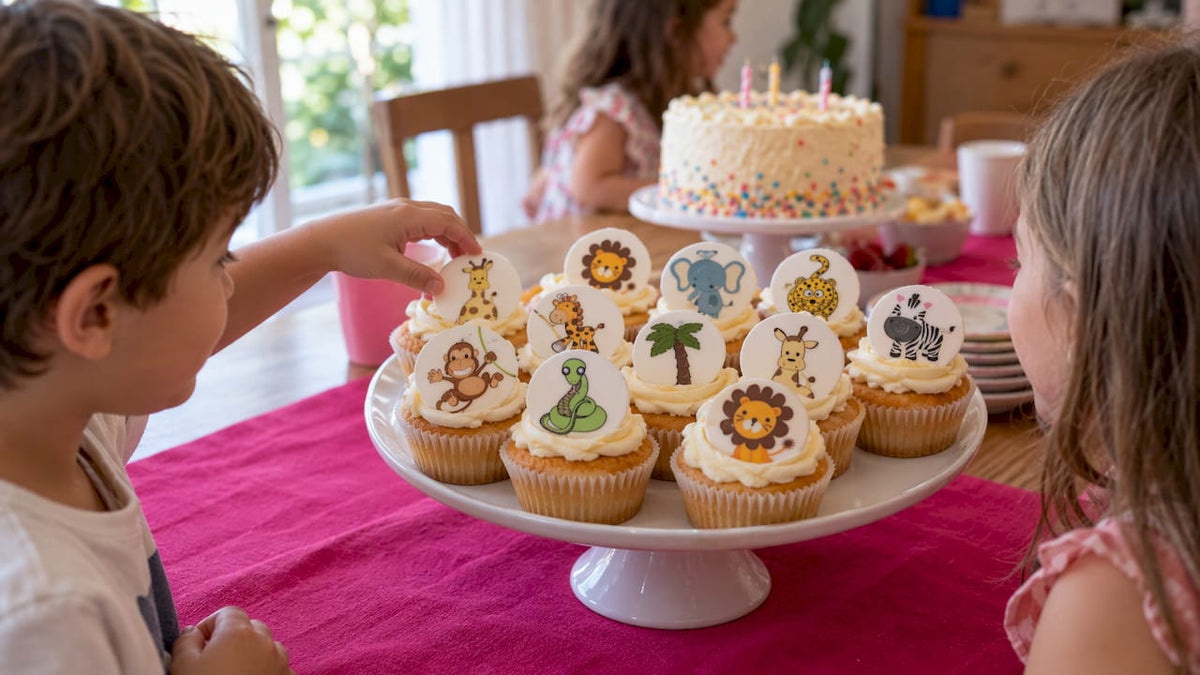
On cupcakes, the cream cheese frosting is usually made with a piping tip, in a spiral, which does not create a flat surface. For sugar paper discs, smooth the top with a small spatula, forming a small smooth dome, and place the disc. Place the discs shortly before serving, for the same reason as always: moisture.
If you are looking for other frostings to compare, we also have a guide for using sugar paper on chantilly, which has similar challenges to cream cheese.
Our opinion
At FunBakery, we see cream cheese cakes decorated with our images every week, and the conclusion is always the same: when the sugar paper fails, it is rarely the paper's fault. It is the frosting that is soft, it is the condensation from the refrigerator, or it is an image applied too early.
Therefore, we advocate sugar paper as the best way to put a photo, a name, or a character on a cream cheese cake. No other homemade technique gives those colors and that detail with so little work. Just respect the order: firm frosting, tempered surface, image at the end.
The other half of the result is in the image. Our designers prepare each design for the right cake size, with margins designed for the edge and for the sides, so that the important part of the photo never gets hidden under the cream. And we send each sheet in a resistant, flat, and protected package, because an image that arrives folded or damp begins to lose before reaching the cake.
David
An image made to fit your cake
You already have the planned frosting, now you need the part that your guests will photograph. At FunBakery, we create custom sugar paper and wafers for cakes, tarts, cupcakes, and cookies, with photos, names, ages, and text of your choice, or with superhero, animal, sports, children's character, and celebration themes.

Our custom design service starts at 6 USD for rectangular, round, and cupcake formats, and at 10 USD for side strips. You can also choose the custom design studio. We offer free 24-hour shipping on orders over 25 € and customer support via WhatsApp or email, 24 hours a day.
Frequently Asked Questions
How long before the party can I put the sugar paper on the cream cheese?
Ideally, apply the image as close to serving time as possible, after the cake has come out of the refrigerator and the surface has lost its condensation. This way, the paper keeps its colors crisp and does not become sticky. If you have to decorate it further in advance, keep the cake in a closed box and expect some loss of shine.
Can I put the decorated cake in the refrigerator?
You can, if necessary, but the humidity of the refrigerator is the main cause of stains and sticky images. Use a closed box and, when removing it, wait a few minutes before opening it so that condensation does not fall on the image. Whenever possible, refrigerate the cake without the image and apply it later.
Does the sugar paper stick on its own to the cream cheese, or do I need something to fix it?
It sticks on its own: the slight moisture of the frosting is enough for the paper to adhere. Do not wet the surface or use water on top, because that makes the colors run. If the frosting is very dry in some area, a very thin layer of frosting in that area is enough.
What do I do if the image starts to melt?
It is usually a sign that the frosting is too soft or moist. Refrigerate the cake to firm up the cream and do not touch the image while it is soft. Next time, use a firmer and well-drained cream cheese and apply the paper on a tempered surface without drops.
Can I use sugar paper on a cream cheese cheesecake?
Yes, as long as the surface is firm, smooth, and without visible liquid. On cheesecakes with fruit or jam topping, apply the image over an area of cream and not over the fruit. You can see all the steps in our guide to using sugar paper.