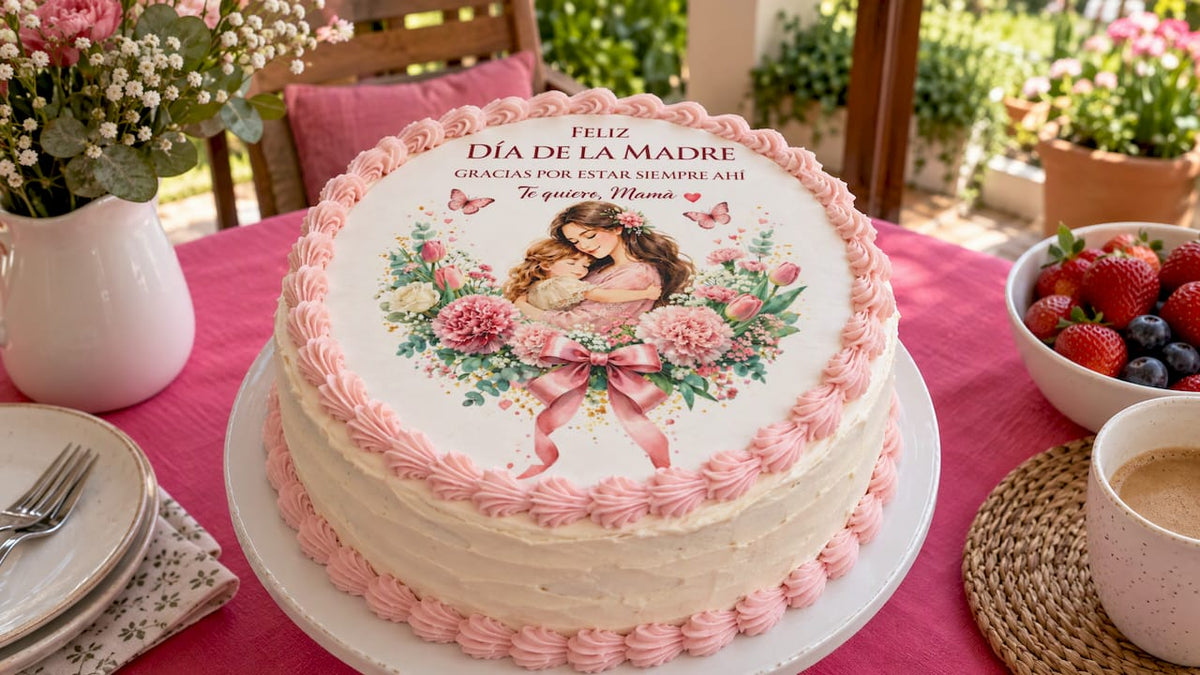
Sugar paper is halal when all ingredients, including edible inks and additives, are permissible, and when manufacturing, storage, packaging, and transport occur without contact with pork, alcohol, or derivatives. It is not enough to be “sugar”: the complete composition, plus the process, is what decides. In this guide, we explain what to look for on the label and technical sheet, how to read a halal certificate issued in Spain, what questions to ask the manufacturer, and how to apply the paper to the cake so that the decoration arrives intact at the party, whether it is a birthday, an Eid, a wedding, or a family christening.
In summary
- Halal applies to the entire product: ingredients, inks, additives, utensils, packaging, and transport, according to the Codex Alimentarius guidelines.
- The points to check are the absence of alcohol and pork derivatives, the origin of additives such as emulsifiers and humectants, and the composition of the edible ink.
- A valid halal certificate indicates the certifying entity, the standards applied, the scope of the products, and an expiration date subject to audits.
- When shopping online in Spain, allergen information must be available before payment, and the remaining mandatory information, at the latest, when you receive the product.
- If the label is not clear, ask for the full list of ingredients and ask about the manufacturing process before ordering.
Table of Contents
- What makes sugar paper halal
- Sugar paper or wafer: what changes in the verification
- What to read on the label and technical sheet
- How to confirm a halal certificate in Spain
- Questions to ask the manufacturer
- How to apply and preserve sugar paper on the cake
- Personalize your party decoration
- Our perspective
- Frequently asked questions
- Sources
What makes sugar paper halal
“Halal” means permissible. For processed foods, this translates into concrete rules that the main references describe in a very similar way.
The general guidelines of the Codex Alimentarius for the use of the term halal establish three conditions: the food cannot contain anything illicit, it must be prepared, processed, transported, and stored with equipment and means free of illicit elements, and it cannot be in direct contact with non-halal foods at any of these stages.
The halal food guide of the Australian Muslim community summarizes the essentials for processed products: no alcohol, no pork, and no contact with its derivatives during manufacturing or preparation, with attention to cross-contamination and the cleaning of utensils and surfaces.
The Halal Food Guidelines from the Department of Halal Certification EU go one step further and include the packaging materials that touch the product. If there is alcohol or pork in any form, including derivatives, the product ceases to be halal.
In practice, for sugar paper, this means looking at four layers:
- The base sheet: sugar, starches, gums, vegetable fats, emulsifiers, and humectants.
- The edible ink: dyes, vehicles, and humectants that give color to the image.
- The process: the production line, the utensils, and the cleaning between batches.
- The packaging and transport: the material in direct contact with the sheet.
A sheet can have an impeccable base and fail in the ink, or vice versa. That is why the right question is never “is sugar halal?”, but rather “is the final product, with the printing, halal?”.
Sugar paper or wafer: what changes in the verification
In cake decoration, two supports are mainly used, and each has its own list of ingredients.
| Sugar paper | Wafer (rice paper/wafer) | |
|---|---|---|
| Base | Thin sheet of sugar paste over a support film | Starch sheet, light and dry |
| Finish | Intense colors, soft touch, blends with the frosting | Firmer, slightly softer colors |
| Ingredients to review | Emulsifiers, fats, humectants, aromas | Starches, oils, possible additives |
| Ink | Edible ink printed on top | Edible ink printed on top |
| Ideal for | Photos and images with a lot of detail on fondant or buttercream | Dry cakes, cookies, decorations that require rigidity |
In both cases, the halal logic is the same: review the complete composition of the sheet and the ink. If you want to delve deeper into the differences in finish, we explain the benefits of sugar paper and also the alternatives to sugar paper for those looking for another type of support.
What to read on the label and technical sheet
In Spain, AESAN reminds that packaged products must indicate the denomination, the ingredients, the highlighted allergens, the net quantity, the date, the storage conditions, the responsible company, and the nutritional information. For those who follow halal criteria, the list of ingredients is the most important document.

The same AESAN page has a rule that interests those who buy online: in distance selling, allergen information must be available before purchase and also upon delivery, and the remaining mandatory information must be available, at the latest, when you receive the product.
Sheet ingredients that deserve attention
- Emulsifiers and humectants: they are technical additives that keep the sheet flexible. Some may have different origins depending on the supplier, so it is worth asking where they come from.
- Fats: confirm that they are of vegetable origin.
- Aromas: some aromas use alcohol as a vehicle. Ask if that is the case.
- Gelatin: if it appears on the list, you need to know the origin.
The edible ink
The ink is the part that many forget. The technical specifications of edible ink cartridges usually list a vehicle, a humectant such as E422 (glycerol), and numbered food colorings, such as E151 for black or E110 and E102 for other colors. These numbers are the key to asking the manufacturer for concrete information about the origin of each component.
The good manufacturing practices guide for pastry published in Spain recommends buying additives such as colorings from trusted suppliers and confirming that they are on the positive list of additives authorized by the European Commission. It is a good food safety rule, and a first filter before the halal issue.
It is also advisable not to confuse edible ink with printing inks for packaging. A technical document from the Finnish food authority on printing inks explains that these are complex mixtures of colorings, binders, solvents, and additives, designed for materials in contact with food and not to be eaten. On sugar paper, the image must always be printed with edible ink.
For the general food safety part, we have a guide on food safety in edible toppers.
How to confirm a halal certificate in Spain
If the product or one of its ingredients has halal certification, the certificate is a document with easy-to-verify elements. Spanish certificates issued by the Halal Institute follow a recognizable format, and a public example, the Frumen halal certificate, clearly shows what to look for:
- Certifying entity: the name of the entity that issues the certificate and the certified company.
- Scope: the products or ranges covered. A company certificate does not automatically cover all the products it sells.
- Applied standards: the certificate lists the standards according to which the audit was conducted. Another public example, the Soria Natural halal certificate, cites standards such as HAS 23000:2012 and HAS 23201:2012 and refers to the entity's accreditation for these standards.
- Validity: a start date and an end date, normally with several years in between.
- Follow-up audits: the validity is subject to passing surveillance or renewal audits within the deadlines indicated in the document itself.
- Type of certificate: the Frumen example expressly indicates that it is not valid as a batch certificate. That is, it certifies the system and the products within the scope, not a specific batch.
When they show you a certificate, confirm that the date is current, that the product you are going to buy is within the scope, and, in case of doubt, contact the certifying entity directly to confirm that the certificate is still in force.
Questions to ask the manufacturer
The Spanish good manufacturing practices guide for pastry indicates that technical sheets must contain, at minimum, the list of ingredients, allergen information, and storage conditions, and that materials in contact with food must have a declaration of conformity for the intended use. Based on this, these are the questions that make sense when the label does not say everything:
- What is the complete composition of the sheet, including processing aids and allergens?
- What is the composition of the edible ink used in the printing?
- Does any ingredient contain alcohol, pork, or derivatives, even in minimal quantities, for example as a vehicle for an aroma?
- What is the origin of the emulsifiers, humectants, and fats: vegetable, synthetic, or animal?
- Does the product or the ingredients have halal certification? If so, who is the entity and what is the validity?
- Does the production line share equipment with products that contain pork or alcohol? What cleaning procedures exist?
- Is the packaging material in contact with the sheet free of these elements?
Ask these questions in writing, by email or message, and keep the answers. If you are going to make a cake for another family or for a customer of your pastry shop, it is the best way to give them a safe answer.
How to apply and preserve sugar paper on the cake
A well-chosen sheet deserves careful application. These steps work on most party cakes:
- Prepare the surface. The frosting should be smooth and firm. Fondant, very cold buttercream, or stabilized ganache are the safest bases.
- Remove the film with dry hands. If the sheet resists, leave it for a few minutes at room temperature. Folding the film over the edge of a table helps to release it.
- Moisten it very slightly. On fondant, a minimal layer of water or the appropriate gel applied with a brush is enough. On buttercream, the frosting's own moisture usually suffices.
- Place the sheet all at once. Start on one side and smooth it from the center outward with a clean and dry palm, without dragging.
- Finish the edges. A cord of buttercream or a colored ribbon hides any edge. We have ideas for colored edges for edible photos.
- Avoid excess moisture. Very liquid chantilly or frosting just out of the refrigerator with condensation can make the colors run.
To preserve the sheet before using it, keep it in the original packaging, closed, in a dry, cool place away from direct light, and do not store it in the refrigerator. After applying it, the ideal is to decorate the cake on the same day or the day before. If you want to protect the image for longer, we explain how to seal edible paper on cakes and cupcakes.
Personalize your party decoration
At FunBakery, we create custom edible wafers and sugar paper for cakes, cupcakes, and cookies, with themed designs or with the image you imagine: a photograph, a name, an age, a special phrase for Eid, a birthday, a wedding, or a christening. Before ordering, you can write to us via WhatsApp or email, with 24-hour service, and talk to us about the ingredients you want to check.

Our design service starts at 6 USD for rectangular, disc, and cupcake formats, and at 10 USD for ribbons. In the custom design studio, you find the rectangular, round, and cupcake design from 6 USD, and the design for ribbons from 9 USD. Orders above 25 € have free 24-hour shipping, in a resistant packaging so that the sheet arrives perfect.
Our perspective
Those who contact us with halal requirements want exactly the same thing as any other family: a beautiful cake, with the birthday person's face or the couple's names, and the peace of mind of knowing what they are serving their guests.
That is why we believe that the conversation about ingredients should happen before placing the order, not at the party door. It is one of the reasons we offer 24-hour customer service via WhatsApp and email: so you can ask what you need to know, at your own pace.
On the design side, our team creates the image to order, with photos, names, ages, and text, and adapts it to the right format, whether it is a disc for the center of the cake, sheets for cupcakes, or ribbons for the side. A design well suited to the format does more for the decoration than any last-minute trick.
And because an edible decoration only does its job if it arrives intact, we ship it in sturdy packaging, with free 24-hour shipping on orders over €25. The party is yours; our job is to make sure the decoration is up to the occasion.
David
Frequently Asked Questions
Is all sugar paper halal because it is made of sugar?
Not necessarily. In addition to sugar, the sheet contains emulsifiers, humectants, fats, and, on top of that, edible ink with colorings and other components. It is the complete composition, plus the manufacturing process and packaging, that determines whether the product is halal.
Can edible ink make sugar paper non-halal?
It can, if any component contains alcohol or derivatives from non-permitted sources. Therefore, when checking, ask for the composition of the ink in addition to the composition of the sheet. The E numbers of the colorings and humectants make it easier to ask the manufacturer.
How do I know if a halal certificate is still valid?
Check the start and end dates, whether the specific product is within the scope of the certificate, and whether the validity depends on follow-up audits. If in doubt, contact the certification body indicated on the document to confirm that the certificate is still in force.
What format should I choose for an Eid or birthday cake?
It depends on the cake: a disc works well on round cakes, a rectangular sheet on trays, sheets for cupcakes on dessert tables, and ribbons on the side. We have a guide on which edible image format to choose that helps you decide.
Sources
Codex Alimentarius: general guidelines for the use of the term halal (CXG 24-1997)
Halal Food Guidelines, Department of Halal Certification EU
AESAN: mandatory mentions on food labeling
Guide to Good Hygiene Practices for Pastry
Ruokavirasto: Food contact materials and articles, Printing Inks
Frumen Halal Certificate, Halal Institute
Soria Natural Halal Certificate, Halal Institute