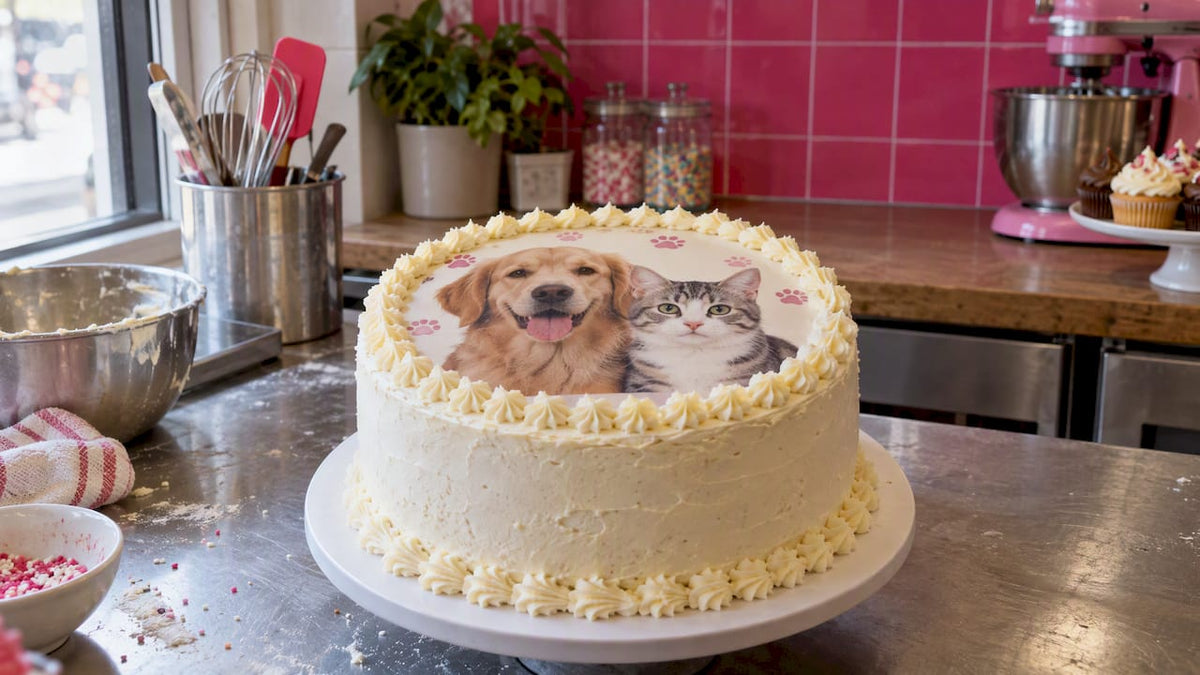
No. Sugar paper should not go in the oven, neither on its own nor already placed on the cake. It is a thin layer of sugar printed with edible inks, and heat softens it, makes the sugar melt and blurs the image. The correct step is to bake the cake, cookies or cupcakes, let them cool completely and only then apply the sheet. In this guide we explain why, show how to apply it to each type of frosting and give the rules that make the difference when the weather is humid, which is when sugar paper suffers the most.
In summary
- Sugar paper is always applied after baking and after the cake has cooled. In the oven, it melts, becomes sticky and the image loses definition.
- Do not confuse sugar paper with baking paper (parchment paper). Baking paper is used to line baking sheets; sugar paper is an edible decoration.
- Humidity is the sheet's greatest enemy: keep it in the original packaging, tightly closed, away from the refrigerator and heat sources.
- On humid days, apply the sheet as close as possible to serving time and avoid very wet frostings underneath.
- A sheet that has become soft or stuck to the backing almost always recovers with a few minutes in the freezer.
Table of Contents
- Why sugar paper does not go in the oven
- Sugar paper, baking paper and wafer: do not confuse
- How to apply sugar paper after baking
- Sugar paper in humid weather: how to store and handle
- Soft, sticky or wrinkled sheet: how to recover
- Our experience with sugar paper and humidity
- An image designed for your cake
- Frequently asked questions
- Sources
Why sugar paper does not go in the oven
To understand what happens in the oven, it helps to know how a sheet is made. Sugar paper is a very thin film, made of sugar and starches, glued to a plastic backing that protects it until the moment of application. The image is printed on top with edible inks. It is a material designed to be used cold.
When it goes into the oven, three things happen at the same time:
- The sugar softens and melts. The sheet stops being a film and turns into a viscous layer that mixes with the surface of the cake.
- The image blurs. The inks follow the melting sugar. Faces, names and numbers lose their outline, and the colors darken or caramelize in the hottest areas.
- The plastic backing cannot withstand the temperature. If the sheet goes into the oven with the backing, it deforms and should not come into contact with hot food.
Therefore, when someone searches how to bake sugar paper, the useful answer is not a temperature or a time. It is a work order: first the oven, then cooling, and only at the end the decoration.
And residual heat?
The problem is not just the oven being on. A cake that has just come out, still warm inside, releases steam for a long time. This steam rises to the frosting and dampens the sheet from underneath, which starts to become transparent, wrinkle and slide. Wait until the cake is cold to the touch on the entire surface, including the center. In tall cakes or those with filling, this can mean several hours, or an entire night, if the cake is covered the next day.
Sugar paper, baking paper and wafer: do not confuse
Much of the confusion comes from the name. Those looking for “sugar paper oven” mostly find rolls of parchment paper to line baking sheets, which have nothing to do with decoration. Here are the differences:
| Material | What is it used for | Goes in the oven? | Is it edible? |
|---|---|---|---|
| Baking paper (parchment or silicone) | Line baking sheets and pans so the batter does not stick | Yes, it is made for that | No |
| Sugar paper | Decorate cakes, cookies and cupcakes with printed images | No | Yes |
| Wafer (rice paper or wafer paper) | Decorate, especially dry and firm surfaces | Not recommended | Yes |
Wafer is made mostly of starch and is firmer and more opaque; sugar paper is more flexible, blends better with the frosting and gives more vivid colors. Confectionery experts highlight the best resolution and stability of sugar paper compared to rice paper, which makes it the usual choice for photographs and drawings with a lot of detail. If you are undecided between the two, we have an article about the difference between wafer and rice paper that helps you choose.
A practical note: you can and should use baking paper in the process, but for something else. It is used to line the pan where the cake is baked, or as a clean surface to place the sugar paper sheet while you cut it.
How to apply sugar paper after baking
This is the method we recommend for a birthday, communion or baptism cake. It works with both rectangular sheets and discs.
- Bake and cool. The cake must be completely cold. If you are going to frost it, apply the frosting and let it set.
- Prepare the surface. The frosting should be smooth, without bubbles or crumbs. The sheet copies any irregularity that remains underneath.
- Wash and dry your hands thoroughly. Damp fingers leave marks and start to dissolve the sugar.
- Release the sheet from the backing. If the sheet is resisting, place it in the freezer for a few seconds (see below) and try again. Peel it off starting from a corner, slowly, with the sheet facing down on the counter.
- Place it without dragging. Hold the sheet by the edges, align it first on one side and lower it onto the cake. After touching the frosting, do not try to pull it, because it will tear.
- Smooth it from the center outward. With the palm of a dry hand, or with a clean spatula, push the air to the edges.
- Finish the edges. A strip of buttercream, sugar pearls or a cord of sugar paste hides the cut and gives a professional finish.
If you want to see the complete process in more detail, our guide to using sugar paper covers every step.
For each type of frosting
- Buttercream or butter cream: it is one of the best bases. Apply the sheet when the cream is still slightly soft, so it sticks without needing anything. If the cream has already hardened in the cold, brush on a very thin layer of sugar syrup or cream.
- Sugar paste (fondant): the surface is dry, so it needs help to stick. Brush lightly with water, almost dry, or with a little shine gel. Too much water melts the sheet.
- Ganache: works well after the ganache has set. If it is very shiny and greasy, the sheet may slide; wait for it to set.
- Chantilly and whipped cream: it is the hardest base, because it is very moist. Apply the sheet right before serving. If the cake is going to wait for hours in the refrigerator, choose another frosting.
- Cookies: bake and cool the cookies. Cut the sheet to size and stick it with a thin layer of royal icing or syrup. Never put the cookies back in the oven after decorating.
- Cupcakes and muffins: the small discs are applied over a low and smooth cream. A tall swirl of cream does not let the sheet set.
For the side ribbons, first apply the side with a slightly sticky cream and wrap the cake all at once, joining the ends at the back. Since the ribbons are long and thin, they are the most sensitive to humidity.
Sugar paper in humid weather: how to store and handle
Those who live near the coast, or prepare a party in a stuffy summer, know the problem: the sheet that was perfect in the morning is soft, sticky or full of waves in the afternoon. The sugar absorbs the humidity from the air, and the more humid the environment, the faster this happens.
Before using
- Keep it in the original packaging, closed. The bag protects the sheet from the air. If you open it to see the design, close it again immediately.
- Choose a cool, dry and dark place. A cabinet away from the stove, the oven, the dishwasher and the window with sun. Direct light can also fade the colors.
- Do not store the sheet in the refrigerator. The cold itself is not the problem; the problem is the condensation when taking the sheet to the kitchen, which dampens it immediately.
- Plan the date. Order with some advance notice, but do not keep the sheet for months waiting. Use it within the timeframe indicated on the packaging.
On the day of the party
- Apply it as late as possible. On a humid day, the decoration should be the last step, one or two hours before serving, if the cake can stay out of the refrigerator.
- Work in a dry area. Do not apply the sheet next to a pot on the stove or with the dishwasher open.
- Use little moisture to stick. In humid weather, the frosting already provides enough moisture. Avoid brushing with water.
- Think about the frosting. Firm buttercream and sugar paste hold up better than chantilly, mousse or fresh fruit on top.
Refrigerator after applying
If the cake has fillings that need cold, it can go into the refrigerator already decorated. Two rules: cover it with a cake box, so it does not absorb smells or humidity, and, when taking it out, leave it covered for a few minutes so that the condensation forms on the box and not on the image. Water drops on the sheet leave stains that can no longer be removed.

To protect the image for longer, or in cupcakes and cookies that will be transported, it is worth knowing the techniques for sealing edible paper, which create a thin barrier over the decoration.
Soft, sticky or wrinkled sheet: how to recover
Most problems have a solution, as long as the sheet has not yet been applied. This table summarizes the most frequent cases:
| What you see | Probable cause | What to do |
|---|---|---|
| The sheet does not peel off the backing | Humidity or heat softened the sugar | Freezer for 20 to 30 seconds, with the sheet in the bag, and peel off by the corner |
| Rigid sheet that cracks | Environment too dry | Leave for a few minutes in the closed bag at kitchen temperature before using |
| Waves or wrinkles after applying | Very moist frosting or cake still warm | Smooth gently with a dry hand; if it persists, disguise with a decorative border |
| Colors running | Too much water when sticking or condensation drops | There is no going back; next time use a very thin layer of glue |
| Sticky sheet to the touch | High air humidity | Apply immediately and avoid touching again; do not leave the sheet exposed |
The freezer trick
When the sheet is stuck to the backing and insists on not coming off, the cold restores its firmness. Place the sheet, still inside the bag or between two sheets of parchment paper, in the freezer for a few seconds, usually less than a minute. Take it out, peel it off immediately and apply it right away. Do not let it cool too much, because it becomes brittle, and do not keep it in the freezer: the idea is only to firm it up to peel it off.
What not to do
- Do not use a hair dryer to dry a soft sheet. The hot air melts the sugar and spreads the ink.
- Do not put the sheet in the oven or microwave to “dry” it. The result is the same as baking: it melts.
- Do not press with wet fingers to correct a wrinkle. It leaves a fingerprint.
Our experience with sugar paper and humidity
At FunBakery we create and ship wafers and sugar paper sheets for birthday cakes, communions, baptisms and weddings every day. The questions we receive via WhatsApp repeat themselves: “can I put the sheet on before baking?”, “why did my sheet become soft?”. Almost always, the problem is not the sheet, it is the time it was applied or the place where it was stored.
Our recommendation is simple. Treat sugar paper as the final touch, and not as an ingredient. Make the cake carefully, let it cool, prepare a smooth frosting and, only at the end, open the bag. If the party is on a hot and humid day, choose buttercream or sugar paste and apply the image close to serving time.
That is also why we give so much importance to the packaging: a resistant packaging protects the sheet from humidity and folds during transport, and it arrives at your home ready to be stored as it is. And, if you have doubts in the middle of the process, our team is available 24 hours via WhatsApp or email to help save the decoration before it is too late.
— David
An image designed for your cake
If you do not have the sheet yet, you can choose from our catalog of themes (superheroes, animals, sports, children's characters, celebrations and themes for adults) or order a custom-made image. In our custom design service, our designers combine the photograph, the name, the age and the text you want, in rectangular format, disc, for cupcakes or in side ribbons. The rectangular, round or cupcake design starts at 6 USD, and the design for ribbons from 10 USD. You can also create your design in the custom design studio, where the design for ribbons starts at 9 USD.
You can choose whether you want the image on sugar paper or wafer paper, depending on the cake's frosting. Orders over €25 have free 24-hour shipping.

Frequently Asked Questions
Can I put sugar paper on the batter before baking?
No. The heat melts the sugar in the sheet, and the image blurs or disappears into the batter. Bake first, let it cool completely, and apply the sheet to the frosting or directly to the cool surface.
How long before the party should I apply the sugar paper?
Under normal conditions, you can apply the sheet a few hours beforehand or the day before, if the cake has buttercream or fondant. On humid days or with cream frostings, apply it as close to serving time as possible so that it does not absorb moisture.
Can I store the decorated cake in the refrigerator?
Yes, as long as it is covered with a cake box. When taking it out, leave it inside the box for a few minutes so that condensation does not fall on the image. The sheet that has not yet been applied should be kept out of the refrigerator, in a cool, dry place.
Does sugar paper work on baked cookies?
It works very well, as long as the cookies are already baked and cool. Cut the sheet to size and stick it on with a thin layer of icing or syrup. The decorated cookies should not go back into the oven.
Sugar paper or wafer paper: which one withstands humidity better?
Both absorb moisture, but in different ways. Wafer paper is more rigid and tolerates dry surfaces better, while sugar paper blends with the frosting and gives more vivid colors. To compare it with other options, also see our article sugar paper vs. fondant: which one to choose.