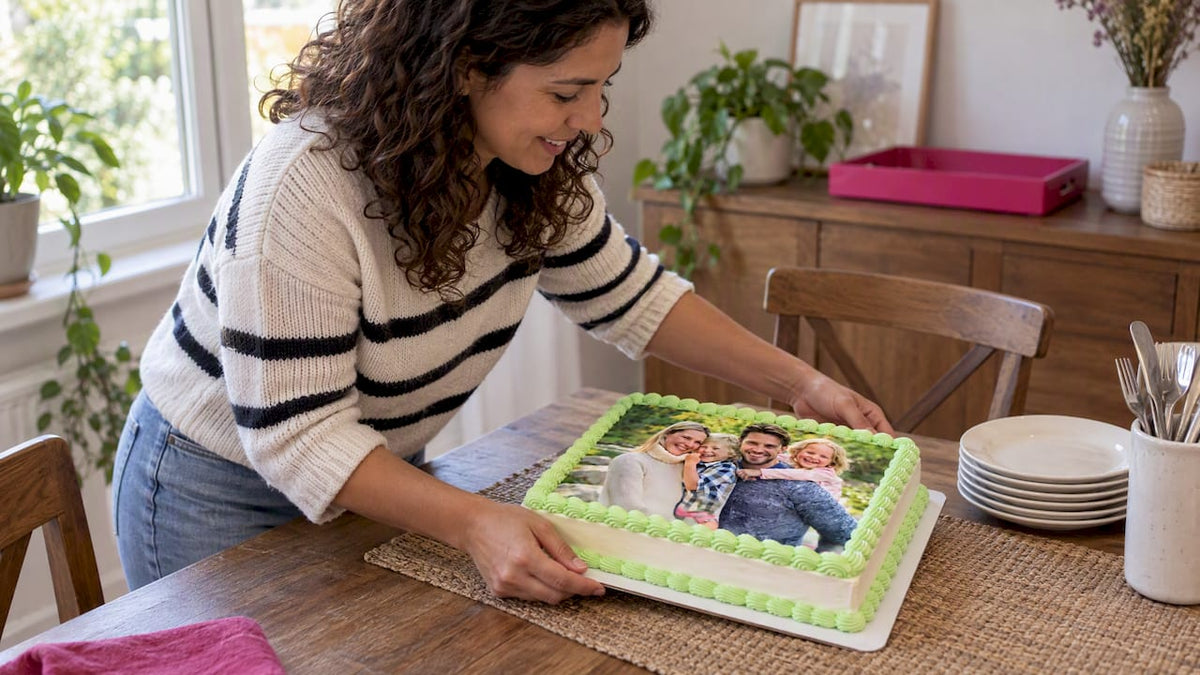
Sugar paper looks great on buttercream if you follow three rules. The cream must be very firm and cold. The paper must be placed as close to serving time as possible. And there should be as little moisture as possible between the cream and the image. When the paper wrinkles, stains, or falls apart on top of a buttercream cake, the fault is almost never the paper. It is usually soft cream, a wet surface, or a cake that has been decorated for too many hours. In this guide, we explain which buttercream holds up best, how to prepare the surface and apply the image step by step, and what sizes to choose for cupcakes, mini cupcakes, and cookies.
In summary
- Firm and cold cream: whip the buttercream when it is very cold and smooth the surface before placing the paper. In general, vegetable buttercream is more stable than plain dairy cream.
- Apply at the end: place the sugar paper after the cake comes out of the refrigerator, as close to serving time as possible.
- Without pressing too hard: place the image all at once, from the center outwards. If there is a bubble, prick it with a pin and smooth it out.
- Cupcakes and cookies: measure the top or the cutter and choose a slightly smaller disc, so there is a visible margin around it.
- Custom-made to size: if you need a specific size or image, order the design with the correct measurements.
Table of Contents
- Why buttercream is the most delicate base
- Which buttercream to choose for sugar paper
- Sugar paper or wafer paper on buttercream?
- How to apply sugar paper to buttercream, step by step
- When to place the paper and how to store the cake
- Sugar paper on buttercream cupcakes
- Sugar paper on cookies: sizes and application
- Our point of view
- Edible images to fit your cake
- Frequently asked questions
- Sources
Why buttercream is the most delicate base
Sugar paper is a thin sheet, made mainly of sugars and starches, printed with edible inks. This is precisely why it blends so well with the frosting: in contact with a slightly moist surface, it softens and takes on the appearance of an image painted directly on the cake.
However, buttercream is mostly water and fat emulsified with air. It has much more moisture than fondant or sugar paste. If the cream is soft or releasing whey, the paper absorbs that water too quickly, wrinkles, and the colors may start to run. We explain this phenomenon in detail in our article on moisture in wafers and edible paper.
The good news is that this can be controlled. You do not need to replace buttercream with another frosting. Just treat the cream as the base for a decoration: firm, smooth, cold, and without excess liquid on the surface. Anyone who has decorated cakes with fondant knows that the paper almost sticks by itself. With buttercream, all the work is in the preparation.

Which buttercream to choose for sugar paper
The buttercream stands out from simply whipped cream because of the sugar and vanilla, and that sugar gives it more body and stability for decorating. To receive sugar paper, what matters is that the cream holds its shape for hours without releasing liquid.
| Type of buttercream | Behavior with sugar paper | Practical tip |
|---|---|---|
| Whipped dairy cream with sugar | Richer flavor, but softens more quickly at room temperature | Use whipping cream, very cold, and do not over-whip it |
| Stabilized dairy cream | Holds its shape better and releases less whey | Add a stabilizer (gelatin or cream stabilizer) according to the recipe |
| Vegetable buttercream | Usually the most stable and least moist base for decorating | Whip until firm and shiny, without letting it become grainy |
| Dairy and vegetable mixture | Balance between flavor and stability | Good option for party cakes that sit on the table for a while |
Vegetable buttercream is widely used in pastry precisely because it stays firm for longer and tolerates room temperature better. For those looking for the best result with sugar paper, it is normally the easiest base to work with. Dairy cream also works very well, as long as it is stabilized and the paper is placed close to serving time.
Three precautions make a difference with any type of cream:
- Everything cold. Put the bowl and beaters in the refrigerator before whipping. Warm cream will never whip firmly.
- The right consistency. The cream should form firm peaks. If it is over-whipped, it will start to separate and release liquid, and that liquid is what ruins the paper.
- Smooth surface. Smooth the top with a spatula or scraper. An uneven surface leaves wrinkles and air pockets under the image.
Sugar paper or wafer paper on buttercream?
In our catalog you will find both materials, and both are used on buttercream cakes. The choice depends on the effect you are looking for.
| Criterion | Sugar paper | Wafer paper |
|---|---|---|
| Final appearance | Blended into the frosting, like a painted image | Firmer, with a slight relief |
| Colors and photographs | Vivid colors and lots of detail, ideal for photos | Beautiful colors, with a more matte finish |
| Flexibility | Very flexible, adapts to curved surfaces | More rigid, stays upright |
| Best use on buttercream | Smooth top of the cake, cupcakes with a flat top | Standing toppers, tall cupcakes, cut-out decorations |
If the idea is to have a clear photograph on top of the birthday cake, sugar paper is the natural choice. If you want cut-out figures stuck into the cream, wafer paper works very well because it is more rigid. To compare with other decoration options, see our guide on sugar paper vs sugar paste.
How to apply sugar paper to buttercream, step by step
This is the method that gives the most consistent results on a cake covered in buttercream.
- Cover and smooth the cake. Coat the cake with buttercream and smooth the top well. The flatter the surface, the cleaner the result.
- Refrigerate. Let the cake cool for at least 30 to 60 minutes, until the cream feels firm to the touch. A cold and firm surface absorbs less and holds the paper better.
- Prepare the paper with dry hands. Sugar paper comes on a plastic film. Cut it first, if necessary, with clean and dry scissors. Then peel off the film: if it resists, place the sheet on the edge of a table and pull the film down, or leave it in the freezer for a few seconds to peel it off more easily.
- Take the cake out of the refrigerator and apply it immediately. Hold the image by the sides, press the center against the cream first, and let the edges fall. Do not drag the paper: once it touches the cream, it cannot be removed without ruining it.
- Smooth gently. Pass a dry hand or a clean spatula over it, without pressing, from the center outwards. The goal is to remove the air, not to spread the cream.
- Remove bubbles. If an air bubble appears, make a small hole with a pin and smooth it again with the spatula.
- Hide the edges. A buttercream border around the image, made with a star tip, hides any imperfections and gives a professional finish.
A useful trick for softer dairy cream: leave the cake in the refrigerator until the surface feels almost dry to the touch. Those who want even more security can place a thin disc of sugar paste, the same size as the image, between the cream and the paper. The paper sits on a dry base and the cream does not touch it directly.
For techniques that protect the image from moisture, see our guide on how to seal edible paper. And, if you are going to decorate a cake that still needs to go into the oven, read what we explain about sugar paper in the oven.
When to place the paper and how to store the cake
The golden rule is simple: sugar paper goes on at the end. On a buttercream cake, place the image as close to serving time as possible, ideally with the cake already assembled, decorated, and ready for the table.
The refrigerator is a delicate point. A buttercream cake needs cold to be stored safely. However, the refrigerator is moist, and when you take the cake out, condensation forms on the surface, which can make the paper look wet or cause the colors to run. Therefore, the correct order is:
- Assemble and cover the cake in advance and store it in the refrigerator without the image.
- Take it out, apply the paper, and serve.
- If you have to refrigerate the already decorated cake again, store it in a closed cake box, away from moist foods. When you take it out, leave the box closed for a few minutes before opening it, so that the condensation forms in the box and not on the image.
With cream, food safety always comes first: do not leave a buttercream cake out of the cold for many hours, especially on hot days. If the cake is for a party away from home, take the image separately, stored in a dry and cool place inside the packaging, and apply it there.
Before using, store the sugar paper closed, in a dry place, away from light and heat, never in the refrigerator.
Sugar paper on buttercream cupcakes
Cupcakes are one of the most beautiful ways to use sugar paper, especially at birthday parties and communions, where each guest receives their little cake with the character or the birthday person's name.
How to choose the size of the disc
Measure the diameter of the top of the cupcake paper mold, not the base. The disc should be slightly smaller, to leave a margin of buttercream around it. Visually, this margin frames the image and prevents the edges of the paper from hanging in the air. The same rule applies to mini cupcakes: measure the top and choose a proportional disc. Very small discs call for simple images, with a face, a number, or an initial, because the detail gets lost.
How to apply to the cupcake
Sugar paper needs a relatively flat surface. Instead of a tall swirl of buttercream, make a smooth and slightly domed layer with a spatula, or dip the top of the cupcake in a disc of cream and smooth it. Refrigerate until the cream is firm and place the disc at the end, just like on the cake.
Tall cupcakes with a swirl of cream
If you want to keep the tall swirl of buttercream, there are two solutions. The first is to place the sugar paper disc on a thin circle of sugar paste and lean it against the swirl. The second is to use wafer paper as a topper stuck into the cream, because it stays upright. Both add volume without sacrificing the image.

Sugar paper on cookies: sizes and application
On cookies, sugar paper almost never goes over buttercream, but the logic is the same: smooth base, controlled moisture, and well-measured size.
Which size to choose
Measure the cutter you will use. For round cookies, choose a disc a few millimeters smaller than the already baked cookie, because the dough can grow or deform a little in the oven. For rectangular or specially shaped cookies, the safest thing is to order the image with the exact measurements of the cookie. This is what our custom design service is for.
Cookies with icing
Cover the cookie with royal icing and place the paper while the icing is still fresh. The moisture of the icing is enough to stick the image. If the icing has already dried, pass a very thin layer of diluted icing or water with an almost dry brush and apply it immediately. Then let it air dry.
Gingerbread cookies
Gingerbread cookies have a rougher surface and, very often, already come decorated with outlines. First make a smooth icing background in the area where the image will go and only then apply the paper. On Christmas cookies with figure shapes, a small disc with a face or a name in the center looks very beautiful. The icing outline hides the edges.
Our point of view
At FunBakery, we see every day that the result of a cake with an edible image depends as much on the image as on the way to apply it. Buttercream is the preferred frosting of many families, and there is no reason to give it up just because you want a photograph or the child's favorite character on top of the cake.
We believe that the secret is to think about the image before making the cake. When you know the size of the mold, the type of cream, and the time you will serve it, you can order a design that fits perfectly: a disc of the right diameter for the cake, discs for cupcakes the size of the top, or ribbons for the side. Our designers prepare the image with photographs, names, ages, and text, so that it arrives at your home ready to apply and with a professional finish.
We also learn that it is worth taking your time at the final moment. A cold cake, a smooth surface, and thirty seconds of attention when placing the paper make all the difference. If you have doubts before ordering or when applying, our team answers via WhatsApp or email at any time.
— David
Edible images to fit your cake
If you already know the size of your cake, cupcakes, or cookies, you can order a ready-to-apply image. In our custom design service, we create the image on sugar paper or wafer paper, with the photo, name, and age of your choice. The rectangular, round, and cupcake designs start at 6 USD, and the banner designs start at 10 USD.

Prefer to start with a specific format? In the custom design studio, you can find rectangular, round, and cupcake designs starting at 6 USD, and banner designs starting at 9 USD. In Spain, orders over 25 € have free 24-hour shipping in sturdy packaging so that the image arrives intact. We also have ready-made themed designs, such as the Barbie edible image. For more ideas, see our guide to using sugar paper on custom cakes.
Frequently Asked Questions
Can I put sugar paper on whipped cream the day before?
It is not ideal. Due to the moisture from the cream and the condensation in the refrigerator overnight, the paper tends to soften and the colors may run. Prepare the cake the day before without the image and apply the sugar paper on the day, as close as possible to serving time.
What is the best whipped cream for sugar paper?
Generally, vegetable-based whipped cream or stabilized dairy cream, because they hold their shape and release less liquid. The most important thing is that the cream is very firm, cold, and has a smooth surface when you place the image.
The sugar paper wrinkled on the whipped cream. Can it be saved?
If they are small bubbles, prick them with a pin and smooth them with a dry spatula. If the image is already very wet, do not try to move it, because it will tear. A whipped cream border made with a star tip around the image hides the edges well.
What size sugar paper should I order for cupcakes and cookies?
Measure the top of the cupcake mold or the cookie cutter and choose a slightly smaller disc, to leave a visible margin. If the measurements are unusual, order a custom design with the exact size.