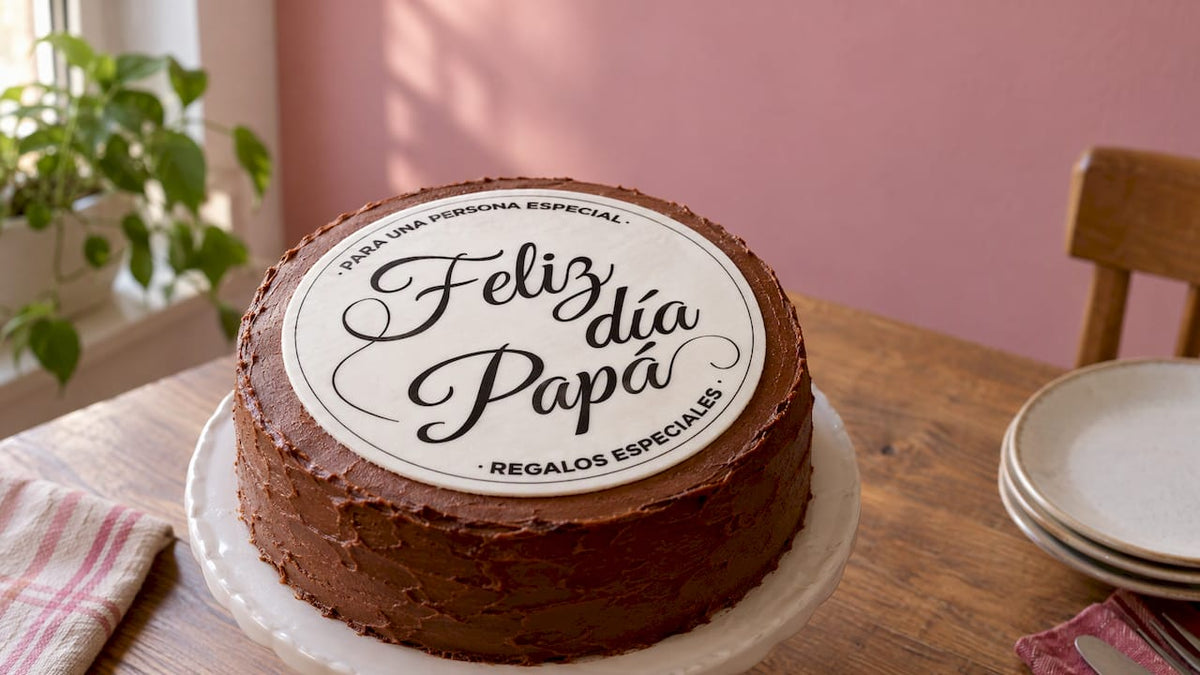
A good birthday color palette has two main colors, an accent, and a neutral. It is repeated throughout the party and culminates in the cake, where all eyes (and all photographs) will land. In this guide, you will find tried-and-tested combinations by age, theme, and season, how to distribute them without overwhelming the decor, and how to complete the circle with a cake that uses exactly those colors. For us, here is the deciding point: a personalized edible image, designed in the colors of your palette and with the name and age of the birthday person, connects the entire decor to the center of the table.
In summary
- Limit the palette to three colors and a neutral: two main shades, an accent for the details, and white, cream, or beige to give the eye a rest.
- Choose the colors based on the birthday person: their favorite theme, character, sport, or color.
- For the little ones, use few colors. From 4 to 7 years, bright colors. For teenagers and adults, one or two shades with a metallic.
- Repeat the palette in all elements: tablecloth, balloons, invitations, plates, sweets, and cake.
- The cake is the focal point. A personalized wafer or sugar paper brings the palette, the name, and the age to the center of the table without needing baking skills.
Table of Contents
- How to build a palette that works
- Combinations by age and type of party
- Palettes according to the season
- Choosing the palette based on the birthday person
- Bringing the same palette to the table, the balloons, and the invitations
- The cake: where the palette is won or lost
- The cake of your party, in the colors of your party
- Our vision
- Frequently asked questions
- Sources
How to build a palette that works
A palette is simply the small set of colors that determines how the party will look. The shorter, the better it works. The safest formula for a party at home is this:
- Two main colors. They occupy the large surfaces: tablecloth, balloon arches, dessert table backdrop.
- An accent. A stronger or metallic color (gold, fuchsia, teal) used in small doses: napkins, bows, candles, name letters.
- A neutral. White, pearl white, cream, beige, or sand. It separates the colors and avoids that "everything at once" effect.
To choose colors that match, it helps to know the color wheel, the disk that orders the colors of the rainbow. Complementary colors are diametrically opposite on the wheel, like blue and orange or yellow and violet, and create contrast and energy. Analogous colors are side by side (yellow, orange, and coral, for example) and give a soft and harmonious result.
In practice:
- Party with a lot of energy (children's, sports, summer): two complementary as main colors and a light neutral.
- Elegant or delicate party (adult birthday, communion, baptism): analogous or shades of the same color, plus a metallic.
- Where it usually goes wrong: combining five or six bright colors in equal amounts. None stand out and the table loses strength in photographs. When in doubt, remove one color and reinforce the neutral.
The most intense shades work best in small quantities. That is why the advice for fairy children's palettes is to reserve the strong colors for details and let the pastel and white occupy the larger space.
Combinations by age and type of party
Age changes everything. Until age 3, the child will not notice sophisticated contrasts, but adults will photograph the table: one color with white (blue and white, pink and white) is the cleanest choice. From 4 to 7 years, children want to recognize the character and their colors, and that is where bright colors make sense. In adolescence, the goal becomes a photogenic table, with one or two shades and little else.
| Occasion | Palette | Effect |
|---|---|---|
| 1st birthday and up to 3 years | White and baby blue, or white and pink | Clean and calm |
| Children's fairy party | Pastel pink, sage green, white or beige, and golden touches | Delicate and magical |
| Cheerful children's party | Pink, lilac, pastel yellow, green, and white | Fun without tiring |
| Soccer | Grass green, white, and black | Recognizable at first glance |
| "Nature" or safari party | Mint green, sand, earth tones, and white | Warm and relaxed |
| Teddy bear | Beige, cream, and light brown | Cute and neutral |
| Soft pastel | Pink, lilac, and mint | Light, ideal for girls |
| Romantic birthday | Rose gold, nude, and white | Modern and luminous |
| 15th birthday | Pink and gold, lilac and silver, emerald green and champagne | Gala party |
| Night party (adults) | Black, gold, and white | Elegant and striking |
| Round ages (30, 40, 50) | White, nude, and a metallic, or burgundy and cream | Sober and festive |
| Communion or baptism | White, cream, and gold, or white and baby blue | Serene and classic |
| Wedding or anniversary | Navy blue, gold, and white | Timeless |
Children's characters bring the palette already made. A Bluey party, for example, lives on light and dark blues with orange and yellow as an accent. When the child chooses the character, the palette is chosen: just add a neutral and repeat those colors in everything.
For a girl's birthday who doesn't want "just pink", try dusty pink with sage green and white, or lilac with mint and a golden touch. They are feminine palettes, but with more personality than pink alone.

Palettes according to the season
The season of the year gives a very useful clue, especially for adult or outdoor parties. The GlobyShop color guide by season proposes:
- Spring: pastel pink, fuchsia, mint green, turquoise, soft yellow, and lavender.
- Summer: coral, turquoise, navy blue, lemon yellow, and orange.
- Autumn: terracotta, mustard, chocolate brown, and olive green.
- Winter: white and silver, gold and black, dark blue, or intense red.
Do not use the entire list of a season: choose two colors from it, an accent, and a neutral. An October birthday with terracotta, cream, and olive green feels cozy. A July pool party with coral, turquoise, and white feels fresh and cheerful.
Choosing the palette based on the birthday person
The most common mistake is starting with shopping: a beautiful pack of balloons, some sale tablecloths, and the palette is born randomly. The right way is the opposite.
- Ask the birthday person. The favorite character, the soccer club, the hobby, the favorite color. The party must be recognized as "theirs", not just look beautiful in photographs.
- Define the central element. Normally it is the cake, or the design that goes on the cake. The colors of that design become the party's palette.
- Take two main colors and an accent from that element and add a neutral.
- Only then buy balloons, tablecloths, plates, and invitations, already with the list of colors in hand (or a photograph of the design on your phone).
Starting with the cake has a practical advantage: it is the only element that all guests look at closely, that appears in all the "happy birthday" photographs, and that the child will remember. If the cake image has the colors of the party, the entire decor seems thoughtfully planned. Involving the child in the design choice is also half the fun. In our guide to themed birthday cakes by age you will find ideas for every stage.
Bringing the same palette to the table, the balloons, and the invitations
A palette is only noticeable when it is repeated. Here is how to distribute it, element by element:
- Invitations: they are the first sign of the party. Use the neutral for the background, the name and age in a main color, and a detail in the accent.
- Table: plain tablecloth in the dominant color or the neutral, table runner or placemats in the accent. Create two or three heights (cake stands, covered boxes, trays) so the table does not look flat.
- Balloons: the element with the most color area, so that is where proportion matters most. More balloons in the main colors, few in the accent.
- Plates, cups, and napkins: can be in the neutral, with napkins in the accent.
- Sweets: choose five or six types in palette colors and place the cake at the highest point, the large jars in the back, and the small ones in front.
- Cupcakes, muffins, and cookies: they are the extension of the cake. Repeating the same design on them, in a small size, gives that "catalog" party feeling. You have more ideas in our tips for decorating cupcakes.
Where it usually goes wrong: the cake arrives from the bakery or comes out of the oven in a shade that has nothing to do with the rest, or with a generic character in other colors. Everything else matches and the center of the table stands out.
The cake: where the palette is won or lost
Painting a cake by hand in the exact colors of the party requires practice with food coloring, fondant, and time, which is precisely what is missing on the eve of a birthday. An edible image solves this: it is a wafer or sugar paper sheet printed with the design, which is placed on top of the cake, cupcakes, or cookies.
For the image to work in favor of the palette, follow these steps:
- Choose the design with the colors of the party in mind. In our catalog there are children's characters, superheroes, animals, sports, celebrations, hobbies, and themes for adults. If none fit, our designers create any image to order.
- Indicate what you want to personalize: name, age, a phrase, and, if you want, a photograph. In the personalized design service we put everything together in a single image, with a professional finish, and you can ask that the design use the colors of your palette.
- Choose the right format for the cake: rectangular, round (disc), for cupcakes, or in strips for the side of the cake. The strips are a simple way to repeat the accent around the cake. See how in the guide to colored borders with edible photo.
- Order with a margin. So that everything arrives on time, account for the shipping time and take care of the design before buying the rest of the decor. Thus, the cake becomes the color reference for everything else.
If you are still deciding between wafer and sugar paper, we explain the differences in our guide about edible paper for birthdays.
The cake of your party, in the colors of your party
At FunBakery we create personalized edible wafers and sugar paper for cakes, tarts, cookies, and cupcakes. You have hundreds of ready-made themed designs and a custom design service where our designers incorporate photographs, names, ages, and texts. The rectangular, round, or cupcake design costs from 6 USD, and the design for strips from 9 USD.

Shipping is free in 24 hours on orders over 25 €, in a resistant packaging, and we answer any questions 24 hours a day via WhatsApp or email. Start with the personalized design studio and tell us the colors of your palette.
Our vision
Who organizes a party usually thinks first about the balloons and only at the end about the cake. We argue the opposite: the cake is the only element of the decor that is eaten, that is photographed up close, and that stays in the memory of the birthday person. It makes sense that it dictates the palette.
A personalized edible image is the simplest way to achieve this. You do not need to know how to work with fondant or get the food coloring right: choose the theme, add the name, age, or a photograph, and our designers transform that into a unique image, with a professional finish, ready to place on the cake, cupcakes, or cookies.
And when the cake, the sweets, and the table speak the same color language, the party seems made by a professional, even when it was prepared in the kitchen at home.
David
Frequently asked questions
How many colors should a birthday palette have?
Three colors and one neutral is the perfect balance: two main colors for the large surfaces, an accent color for the details, and white, cream, or beige to separate them. With more colors, none stand out and the table looks cluttered in photographs.
What colors work well for a girl's birthday party?
Pink, lilac, and mint for a soft result; rose gold, nude, and white for something more modern; or dusty pink with sage green and white to move away from "just pink." If she has a favorite character, use that character's colors as a starting point.
How can I make the cake match the decorations?
Choose the cake design first and draw the party colors from it, or order a custom design in the colors you have already chosen. An edible image or sugar paper with the birthday person's name and age, repeated in small dots on the cupcakes, ties the cake to the rest of the table.
What color palette should I use for a First Communion or a baptism?
White and cream with a touch of gold is the most classic combination, and white with baby blue or light pink works very well for a baptism. These are occasions where fewer colors convey a greater sense of serenity.
Sources
- La Nube Artística: complementary and analogous colors
- Eli Decor: the best colors for a children's fairy-themed party
- Tucán Fiestas: birthday decorations with balloons
- Events El Cobertizo: 15th birthday party decorations
- GlobyShop: color guide for parties by season
Recommendations
- Party design examples: ideas for 2026
- Theme birthday cake: ideas by age and how to personalize it
- Children's birthday inspiration: practical guide 2026
- Personalization at birthday parties: practical guide
Thank you for reading! 🎂
At FunBakery, we love helping you add a special touch to your celebrations. That's why we're giving you a 10% discount on your next order at funbakery.es. Just enter the code: funbakery10 at checkout.
Personalize your edible cake image with your favorite photo, a name, or the design you like best. Make your next celebration even sweeter! ✨