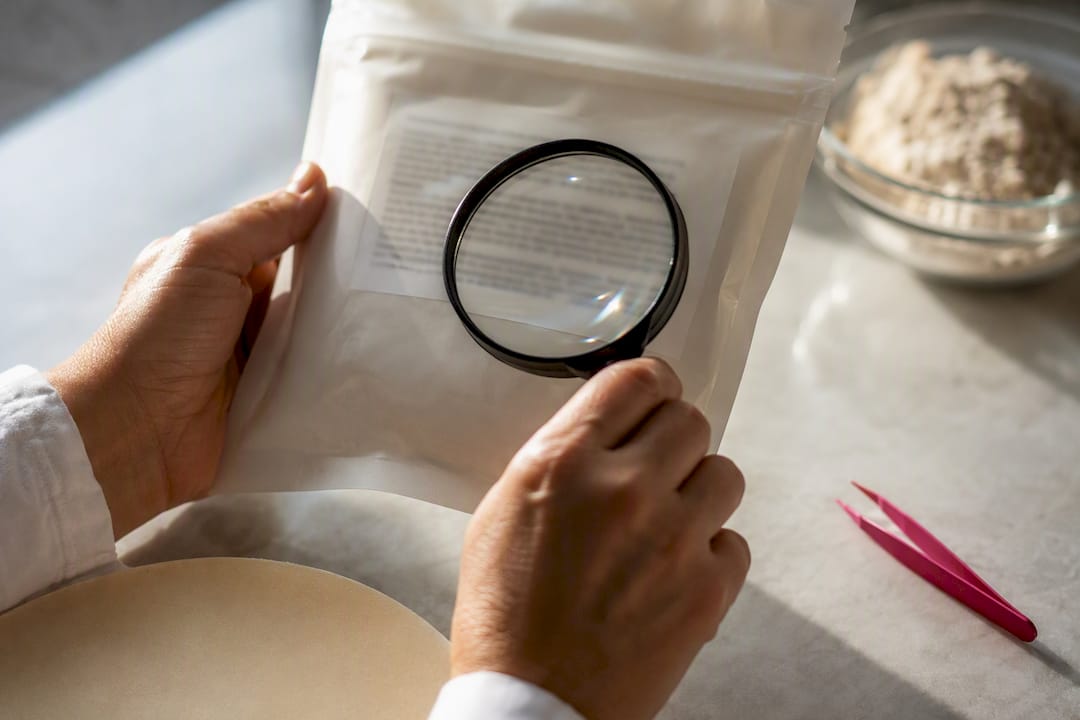
Use inert food materials, such as certified wafer paper, food-grade PLA film, or reinforced barrier cellulose, always with clear labeling and compliance with Regulation (EC) 1935/2004. The exact choice depends on whether the product is sold pre-packaged or applied by the end customer at home, but the legal requirement for chemical inertness and good manufacturing practices, established in Regulation (EC) 2023/2006, is non-negotiable in either case.
In summary:
- Inert materials used in the packaging of edible wafers must comply with Regulation (EC) 1935/2004 and have a declaration of conformity from the manufacturer.
- Biodegradable materials have limitations in moisture, light, and temperature resistance, requiring specific protection solutions during transport.
- Legal compliance requires migration testing and clear labeling, including allergen indications and net weight, in the national language.
- The choice between compostable or recyclable materials should follow the availability of approved and certified treatment infrastructures (EN 13432).
- It is recommended to request all technical documentation, certificates, and tests before deciding on the packaging supplier to ensure safety and efficiency.
Table of Contents
- Practical materials and formats for edible wafer packaging
- Legal compliance: food safety checklist for wafer packaging
- How packaging affects the durability and safety of wafers
- Compostable or recyclable: what is the right destination for wafer packaging
- Checklist for choosing the right packaging for edible wafers
- What Funbakery's experience teaches about this type of packaging
- Personalize your edible wafer with the right packaging
- Sources
Practical materials and formats for edible wafer packaging
Each edible or biodegradable material behaves differently with moisture, light, and pressure, and this difference determines whether the wafer reaches the consumer intact or falls apart in the box.
Starch (from corn or potato) forms thin, economical, and biodegradable films, but absorbs moisture easily and loses rigidity in environments with more than 60% relative humidity. Wafer paper or rice paper, the traditional base for these decorations, is extremely sensitive to water and requires almost complete isolation from ambient air before use. PLA (polylactic acid) offers greater mechanical resistance and some transparency, approaching the performance of conventional plastic, although its heat tolerance is low: it softens near 55-60°C. Treated cellulose has good tear resistance, but on its own does not block water vapor well, something that scientific reviews on biopolymers confirm is a common limitation for almost all materials in this family.
These weaknesses require practical workarounds:
- Protective sheets placed between layers of printed wafer to prevent direct contact and moisture transfer.
- Inert barrier films, applied only to the outside of the packaging, never in direct contact with the edible surface.
- Rigid cardboard packaging with internal dividers, essential for shipping orders with multiple personalized units.
- Individual sealed envelope for single pieces or those with high decorative value, such as those used on birthday cakes.
The right format depends on the volume and destination: a bakery that buys in bulk benefits from cardboard packaging with dividers, while an individual who orders a personalized wafer online needs a crush-resistant individual envelope.
Professional tip: Always store packaged wafers between 15°C and 20°C, with relative humidity below 50%. Above this value, even a material with a good barrier begins to lose rigidity within a few days.
Those looking to learn more about the edible wafer printing process will find additional guidance on which surfaces accept edible ink without risking staining during storage.
Legal compliance: food safety checklist for wafer packaging
No material comes into contact with an edible wafer without first passing through the European legal sieve. The starting point is always the same: Regulation (EC) 1935/2004 requires that no packaging component transfers substances to food in quantities that endanger health or alter the taste and appearance of the product. This regulation is joined by the obligation of good manufacturing practices, established in Regulation (EC) 2023/2006, which requires documented quality control systems throughout the entire production chain.
A minimum checklist before accepting or specifying an edible packaging supplier should include:
- Written confirmation that the material complies with Regulation (EC) 1935/2004 and has a declaration of conformity.
- Migration test results specific to the type of food and intended contact time, a requirement reinforced by Regulation (EU) 2025/351 for plastic and multi-layer materials.
- Labeling in Portuguese (or Spanish, in the case of the Spanish market), with net weight, visible allergens, and clear usage instructions.
- EN 13432 certificate whenever compostability is claimed, without which the claim lacks technical validity.
Labeling is not a cosmetic detail. The Spanish technical-sanitary regulations applicable to confectionery and pastry products set a limited weight tolerance and require that the packaging adequately protects the product until consumption. This means that an undersized box or an envelope that is too thin can, in itself, constitute a non-compliance, regardless of the quality of the material used.
There is also a common trap: assuming that “plant-based origin” equals “safe”. AESAN warns that materials such as bamboo or straw are not automatically authorized for food contact without prior assessment, and that the absence of EFSA assessment makes the material technically non-compliant, no matter how “natural” it may seem on the label.
How packaging affects the durability and safety of wafers
The edible wafer is a living product from a physicochemical point of view: it reacts to moisture, oxygen, and contact with fats from the decoration itself. Three mechanisms explain most of the failures seen in poorly packaged orders:
- Moisture absorption, which softens the structure and ruins the print in a few hours if the packaging does not close hermetically.
- Exposure to oxygen, which accelerates the oxidation of edible dyes and fades the decoration before the use-by date.
- Fat migration, common when the wafer comes into direct contact with creams or frostings before final application, which compromises both the texture and the legibility of the printed image.
Prevention involves simple but systematic solutions: protective sheets between layers, food-grade lacquers that seal the printed surface without altering the taste, and rigid dividers that prevent friction during transport. For products with printed decorations, the most reliable practice is to test the ink's resistance after a period of simulated storage in high temperature and humidity conditions, complemented by dye transfer tests.
Professional tip: If the decorated wafer is traveling for more than 48 hours before reaching the customer, always opt for packaging with hermetic sealing and a rigid outer layer. The extra cost is minimal compared to the risk of resending the product.
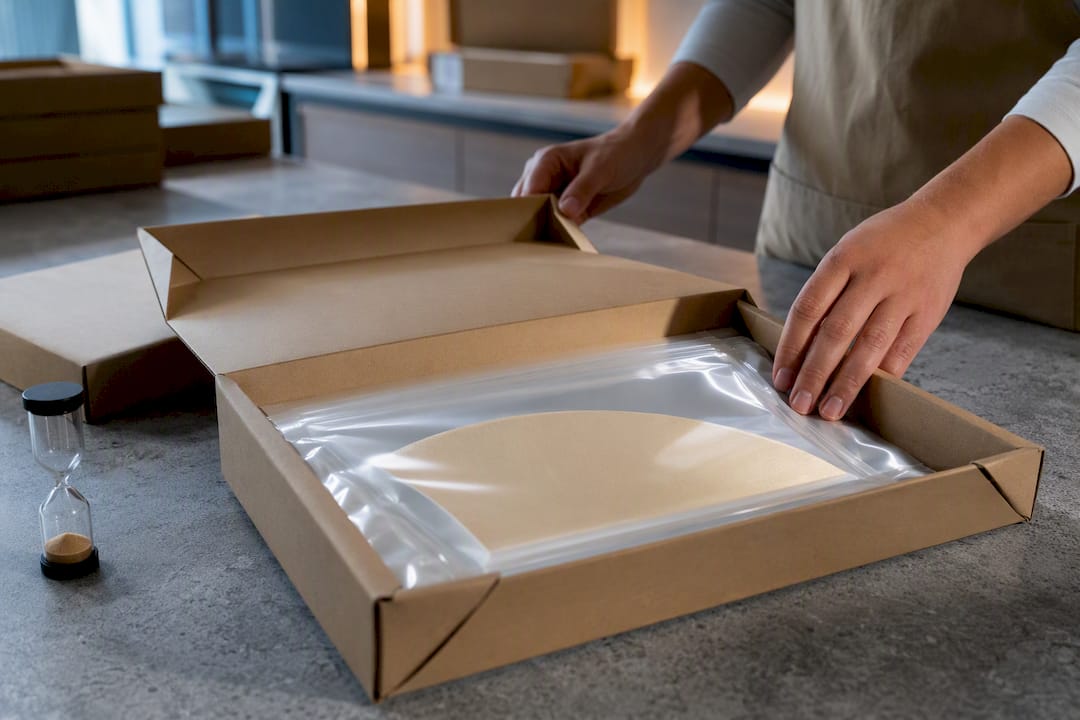
Traceability closes the safety cycle. A production line shared between different designs requires regular documentation of allergen analyses and, when there is a risk of cross-contamination, the inclusion of “may contain” statements on the label. This point is directly linked to the good practices described in the guide on food safety in edible toppers, where allergen management is covered in more detail.
Compostable or recyclable: what is the right destination for wafer packaging
Compostable and recyclable are not synonyms, and confusing the two terms on the label is an error that can mislead the consumer and generate contamination in treatment flows. A compostable material only fulfills its environmental function if there is a compatible industrial or domestic treatment route, certified according to the EN 13432 standard, which defines the criteria for disintegration and the absence of toxic residues. A recyclable material, on the other hand, depends on a selective collection infrastructure already installed in the region where the product is sold.
Regulation (EU) 2025/40 comes to tighten this balance: it prioritizes recyclability over compostability and limits the use of biodegradable polymers to contexts where there is no viable recyclable alternative, expressly recommending EN 13432 as a technical reference.
In practice, this translates into simple criteria for choosing:
- Prefer compostable for small single-dose packages intended to join the domestic bio-waste collection, where that route already exists.
- Prefer recyclable when the packaging volume is larger and the region has effective selective collection of paper or plastic.
- Avoid mixing the two concepts on the same label without clearly indicating which of the routes applies to that specific packaging.
A poorly labeled biodegradable material can end up contaminating an entire recycling batch, which nullifies the environmental benefit that motivated the choice in the first place.
Checklist for choosing the right packaging for edible wafers
Before closing a packaging order with any supplier, it is worth organizing the decision by priority: safety first, then preservation, then sustainability, and only at the end, cost.
- Always request the certificate of conformity with Regulation (EC) 1935/2004 and the results of the migration tests applicable to the type of food.
- Confirm the weight tolerances and labeling requirements provided by the technical-sanitary legislation of the destination market.
- Demand concrete technical specifications: barrier thickness, moisture resistance in percentage, and recommended maximum storage temperature.
- Request the EN 13432 certificate whenever the material is presented as compostable.
- Keep all documentation (technical sheets, certificates, test reports) in an accessible file for eventual audits or complaints.
Professional tip: Never accept the word “biodegradable” in isolation in a quote. Always ask for the standard number and the certifying entity; without that, it is just a marketing promise.
What Funbakery's experience teaches about this type of packaging
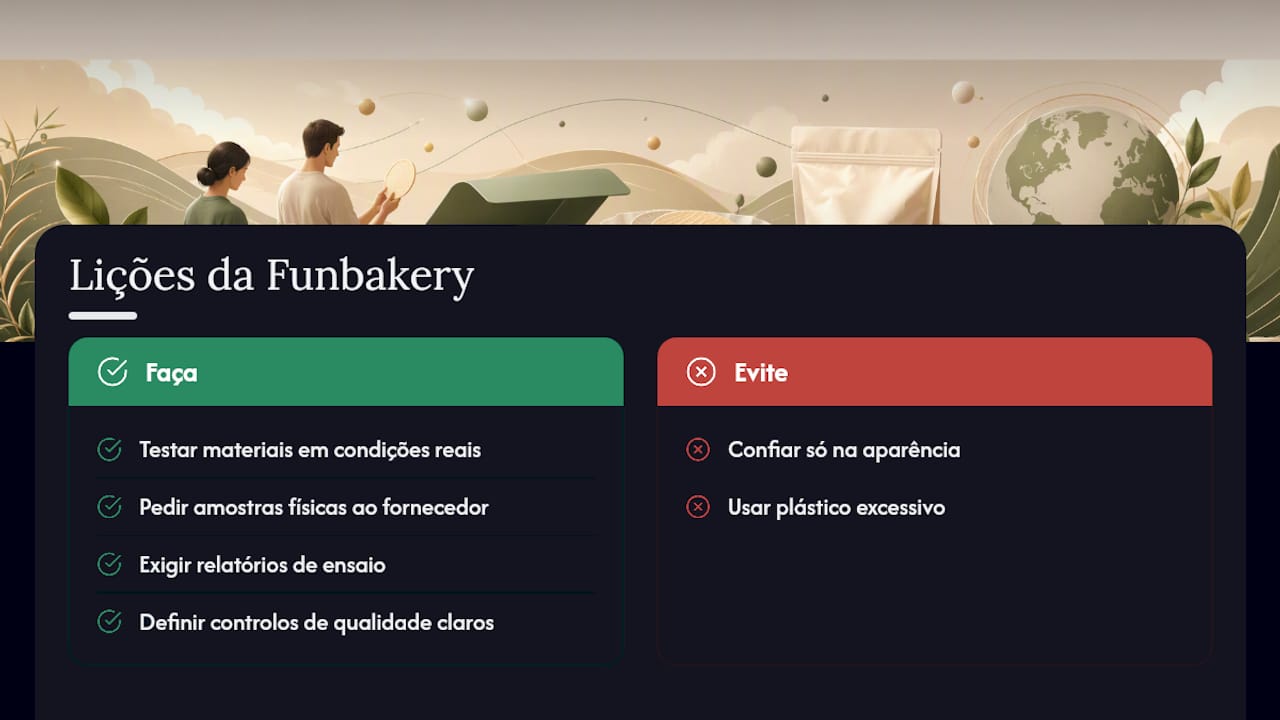
The daily production of personalized edible wafers and sugar paper requires testing, in practice, exactly the compromises described above: a material that protects the print without compromising the edible texture, and packaging that survives transport without resorting to excessive plastic. Funbakery builds its quality controls around this real tension between durability and simplicity.
It is always worth asking any supplier for concrete evidence, including physical samples and test reports, before assuming that a packaging “looks resistant” to the eye.
— David
Personalize your edible wafer with the right packaging
Ordering a personalized edible wafer implies thinking about the packaging from the very beginning, not as a final detail. Creating custom wafers and sugar paper, with photos, names, and dates incorporated into the design, and taking care of how each piece travels to the customer's home are important steps in this process.
When ordering, always ask for the technical sheet of the material used, the storage instructions, and the labeling information corresponding to the chosen product, especially if the destination is professional resale. This care avoids surprises on the day of the event and ensures that the decoration arrives as clear as it was designed. To start, visit the customization page of a Stumble Guys wafer with photo and name and choose the format that best protects your order until the day of the party.
Sources
- Food safety & safe food contact materials - EUR-Lex
- Materials in contact with food - AESAN
- Royal Decree 2419/1978 - BOE
- Biodegradable packaging: a sustainable alternative… - Gastronomía & Cía