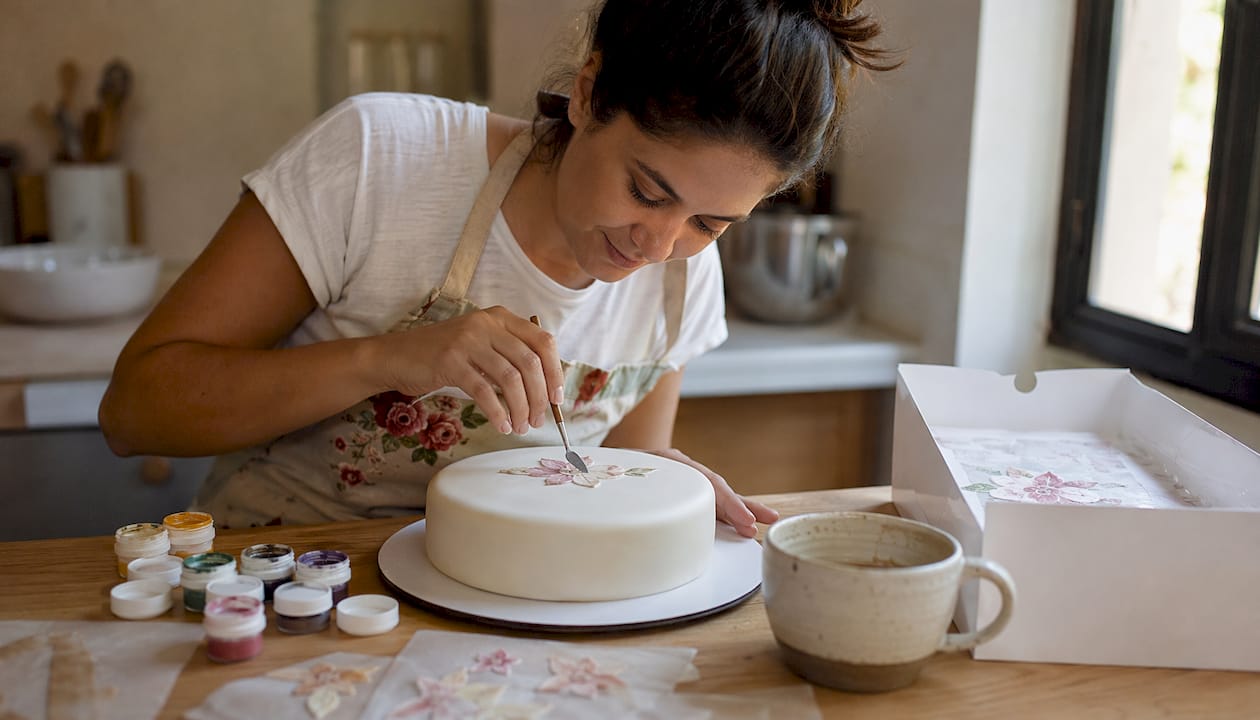
In summary:
- The most popular motifs for decorating cakes with sugar paper are children's characters, realistic flowers, geometric designs, personalized photos, and sports themes. They work because they combine high visual contrast with recognizable shapes that are faithfully reproduced on icings such as fondant or ganache. Choosing the right material and design will ensure a professional and eye-catching finish for every occasion.
The most popular motifs for decorating cakes with edible sugar paper are children's characters, realistic flowers, geometric designs, personalized photos, and hobby or sports themes. They work because they combine high visual contrast with recognizable shapes that edible printing faithfully reproduces, especially on fondant or ganache. Sugar paper is a flexible sheet of starch and sugar with a light vanilla flavor that adheres well to different icings and allows for professional-quality finishes.
The motifs that work best share three characteristics: simple silhouettes, color contrast, and adaptability to different cut sizes. A birthday photo with a clean background, a superhero on a white background, or a bouquet of peonies with saturated colors look just as good on an 8 cm circular cupcake topper as on a 20×15 cm rectangle for a medium cake.
The most popular designs on edible sugar paper:
- Characters from series and video games (Minecraft, Roblox, Stumble Guys, Marvel and DC superheroes)
- Personal photos with name and age for birthdays
- Realistic flowers: peonies, roses, sunflowers
- Geometric patterns and pastel watercolors
- Sports themes: football, basketball, cycling
- Animals and wildlife: unicorns, dinosaurs, pets
- Seasonal motifs: Christmas, Halloween, Valentine's Day
- Adult hobbies: music, travel, gaming, gastronomy
Table of Contents
- What motif to choose based on the occasion and recipient?
- Sugar paper or wafer paper: which one is best suited to your design?
- Six criteria for choosing the right motif before printing
- How to apply sugar paper and what details to include in your order
- Ingredients, allergens, and food safety
- Specific ideas for motifs and recommended sizes
- Technical requirements for preparing your image file
- How to store sugar paper before using it
- Key points
- What no one tells you about choosing motifs for sugar paper
- Funbakery: personalized motifs ready to order
- Useful sources and recommended reading
What motif to choose based on the occasion and recipient?
The type of event almost always determines the design style. A first birthday cake is not the same as a wedding cake or a retirement celebration.
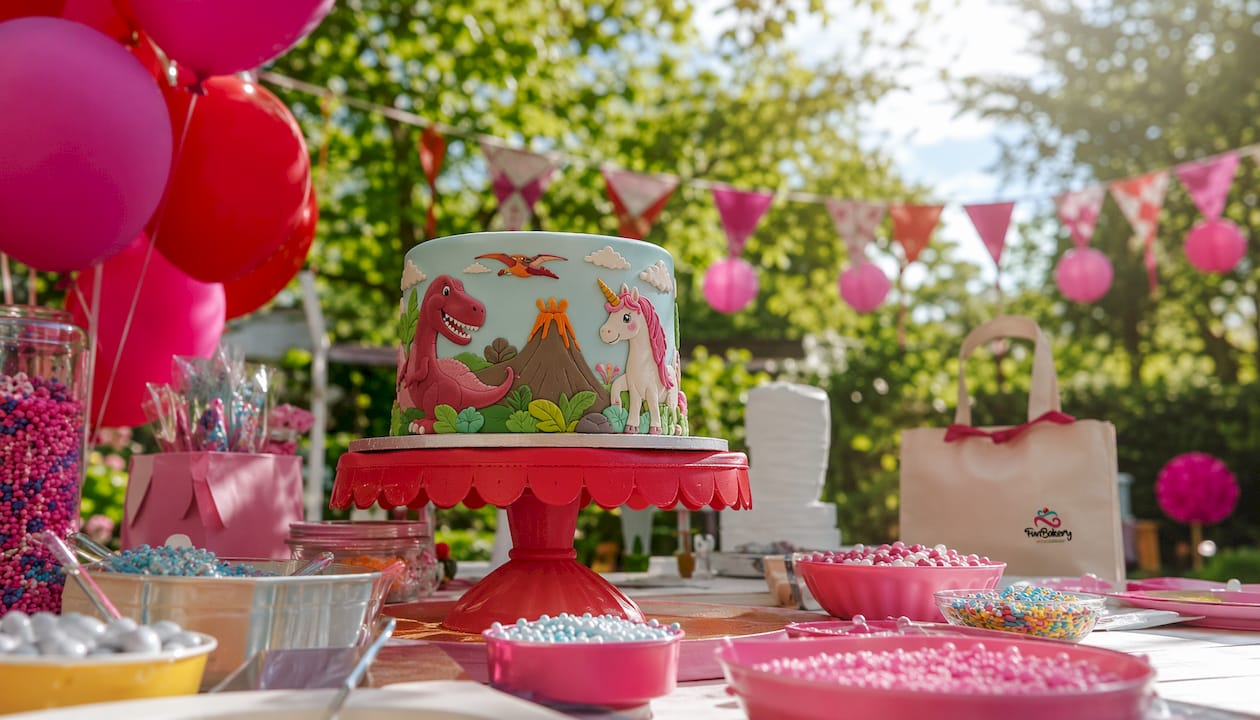
Children's birthdays (ages 2–12): popular characters, dinosaurs, unicorns, or a photo of the child with their name and age. Bright colors and white or light backgrounds ensure readability even on small cakes. For the most special birthdays, combining the photo with the child's favorite character is the most popular choice for families.
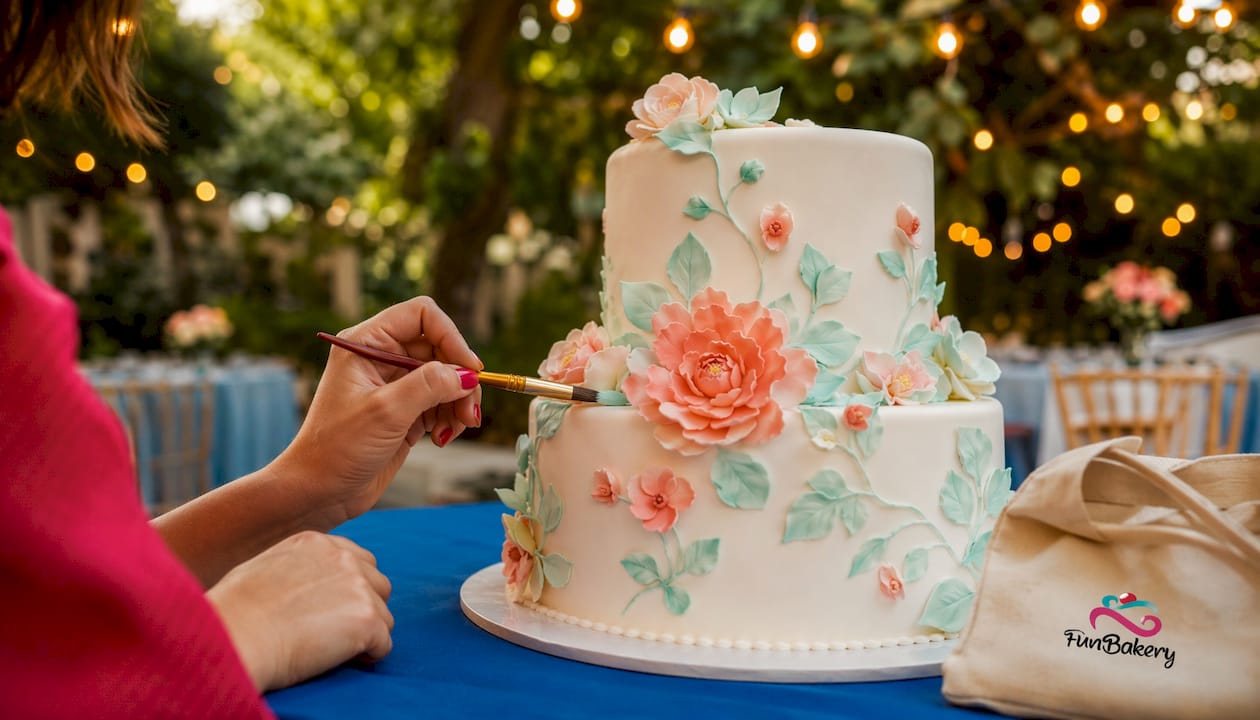
Weddings and anniversaries: delicate floral motifs, elegant typography, watercolors in nude or gold tones. Sugar paper at weddings allows the bride's bouquet or the couple's initials to be reproduced with a level of clarity that hand decoration can hardly match.
Baby showers: cute illustrations, pastel palettes, animal silhouettes, or the baby's name. Designs with little text and plenty of white space work best.
Adult themed parties: specific hobbies (a guitar, a map, a glass of wine), sports team logos, or photo collages. The level of detail can be greater here because the cake is usually larger.
Seasonal celebrations: Christmas motifs (snowflakes, reindeer, trees), Halloween (pumpkins, bats), or Valentine's Day (hearts, red flowers). These designs work well in cupcake sets with repeating motifs.
Sugar paper or wafer paper: which one is best suited to your design?
The choice between the two main substrates depends on the motif and the finish you are looking for.
Sugar paper offers greater color definition and sharpness for photographic prints compared to wafer paper, which usually produces more muted colors and is more translucent. If the design includes a photo, gradients, or saturated colors, sugar paper is the right choice.
Wafer paper, made mainly from potato starch, is stiffer, has a neutral flavor, and may be gluten-free. Its stiffness makes it the preferred choice for lightweight three-dimensional pieces, modeled flowers, or decorations that need to stand upright.
Quick rules for deciding:
- Photo or design with fine detail → sugar paper
- 3D piece or lightweight decoration → wafer paper
- Wet icing (whipped cream) → wafer paper holds up better, although both require caution
- Guest with a gluten intolerance → check the ingredients; potato starch wafer is usually the safest alternative
Professional tip: Sugar paper comes attached to a plastic backing sheet that you should not remove until you are ready to apply it. Removing it too early causes the sheet to curl or stick to itself, making the design unusable.
Six criteria for choosing the right motif before printing
Before sending any image to be printed, it is worth checking these points. They save time and prevent disappointment.
- Scale and final size. A design that looks good on screen may lose detail when printed at 6 cm in diameter. Always check how it looks at the actual size before confirming the order.
- Resolution. The image must be at least 300 DPI at the final print size. A mobile photo taken under good conditions usually meets this requirement; a screenshot almost never does.
- Contrast and color palette. Designs with low contrast get lost at small sizes. Prioritize clean shapes and colors that stand out clearly from the background.
- Ease of cutting. If the design has irregular edges or very fine details along the margins, the cut may not be precise. Motifs with a solid background or a clear geometric shape are easier to cut out.
- Compatibility with the icing. Fondant and buttercream are the most stable surfaces. High-fat ganache may make the print translucent if a thin layer of insulation is not applied. On whipped cream, moisture dissolves the paper quickly.
- Text and readability. Small text (less than 8–10 pt at actual size) is usually unreadable. If the design includes a name and age, use bold fonts with good contrast.
Quick checklist before sending:
- Is the image 300 DPI at the final size?
- Is the background clean, or does it require complex cutting?
- Do the colors have enough contrast?
- Is the text readable at actual size?
- Have you specified the type of substrate (sugar or wafer) and the exact size?
How to apply sugar paper and what details to include in your order
Correct application makes the difference between a professional finish and one that disappoints. The process varies depending on the icing.
- On fondant: smooth the surface well and make sure it is slightly damp to the touch. Remove the plastic backing from the sugar paper just before placing it, support one end, and carefully lower the rest to avoid bubbles. Press gently from the center toward the edges.
- On buttercream: apply when the cream is cold and firm, freshly taken from the refrigerator. The cold stabilizes the surface, and the paper adheres without sinking.
- On ganache: if the ganache has a high fat content, first spread a very thin layer of buttercream or melted white chocolate as insulation. Place the print when that layer is dry.
- On whipped cream: sugar paper may dissolve with prolonged contact with moisture. Apply the print just before serving or use an insulating layer between the cream and the paper.
What to include in the order:
- Final size (width × height in centimeters)
- Cut shape (circular, rectangular, with or without bleed)
- Type of substrate: sugar paper or wafer paper
- High-resolution image file (PNG or JPEG)
- Personalized text: name, age, message
- Required delivery date
Professional tip: Order the print at least 3–5 days before the event date. Most edible printing services in Central Europe need between 1 and 3 business days for production, plus shipping time.
Ingredients, allergens, and food safety
Sugar paper is mainly composed of starch, sugar, and water, with additives for texture and flexibility. Its flavor is mild and slightly sweet, and it blends well into the cake without altering the flavor of the rest. Wafer paper, on the other hand, uses potato starch as a base, has a more neutral flavor, and contains fewer stabilizing additives.
Frequently asked questions about allergens:
- Does it contain gluten? Standard sugar paper may contain traces of gluten depending on the manufacturer. Potato starch wafer is generally the gluten-free alternative, but you should always check the specific product labeling.
- Does it contain dairy or egg? Normally no, but traces depend on the manufacturing environment. Always consult the supplier's technical data sheet.
- Are the inks safe? Only if printers and cartridges certified for food use are used.
Home printers previously used with conventional inks are not safe for food, even if the cartridges are changed. Toxic ink residues remain in the internal ducts. A professional printing service uses equipment dedicated exclusively to food and certified inks, which completely eliminates this risk.
If you are organizing a celebration with guests who have known allergies, inform the printing service before placing the order. Reputable suppliers provide allergen information for their materials.
Specific ideas for motifs and recommended sizes
These are the formats and combinations that work best in practice:
- Circular toppers (Ø 6–8 cm) for cupcakes: video game characters, animals, initials, or passport photos. On buttercream or fondant, without complex cutting.
- 10×15 cm rectangle for medium cakes: photo of the birthday person with name and age, or themed illustration (football, music, unicorn). Ideal on smooth fondant.
- 20×15 cm rectangle for large cakes: photo collage, travel map, wedding design with typography. On fondant or firm buttercream.
- Side strip for cakes (band): repeating pattern of flowers, stars, or geometric shapes. Requires flexible sugar paper and a well-smoothed fondant surface.
- 5×5 cm square for cookies: simple motifs, a letter, a heart, an animal. Funbakery offers sugar paper for cookies with cuts adapted to different cookie cutter shapes.
For weddings, watercolor floral motifs in nude or off-white tones on ivory fondant are the most requested. For children's birthdays, the combination of the child's photo and their favorite character in a central rectangle is the design that appears most often in Funbakery orders.
There is also the burn away cake technique, which uses two overlapping layers of edible paper: the top layer is removed or burned in a controlled way to reveal a hidden message underneath. It is an eye-catching resource for surprise announcements or gender reveals.
Technical requirements for preparing your image file
Sending the correct file from the beginning avoids delays and ensures that the print comes out sharp.
Basic specifications:
- Format: PNG (preferred for its transparency and lossless quality) or high-quality JPEG. For files with layers or fine adjustments, uncompressed TIFF.
- Resolution: minimum 300 DPI at the actual print size. If the final size is 15×10 cm, the image must have that resolution at that size, not at a larger size reduced down.
- Color mode: RGB. Some services convert to CMYK during production; if you have specific color preferences, indicate them in writing when placing the order.
- Bleed: add 2–3 mm of extra margin around the design so that the cut does not leave visible white edges.
Checks before sending:
- Open the image at 100% on screen and check that the details look sharp.
- Check that the contrast between the text and background is sufficient.
- Remove or enlarge any text smaller than 8 pt at the final size.
- Confirm that the background is the correct color (pure white if you want the paper to look clean).
- Include in the order message: final size, orientation (horizontal or vertical), cut type, and any relevant color notes.
How to store sugar paper before using it
Sugar paper is sensitive to moisture and temperature changes. Storing it improperly can ruin the print before it reaches the cake.
Keep the sheets in their sealed original packaging until you are ready to use them. The plastic backing protects the paper during storage; removing it too early increases the likelihood that the sheet will curl or stick to itself. Store the paper in a cool, dry place away from direct light. The refrigerator is not the right place: condensation when taking the paper out creates moisture that deteriorates it.
If you receive the order several days before the event, leave it in its envelope inside a cabinet at room temperature. Once the packaging is opened, use it on the same day or store it in a sealed bag with a sheet of absorbent paper inside to control residual moisture.
Key points
The most effective motifs for edible sugar paper combine high contrast, recognizable shapes, and a minimum resolution of 300 DPI, and the correct substrate always depends on the final use and the chosen icing.
| Point | Details |
|---|---|
| Most popular themes | Children's characters, personalized photos, flowers, and hobby themes lead the orders. |
| Substrate according to the design | Sugar paper for photos and color; wafer paper for 3D pieces or when a gluten-free option is required. |
| Minimum resolution | 300 DPI at the actual print size; uncompressed PNG or TIFF for best results. |
| Compatibility with frostings | Fondant and cold buttercream are the most stable surfaces; on whipped cream, apply just before serving. |
| Funbakery | Offers a catalog of themed designs and a personalized design service with photo, name, and age. |
What no one tells you about choosing designs for sugar paper
There is a trap that almost everyone falls into the first time: choosing the design thinking about how it looks on screen, not how it will look on the cake. An image with a dark gradient background can look spectacular on your phone and turn into a brown smudge on white fondant. The contrast between the design and the frosting matters as much as the quality of the image itself.
Another common mistake is underestimating the size. A 6 cm cupcake topper cannot reproduce the level of detail of a poster. The designs that work at a small scale are those with clear silhouettes, solid colors, and large text. The smaller the format, the simpler the design should be.
What does work systematically, and that few guides mention, is to make a cupcake-sized test before confirming a large print run. That small test detects contrast and readability issues that are not noticeable on screen, and it is a common practice in commercial baking. If the result at 6 cm is good, the one at 20 cm will be excellent.
Finally, the frosting is not a secondary detail. I have seen perfect cakes ruined because the sugar paper was placed on whipped cream hours in advance. The moisture dissolves it. Planning the time of placement is as important as choosing the design.
Funbakery: personalized designs ready to order
Funbakery designs and ships edible wafer paper and personalized sugar paper for cakes, cupcakes, and muffins, with delivery in Central Europe. The catalog includes hundreds of themed designs, from video game characters like Roblox or Stumble Guys to wedding, sports, and adult hobby designs. For those who want something unique, the personalized design service incorporates the photo, name, and age of the honoree in the format and size you need.

The process is straightforward: choose the design or upload your image, indicate the final size and the type of substrate, and the Funbakery team manages the printing with inks and equipment certified for food use. To see all the customization options and place your order, visit Funbakery's personalized cake wafer paper.
Useful sources and recommended reading
These sources support the technical points of the article and are useful if you want to delve deeper into specific aspects:
- Differences between rice paper and sugar paper (Scoolinary): technical comparison of edible substrates; useful for understanding printing and color properties.
- Personalized edible prints (María Lunarillos): practical guide on application and creative techniques, including the layering technique for hidden messages.
- Differences between sugar paper and wafer paper (Turrones y Dulces): explanation of the composition and uses of each substrate, with a note on gluten-free options.
- Choosing edible printers (Druko): technical reference on food safety in printing, DPI requirements, and file formats.
- Wafer Paper vs Sugar Paper vs Revoprint Sheet (Mundo Repostería): expanded comparison of edible materials with design and contrast criteria.
- Types of sugar paper for bakers (Funbakery): internal guide on edible paper variants and their practical uses in baking.
- Top edible paper for cakes (Funbakery): comparison of edible paper types with product recommendations for different uses.