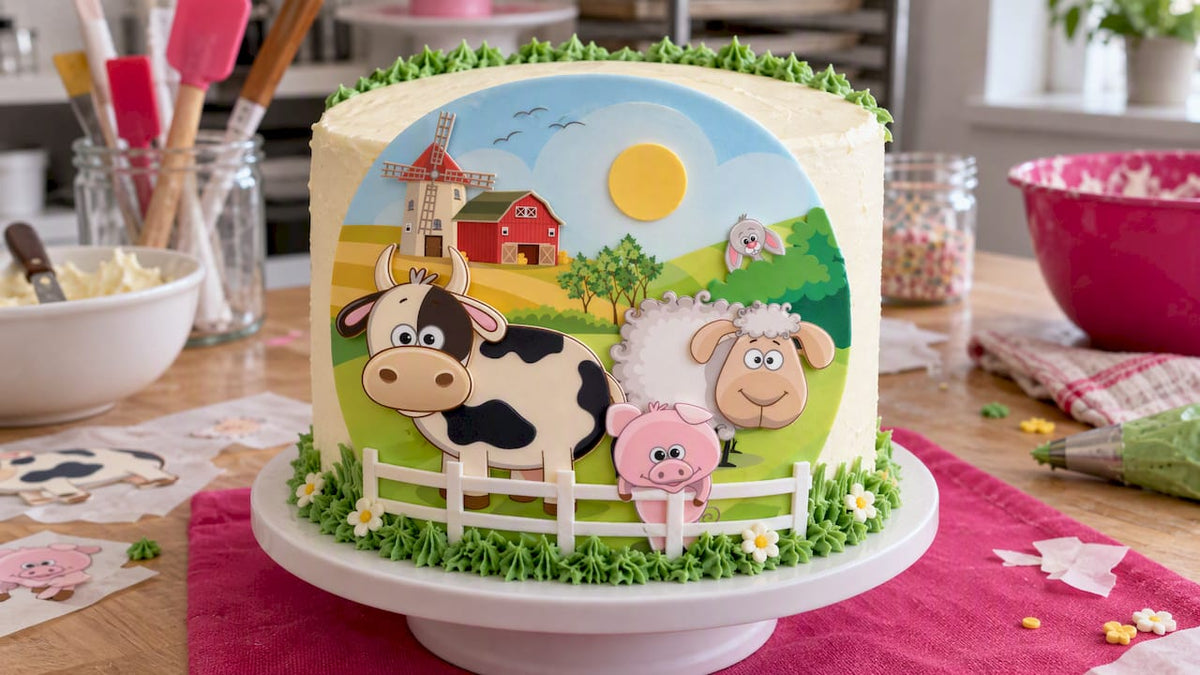
For plain or fondant-covered cakes, choose sugar paper, which adheres better to dry and firm surfaces; for cupcakes and moist surfaces such as whipped cream, thin wafer paper usually gives better results. A custom order with a supplier allows you to adapt photos, text, and format to the party theme. Before paying, always ask for the list of ingredients and confirm the allergens present.
In summary:
- The choice between sugar paper and wafer paper depends on the moisture of the cake surface, with sugar paper being more resistant and versatile.
- Before ordering, you should check the compatibility of the image with the support, the ingredients, and the allergens, as well as define the size and quantity needed.
- It is essential to send files with a minimum resolution of 300 DPI and prefer PNG or JPEG formats, ensuring a quality print and avoiding pixelation.
- The production of custom images varies depending on the degree of customization, with orders using an existing design tending to be faster and more economical.
- Always confirm the list of ingredients and allergens before paying, especially if there are guests with dietary restrictions.
Table of Contents
- Catalog examples and formats for bachelorette parties
- Practical criteria for choosing the right edible image
- How to prepare images for high-quality printing
- Mandatory labeling and allergen management
- How to apply and store edible images without ruining them
- Deadlines, quantities, and order organization
- How customization works at Funbakery
- Creative ideas for bachelorette parties
- Choosing a custom order saves you the trouble of testing materials and avoids surprises on the day of the party, because the design arrives ready to apply, adapted to the shape of the cake or cupcakes.
- Frequently asked questions
- Fonts
Catalog examples and formats for bachelorette parties
In the catalog, we find ready-to-adapt designs and fully customized options, making it easier to choose something suitable for the tone of the party, whether more discreet or more fun. The Graduation design illustrates well how a pre-structured theme can be repurposed: we change names, dates, and colors to transform a graduation motif into a bachelorette party motif, maintaining the original composition.

Licensed designs also serve as a visual reference for the type of finish that can be requested. The custom Stranger Things wafer edible image shows how a dark and graphic aesthetic works well on themed series cakes, while the custom Stranger Things wafer for a tart demonstrates the application of the same visual universe in a round format, designed for the top of the main cake.
These three examples help you understand what type of file and format is suitable for each sweet:
- For the main cake of the party, a larger round or rectangular image, placed on top, concentrates the visual impact.
- For individual cupcakes, small discs with the bride's name, a humorous phrase, or a recurring icon (veil, champagne, crown) maintain consistency between the units.
- For cookies, simple shapes and short text work better than detailed photographs, because the surface is small.
Recurring themes at bachelorette parties include photos of the group of friends, phrases honoring the bride, travel icons when the party is out of town, and color palettes linked to the event theme. The choice of design depends mainly on the support: a photo with many details may lose sharpness on a small disc, but works well on a larger rectangle.
Practical criteria for choosing the right edible image
Before finalizing the order, it is worth evaluating four aspects in the correct order, because each one conditions the next.
- Compatibility with the support: confirm whether the image will go over fondant, whipped cream, chocolate, or a dry surface, because sugar paper and wafer paper behave differently depending on the moisture and texture of the frosting.
- Ingredients and allergens: ask for the complete list before deciding on the color or size, because a present allergen may require changing the supplier or the cake recipe.
- Size and quantity: define how many cupcakes or cakes will have an image, since the price usually follows the printed area and the number of units.
- Durability versus visual quality: decide whether you prioritize a very sharp image, which may be more sensitive to moisture, or a more resistant option for transport and prolonged display.
The difference between wafer paper and sugar paper helps you understand which of the two materials adapts better to the type of frosting you have already planned. When the doubt is between sugar paper and other decorative finishes, the comparison between sugar paper and sugar paste clarifies the differences in texture and final finish.
The budget also comes into the equation. Since suppliers generally charge by printed area or by unit, large cakes with a single image tend to be more economical per square centimeter than several small cupcakes with individual designs.
Professional tip: always ask for a digital proof (mock-up) before final production, to confirm colors and framing without wasting material.
How to prepare images for high-quality printing
The final quality of the edible image depends almost entirely on the file sent. A stretched photo, with low resolution or poorly framed, will always result in a finish worse than expected, regardless of the quality of the material used in the printing.
- Send files with at least 300 DPI at the desired final size, to avoid pixelation when the image is enlarged to the size of the cake.
- Prefer PNG when the image has a transparent background or overlaid text, and JPEG for photographs without the need for transparency.
- Leave a safety margin on the edges, without faces or important text close to the limit, because the final cut may remove a few millimeters.
- Center the face or the main element, since round formats cut more on the sides than rectangular ones.
- Increase the contrast in dark photographs or those taken indoors with low light, because food printing tends to soften very close tones.
- Remove complex backgrounds when the goal is to highlight only one person or object, so that the final result looks cleaner on the cake.
The practical guide on how to choose images for cakes details these points with more examples of framing and color correction, useful when the original photograph was not taken with an edible print in mind.
Mandatory labeling and allergen management
The list of the 14 main allergens, defined at the European level, includes cereals with gluten, crustaceans, eggs, fish, peanuts, soy, milk, nuts, celery, mustard, sesame, sulfites above certain concentrations, lupin, and mollusks, and also applies to edible decorations such as wafer paper and sugar paper, according to the EFSA. This means that any of these ingredients present in the printed image must be clearly identified before purchase.
Before confirming the order, the consumer has the right to consult the product description, the list of ingredients, the allergens, and the supplier's contacts, according to the transparency rules of Youreurope on food labeling. A beautiful marketing label never replaces this concrete information.
When contacting the seller, ask these direct questions:
- What are the exact ingredients of the wafer paper or sugar paper used in this order?
- Do the pigments or printing additives contain any of the 14 main allergens?
- Is there a risk of cross-contamination during production, for example, with gluten or nuts?
- Does the supplier provide a direct contact to clarify doubts before payment?
Mentions such as "vegan" or "vegetarian" in confectionery products are generally voluntary and do not replace the verification of the list of ingredients, according to EuroVeg. When there are guests with known restrictions, confirming in writing is always safer than relying solely on the product name.
How to apply and store edible images without ruining them
Correct application makes the difference between a professional finish and a wrinkled or discolored image. The following steps apply to both wafer paper and sugar paper, with small adjustments depending on the cake frosting.
- Remove the image from the plastic support only at the time of application, never beforehand, to prevent it from absorbing moisture from the environment.
- On fondant, slightly dampen your fingers or use a little water with a fine brush before placing the image, so that it adheres without air bubbles.
- On whipped cream or chocolate, apply the image as soon as the surface is smooth and slightly firm, avoiding frostings that are still very liquid.
- Smooth gently from the center to the edges with clean and dry fingers, removing air bubbles without stretching the paper.
- Avoid storing the already decorated cake in very humid environments or in the refrigerator without protection, because condensation can undo the colors.
Professional tip: apply the edible image as close as possible to the time of the event, ideally in the last few hours, to reduce the risk of stains or discoloration due to moisture.
The ideal occasions for sugar paper on cakes bring additional examples of application on different types of frosting, useful when the party involves several cakes with distinct finishes.
Deadlines, quantities, and order organization
Ordering in advance avoids last-minute rush and gives room to correct eventual problems in the file or design. As a general rule, the more personalized the image is, the more production time you should plan, so always confirm the deadline directly with the supplier before setting the party date.
- For designs already existing in the catalog, the production time tends to be shorter than for completely new creations with personalized photos and text.
- For large cakes, a single central image is usually enough, while for cupcakes you need to calculate one unit per sweet plus a few spares.
- Orders made close to the event date may limit the available shipping options and, in some cases, imply additional costs for faster delivery.
- Always confirm the product's expiration date after receiving it, to ensure it is still in good condition on the day of the party.
Reserving a few extra units of cupcakes with an image is a common practice, since small accidents during transport or application can render one or another piece unusable.
How customization works at Funbakery
The design service incorporates photos, names, ages, and personalized text, with designers handling the adjustment of the image to the chosen format, whether rectangular, round, for muffins, or for decorative ribbons. This structure covers both whole cakes and individual cupcakes within the same order.
The author David's technical articles on formats and customization deepen the practical differences between wafer paper and sugar paper, serving as a reference for those who want to better understand which material to choose before deciding.
Before finalizing the purchase, it is worth asking the supplier:
- Photos of previous works similar to the desired theme, to assess the actual finish.
- A sample or digital proof of the design before the final print.
- Written confirmation of the ingredients and any allergens present in the image.
This type of prior verification reduces the risk of surprises on the day of delivery and helps confirm that the final result corresponds to what was agreed.
Creative ideas for bachelorette parties
Three ideas that usually work well: a main cake with the photo of the group of friends in rectangular format, individual cupcakes with each guest's name printed on a small disc, and cookies with simple icons such as champagne glasses or crowns, easy to produce in quantity.
The choice between discreet or bolder designs depends on the group of guests: parties with family members from different generations call for softer images, while groups of only close friends tolerate more direct humor. Whatever the option, always confirm the allergens before finalizing the order and plan with enough advance notice.
— David
Choosing a custom order saves you the trouble of testing materials and avoids surprises on the day of the party, because the design arrives ready to apply, adapted to the shape of the cake or cupcakes.

The process boils down to four simple steps:
- Choose the desired format, rectangular, round, for muffins, or for ribbons, in the custom design collections or design service.
- Send the photo, text, and color indications you want to see in the final result.
- Review the digital proof sent by the designers before production.
- Confirm the ingredients and allergens and only then finalize the payment.
Always confirm the list of ingredients before paying, especially if any guest has known allergies. You can start your order directly on the Funbakery page.
Frequently asked questions
What is the difference between wafer paper and sugar paper?
Wafer paper is thinner and drier, suitable for dry surfaces such as whipped cream or chocolate, while sugar paper is slightly thicker and adheres better to fondant. The right choice depends mainly on the cake frosting and the moisture of the surface.
How do I know if the edible image contains allergens?
The supplier is required to provide the full list of ingredients before purchase, highlighting the 14 main allergens such as gluten, milk, soy, or nuts. Always ask for this information in writing before confirming the order.
How far in advance should I order edible images?
The timeframe varies depending on the level of customization, being shorter for designs already in the catalog and longer for completely new creations with photos and text. Confirm the exact timeframe directly with the supplier before setting the date of the party.
How much does it cost to customize an edible image?
Custom design prices at Funbakery start at 6 USD for rectangular, round, and cupcake formats, and at 9 USD for decorative strips. The final price depends on the chosen format and the complexity of the design.
Can I apply the image directly onto wet fondant?
It is preferable to wait until the fondant is slightly firm before applying the image, moistening only your fingers or using water with a fine brush. Applying it to fondant that is still very wet increases the risk of air bubbles or the image slipping.