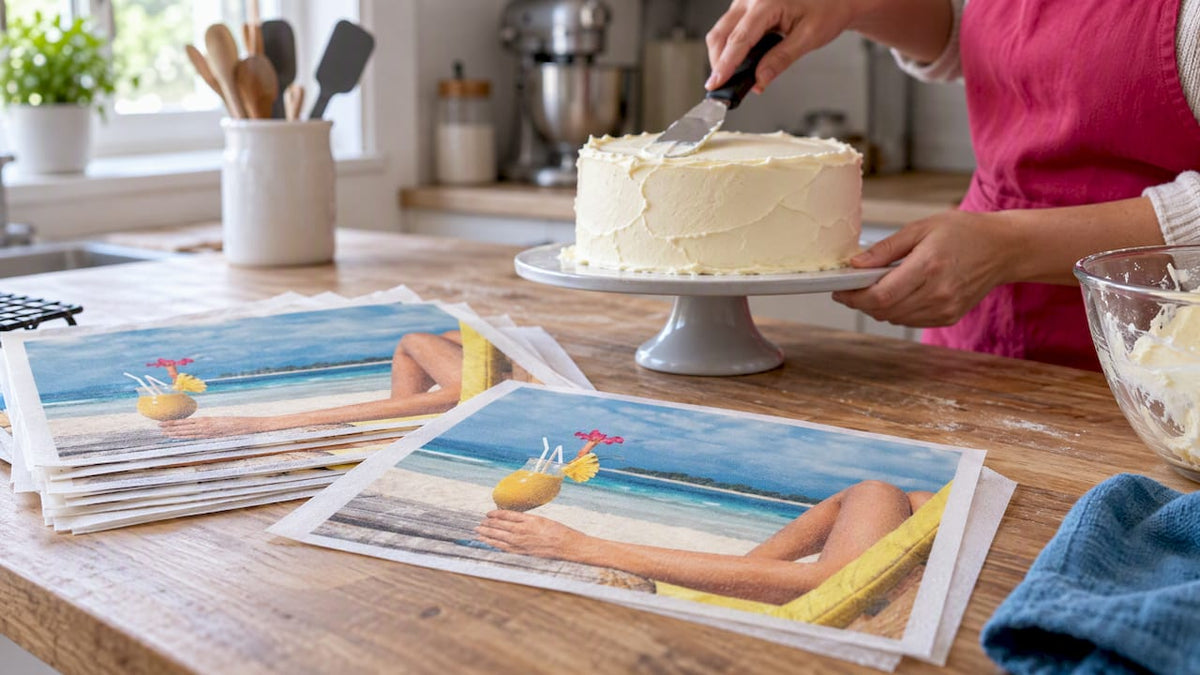
Store closed sheets in their original packaging in a cool, dark place, and avoid applying them to still-damp frostings: this will prevent the sugar paper from becoming damp. If you use the refrigerator, allow it to come to room temperature before handling it, so that condensation does not form on the ink. These three precautions will solve most moisture problems with sugar paper.
In summary:
- After opening the package, store the sheets in an airtight container with food-safe silica gel and separate each sheet with baking paper.
- Apply the sheet when the frosting is cool and firm, using a minimal amount of thick adhesive, and decorate the cake just before serving.
- If only the edges have become damp, trim them and dry the sheet flat at room temperature; discard any sticky, slimy, or moldy pieces.
- In coastal or very humid kitchens, ask for the sheets to be cut to the required size to reduce handling and the time they spend exposed to the air.
Table of contents
- Why moisture and grease damage sugar paper
- How to store unopened and opened sugar paper
- How to apply sugar paper to fondant, icing, and damp frostings
- Quick fixes and when to discard damp paper
- What we observe at Funbakery about thickness and preservation
- What really matters when storing sugar paper
- How we can help you avoid these problems from the time you order
- Frequently asked questions
- Sources
Why moisture and grease damage sugar paper
Sugar paper is a very thin sheet made of sugar, water, and thickeners, designed to dissolve upon contact with moisture. This same property that makes it edible and easy to apply is what makes it fragile in the environment. The key concept here is water activity, a parameter that measures how much free water is available in a food and is more decisive than simple ambient humidity when explaining why a material absorbs moisture and changes texture, as reported in a technical chapter on measuring water activity in foods. The more free water the paper finds around it, the sooner it begins to soften, lose rigidity, or wrinkle.
There are three mechanisms that are usually combined:
- Ambient water or water from a damp frosting migrates to the paper and softens it through contact.
- Grease from fillings, buttercreams, or oily frostings gradually seeps through and makes the paper translucent or brittle.
- Condensation, typical when taking a cold product to room temperature, deposits tiny droplets that run the ink and soak the surface.
Understanding these three issues helps you choose the right solution in each case: a sheet that has become wet from condensation is not the same as one that has been absorbing grease from a filling for days.
How to store unopened and opened sugar paper
Storage is the variable that home bakers control the most, and also the one they neglect the most. Unopened sheets are best preserved inside their original packaging, which is already designed to isolate them from air and light.
- Store the closed package in a dry, dark place at a stable room temperature, away from windows, ovens, or areas with kitchen steam.
- If you need to open the package before using all the sheets, transfer them to a resealable bag or a rigid container with a tight lid.
- Add a packet of food-safe silica gel inside the container to absorb residual moisture from the air.
- Place a sheet of baking paper between each sheet if you are going to stack several, to prevent them from sticking together or transferring moisture to one another.
- Use the oldest sheets first when you have several packages, always checking the best-before date indicated by the manufacturer.
In coastal climates or kitchens with high ambient humidity, it is advisable to reinforce these measures with airtight containers and food desiccants, as moisture-laden air is the main enemy of opened sheets. The manufacturer's specific instructions always take precedence over any general recommendation, because each formulation may behave somewhat differently.
Professional tip: always store the package horizontally, never folded or resting on its side, so that the sheets do not curl over time.

How to apply sugar paper to fondant, icing, and damp frostings
The time of application is when most sheets are ruined, usually due to rushing. Before placing anything, check that the frosting has set: freshly spread fondant or still-shiny icing releases moisture that the paper absorbs in seconds.
- Wait until the fondant loses its surface shine and feels slightly firm to the touch, not sticky.
- With icings or chocolate frostings, let them cool to room temperature before applying; residual heat generates steam that fogs the paper.
- Use a thick adhesive, such as reduced syrup or a thin layer of vegetable shortening, applied with a dry brush in a minimal amount; excess liquid is the most frequent cause of wrinkling.
- Place the sheet from the center toward the edges, smoothing it with clean, dry fingers or with a rubber spatula, to expel air before it gets trapped.
Avoid two common mistakes: stacking decorated cakes before the paper has fully set, and applying it to still-warm surfaces, which, in addition to generating condensation, can melt the pigments of the edible ink. If small bubbles appear during placement, they can usually be resolved with a practical guide to correcting bubbles in sugar paper, which explains how to smooth them out without tearing the sheet. For the complete step-by-step application process, it is also advisable to review how to apply sugar paper to fondant and icing.
Professional tip: apply the paper as close as possible to the time the cake is served, thus minimizing the exposure time to ambient moisture.
Quick fixes and when to discard damp paper
If a sheet has already absorbed moisture, there is still room to save it before giving up on it.
- Let it dry flat on a level surface, at room temperature and away from direct heat sources, as heat can deform or run the edible ink.
- If only the edges are affected, trim them with clean scissors and use the central part, which usually retains the print better.
- Small pieces that are no longer useful for the main design can be reused as loose details, initials, or decorative cutouts.
- Before using a recovered sheet, check that it does not have a strange odor, that the texture is not sticky or gummy, and that the ink has not run: any of these signs is reason to discard it.
Food safety takes precedence over any attempt to save money: a sheet with visible mold, a damp odor, or a slimy texture should not be used under any circumstances, no matter how much of the design is still visible.
What we observe at Funbakery about thickness and preservation
In our experience working with sugar paper and edible wafers, the thickness of the sheet directly influences how it behaves in the face of household moisture. We observe that sheets with an appropriate thickness usually maintain good flexibility without becoming brittle or absorbing moisture as quickly as thinner sheets.
- A thickness within that range makes handling easier without the sheet tearing when peeling it off the backing.
- The original packaging serves a real barrier function, not just a presentation one, so keeping it intact for as long as possible helps maintain quality.
- The best-before dates indicated by each manufacturer reflect their own product testing, so it is advisable to respect them rather than following general rules.
For those who want to delve deeper into how to choose the right thickness according to the design, we provide more detail in this entry on how to choose the thickness of sugar paper, and a broader explanation of the differences between wafer paper and sugar paper.
What really matters when storing sugar paper

If there is one thing we learn from reviewing inquiries and questions from home bakers, it is that most moisture problems do not come from a bad product, but from leaving too much time between purchase and application. Prevention always beats correction: applying the paper as close as possible to the event reduces almost all risks, much more than any last-minute trick to save a sheet that is already damaged.
That is why, in very humid or coastal environments, it is usually more worthwhile to order the sheets already cut and packaged to the exact size you need, rather than cutting and handling a large sheet at home, where every minute exposed to the air is an opportunity for it to absorb moisture. You do not need professional experience to decorate a cake well, but you do need to respect the material's requirements.
— David
How we can help you avoid these problems from the time you order
Part of the moisture problem is solved before the paper reaches your kitchen. We package each sheet securely and cut it to the size you need, which reduces handling and exposure time to the air compared to buying a large sheet and cutting it at home.

Our catalog includes designs ready to apply directly, such as Alice in Wonderland, Sloths for cupcakes, or Butterflies, in addition to a custom design service for anyone who needs a bespoke image with photos, names, or ages. We also offer custom designs in different formats, from rectangular to cupcake sizes, designed to arrive at your table ready to place, without intermediate steps that increase the risk of moisture.
Frequently asked questions
How do you remove moisture from sugar?
If regular sugar has clumped due to moisture, it is usually dried by spreading it on a tray at room temperature, away from direct heat sources, and then sifting it to break up lumps. In the case of sugar paper, the same gentle drying principle applies when a sheet has become slightly damp, although the result depends on how much moisture it has absorbed.
How long does sugar paper last?
The lifespan depends on the manufacturer and the batch, so the real reference is always the best-before date indicated on the packaging. Unopened and stored in a dry, dark place, many sheets remain usable for several months, although some references recommend a preferred use of two or three weeks after opening the package.
How do you prevent powdered sugar from becoming damp?
Powdered sugar is best stored in an airtight container, in a dry place, away from kitchen steam and the refrigerator, as sudden temperature changes promote condensation. Adding a food-safe desiccant inside the container helps keep it loose for longer.
Why does sugar become damp?
Sugar absorbs moisture from the air when the water activity of the environment is higher than that of the product itself, a phenomenon described in technical literature on water activity in foods. That is why a humid environment, a poorly closed container, or a sudden temperature change accelerates clumping or, in the case of sugar paper, loss of firmness.
Sources
- Chapter 8: Applications in the food industry (moisture / water activity measurement)
- General search on storage times and recommendations