Sugar paper usually measures in a range close to 0.4–0.55 mm; wafer paper usually falls between 0.3 and 0.6 mm. That difference of barely a tenth of a millimeter determines whether a sheet prints with crisp colors and applies without wrinkles, or breaks when peeled off. The thinner, the more flexible and discreet when bitten; the thicker, the more resistant to handling but also more rigid on curved surfaces.
In summary:
- It is essential to request the exact thickness in millimeters in writing from the supplier, as a difference of 0.1 mm can affect the behavior in edible prints.
- Sugar paper, which measures between 0.4 and 0.55 mm, offers greater sharpness and vivid colors, ideal for detailed designs and precise prints.
- Wafer paper, made with potato or rice starch, is more rigid and neutral in flavor, recommended for 3D decorations or high-humidity environments.
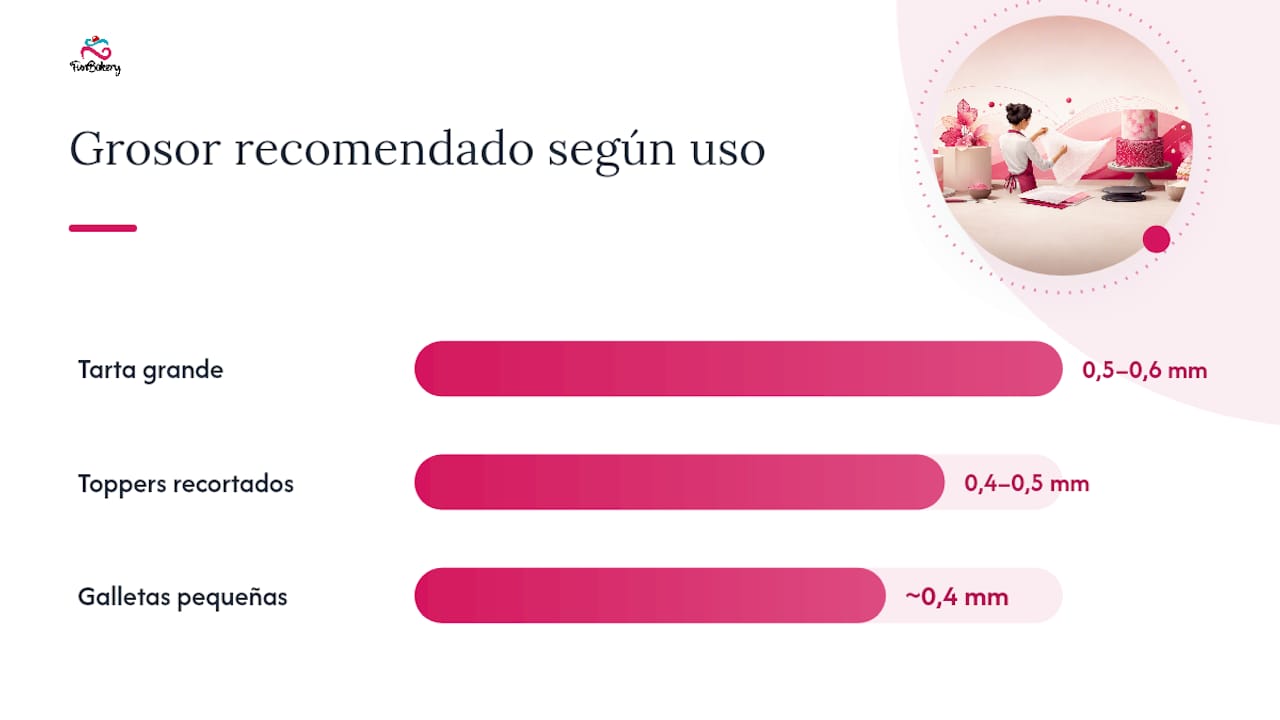
- For full coverage or large pieces, a thickness between 0.5 and 0.6 mm is advised; for cut-out decorations, between 0.4 and 0.5 mm.
- It is important to always check the tolerances, sheet size, and material on the label, as these factors influence quality and ease of work.
Table of Contents
- Sugar paper thickness ranges and how to read a technical data sheet
- Sugar paper versus wafer paper: what makes them different
- What thickness to choose according to the job you have at hand
- How to print and apply without wrinkles or jams
- How we work at Funbakery with different thicknesses
- The recommendation I give after seeing hundreds of orders
- Order your sugar paper with the exact thickness for your cake
- Sources
Sugar paper thickness ranges and how to read a technical data sheet
Product data sheets and supplier descriptions follow a fairly consistent pattern. sugar paper is usually declared between 0.4 and 0.55 mm, while some manufacturers offer A3, A4, and A5 formats with a thickness of 0.55 mm as a standard option.
Professional tip: if the technical data sheet does not specify the exact thickness, ask the supplier in writing before buying in bulk. A difference of 0.1 mm between batches can change how the sheet behaves in your edible printer.
That variation between batches is not a manufacturing defect: it responds to the ambient humidity during drying and the thickness of the starch or sugar layer applied. Some specialty stores even sell sheets slightly smaller than standard A4, around 28.7 × 21 cm with thicknesses of 0.45 to 0.55 mm, so it is advisable to also check the exact measurements, not just the thickness.
Before buying, check three things on the label: the thickness in millimeters, the sheet size, and if the manufacturer specifies tolerance (for example, ±0.05 mm). If the sheet only says "thin" or "thick" without a number, it is a sign that it is worth asking directly.

Sugar paper versus wafer paper: what makes them different
Sugar paper is made mainly of sugar and starch on a white and opaque edible base. Wafer paper, on the other hand, is made with potato or rice starch and is more translucent and neutral to the palate. That difference in composition is the reason why sugar paper produces a print quality considered superior with more vivid and crisp colors.: its smoother surface retains edible ink better.
As for flavor and texture, sugar paper provides a slight sweetness that usually pairs well with fondant, while wafer paper, more rigid and neutral, adapts better to decorations that need to maintain their 3D shape.
- Photos and detailed designs: sugar paper, due to its color sharpness.
- Three-dimensional figures or decorations that must stand upright: wafer paper, due to its rigidity.
- High-humidity environments (cream, very juicy fillings): wafer paper is better, or protect the print with an intermediate layer.
- Cakes with fondant or firm buttercream: sugar paper adapts without resistance.
Neither material tolerates prolonged exposure to liquid water well. The difference is in the margin of error: wafer paper holds up a bit longer before deforming.
What thickness to choose according to the job you have at hand
There is no universally correct thickness. It depends on the size of the piece, the surface where it is placed, and how much handling the sheet will withstand before reaching the cake.
- Full coverage of a large cake: opt for 0.5 to 0.6 mm. It covers more surface and needs to resist tearing during placement.
- Toppers and cut-out decorations: between 0.4 and 0.5 mm is usually enough. Less thickness makes it easier to cut complex shapes without tearing.
- Cookies and small surfaces: thinner paper, close to 0.4 mm, adapts better to curved surfaces without lifting edges.
- 3D figures or pieces that must support themselves: thicker wafer paper offers more structural rigidity.
Professional tip: if you are going to transport the already printed sheets before applying them, store them flat between two rigid cardboard pieces and in a dry environment. Thinner paper curls with ambient humidity much faster than a thick one.
Before ordering, confirm with the supplier: exact thickness in mm, sheet size, material type (sugar or wafer), and if the plastic backing is removed before or after shipping.
How to print and apply without wrinkles or jams
The edible printer needs the side with the plastic backing (acetate) to enter the tray first. Feeding the sheet backwards is the most common cause of jams and smeared ink.
- Let the ink dry for 5 to 15 minutes before handling, especially in humid environments, before removing the plastic backing.
- Always remove the acetate before cutting complex shapes: cutting with the backing on usually tears the paper at the curves.
- To adhere without fixing permanently, apply a very thin layer of vegetable shortening, which allows you to reposition the sheet if you make a mistake in placement.
- Avoid syrup as an adhesive if you need adjustment margin: it fixes irreversibly as soon as it touches the surface.
Professional tip: if you work with thin sugar paper on very soft buttercream, let the cream form a slight surface crust before applying the sheet. It reduces the risk of it sinking or wrinkling.
How we work at Funbakery with different thicknesses
For birthday cakes with a photo or custom design, we usually recommend sugar paper in the medium-high range, because it balances print sharpness with handling resistance during shipping.
Our practical recommendations, summarized:
- Designs with photographs and custom text: sugar paper, prioritizing color definition.
- Cut-out toppers with complex shapes: medium thickness, to facilitate cutting without tearing.
- Orders for cupcakes and small pieces: size-adjusted format, avoiding leftover paper.
Before sending your file, check our guide on types of sugar paper explained for bakers and also what makes illustrations on sugar paper maintain vivid colors after printing. Working the sheet and the acetate backing as a single system, without separating them prematurely, avoids deformations in orders that travel long distances.
The recommendation I give after seeing hundreds of orders
If I had to stick to a single number for home orders and celebrations, I would choose sugar paper with a medium thickness, as it is the point where most homemade cakes find a balance between print sharpness and handling resistance. For figures that must support themselves, wafer paper wins due to rigidity, not by whim.
That said, do not rely on memory for any figure you read, not even mine. Always confirm the exact thickness and handling conditions with the supplier's technical data sheet before placing a large order.
— David
Order your sugar paper with the exact thickness for your cake
Choosing the right thickness is only half the work. The other half is getting the print to arrive crisp and well cut to your home, without depending on setting up an edible printer in the kitchen.

You can upload your photo, name, and age in the custom design studio and our team adjusts the file before printing, so you avoid resolution or cutting errors that ruin an already printed sheet. We also have catalog designs ready to order, such as this personalized wafer paper with photo and name in rectangular format. If your next celebration needs something custom-made, start the order this week to have shipping margin.
Sources
The thicknesses cited come from product data sheets from Brama Hispania and technical comparisons from GASDA, Mundo Repostería, and Minitartas. To expand on types and practical applications, also consult our sugar paper topper guide.
- SUGAR PAPER (25 SHEETS) - GLUTEN-FREE-Without E171
- Wafer paper vs Sugar paper vs Revoprint edible sheet: Which one to choose? | Mundo Repostería
- Edible Sugar Paper: What It Is and How to Use It | Minitartas