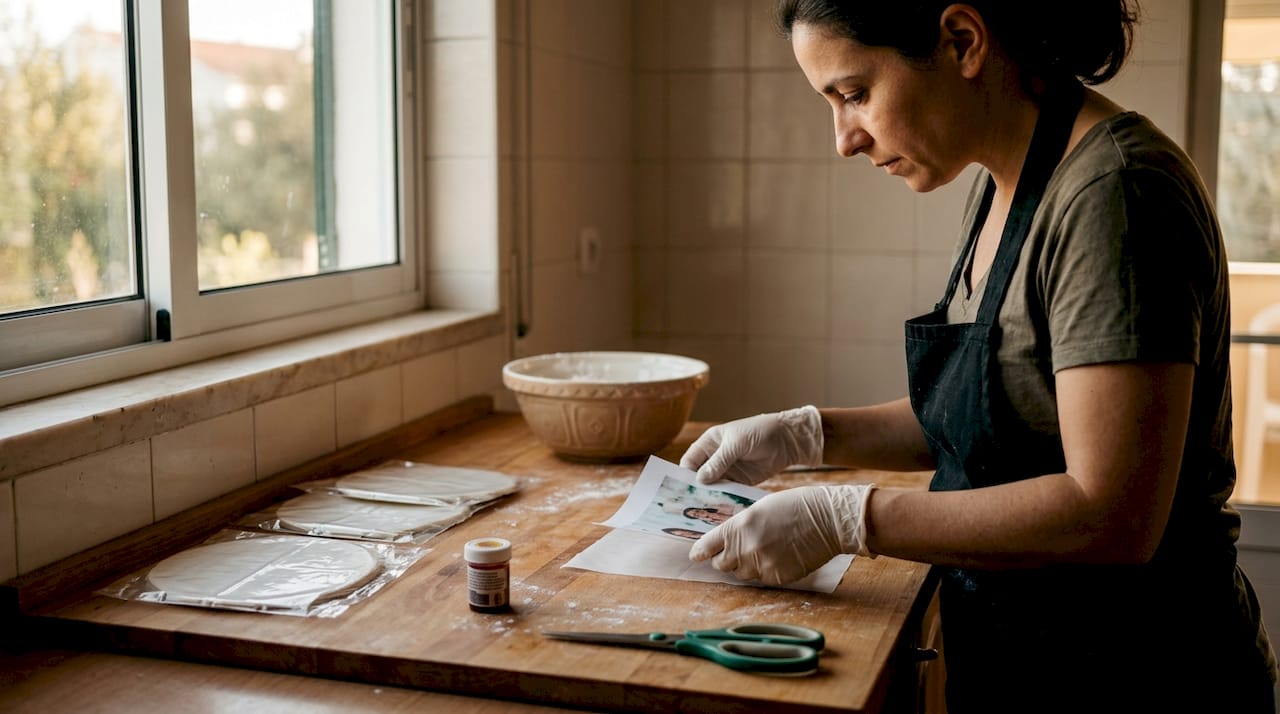
TL;DR:
- Decorative sugar paper is an edible sheet with food printing, ideal for personalizing and decorating desserts.
- It adheres properly to moist surfaces such as fondant or buttercream, avoiding oleic or greasy bases.
Decorative sugar paper may seem simple at first glance, but many people who are new to baking are not clear about exactly what its function is, how it adheres well, or why sometimes the result is not what they expected. Is it edible? Does it go on top of or under the fondant? Can it be placed on any surface? These questions are more common than you think. In this article you will find concrete answers: from its composition to the techniques that make the difference between a perfect decoration and a sticky mess.
Table of contents
- Key points
- What is decorative sugar paper
- How sugar paper adheres correctly
- Limitations and incompatible surfaces
- Creative applications in celebrations and baking
- My experience with sugar paper: what no one tells you
- Decorate your cakes with Funbakery sugar paper
- Frequently asked questions
Key points
| Point | Details |
|---|---|
| What is sugar paper | It is an edible sheet made of starches and sugars, printed with food ink to decorate desserts. |
| Main function | Its purpose is decorative: it personalizes cakes, cupcakes, and cookies with high-resolution images. |
| Correct adhesion | It must be placed on moist surfaces such as fondant or buttercream, never directly on oleic bases. |
| Proper storage | Store in an airtight bag, in a dry place and without refrigeration to maintain its visual integrity. |
| Total personalization | It can be printed with photos, names, and custom designs for any type of celebration. |
What is decorative sugar paper
Sugar paper is a thin and flexible sheet made mainly of starches, sugars, and glycerin. Its texture is smooth to the touch, its flavor is slightly sweet (with vanilla notes in many cases), and it dissolves on contact with moisture. That last thing is exactly what makes it work on a cake.
The printing with food ink on this sheet produces sharp images with vibrant colors, which makes it the preferred format for personalized decorations in baking. A birthday photograph, the shield of a soccer team, or a child's favorite design can go from screen to cake with surprising quality.
Differences with other edible papers
Sugar paper is not the same as rice paper, although many people confuse them. Rice paper is more opaque, thicker, and less flexible. It is mainly used in artistic techniques such as edible decoupage, where a more rustic texture is sought. Sugar paper, on the other hand, is more translucent, thinner, and integrates better with the surface of the dessert. This makes it ideal for decorations where the image must stand out without visually altering the base.
There is also wafer paper, which shares many characteristics with sugar paper but usually has a crunchier finish. The choice between one and the other depends on the type of dessert and the visual effect you are looking for.
Professional tip: If you are going to print on sugar paper, always choose a calibrated printer with certified food inks. An overexposed image or one with very saturated colors can stain the surface of the dessert upon contact with moisture.
How sugar paper adheres correctly
Here is the key that many people do not know: sugar paper does not stick on its own. It needs a surface with the correct level of moisture for the adhesion to be clean and long-lasting. Too much moisture dissolves the ink; too little and the paper peels off or forms bubbles.
Clean and long-lasting adhesion depends on this balance between the moisture of the base and the weight of the paper. The most used methods are:
- Fondant: It is the simplest base. If the fondant is fresh and slightly sticky to the touch, the paper adheres on its own. If it is already dry, lightly moisten the surface with a brush and water before placing the sheet.
- Buttercream: It works very well, but you must apply small amounts of edible glue and avoid having the cream too moist, as it can deform the image.
- Ganache: Requires the surface to have hardened well before placing the paper. If it is too soft, the paper moves and the image loses precision.
- Cookies: For cookies, the most effective method is to prepare homemade glue with powdered sugar and a few drops of water, apply it with a brush on the cookie, and press the paper gently until it dries.
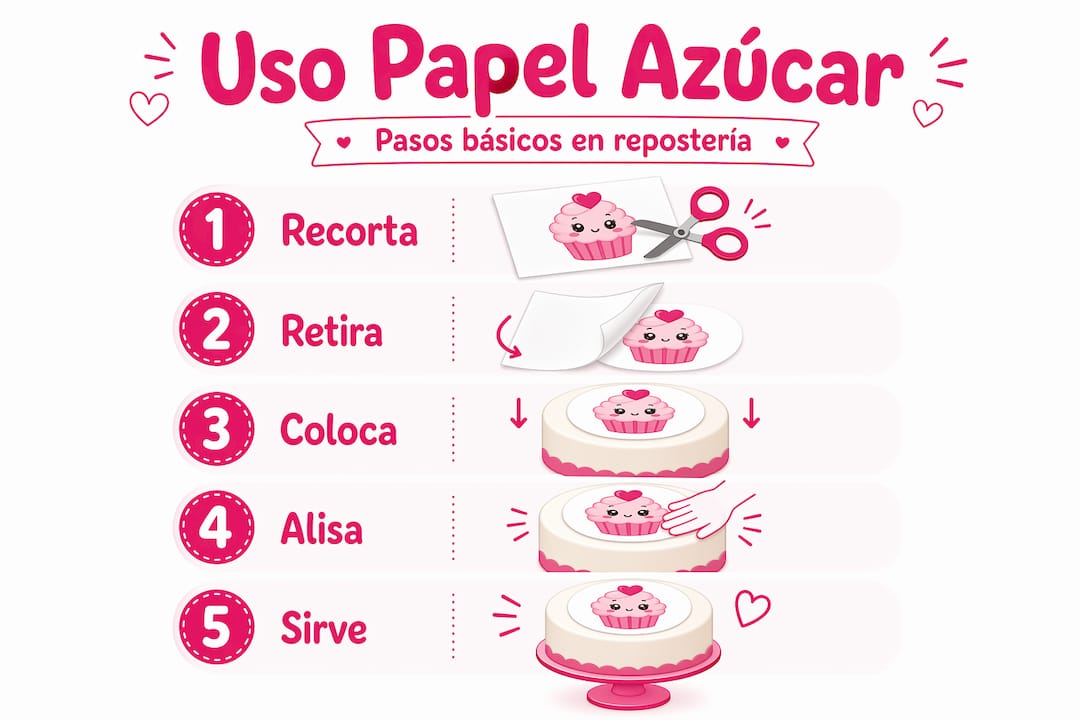
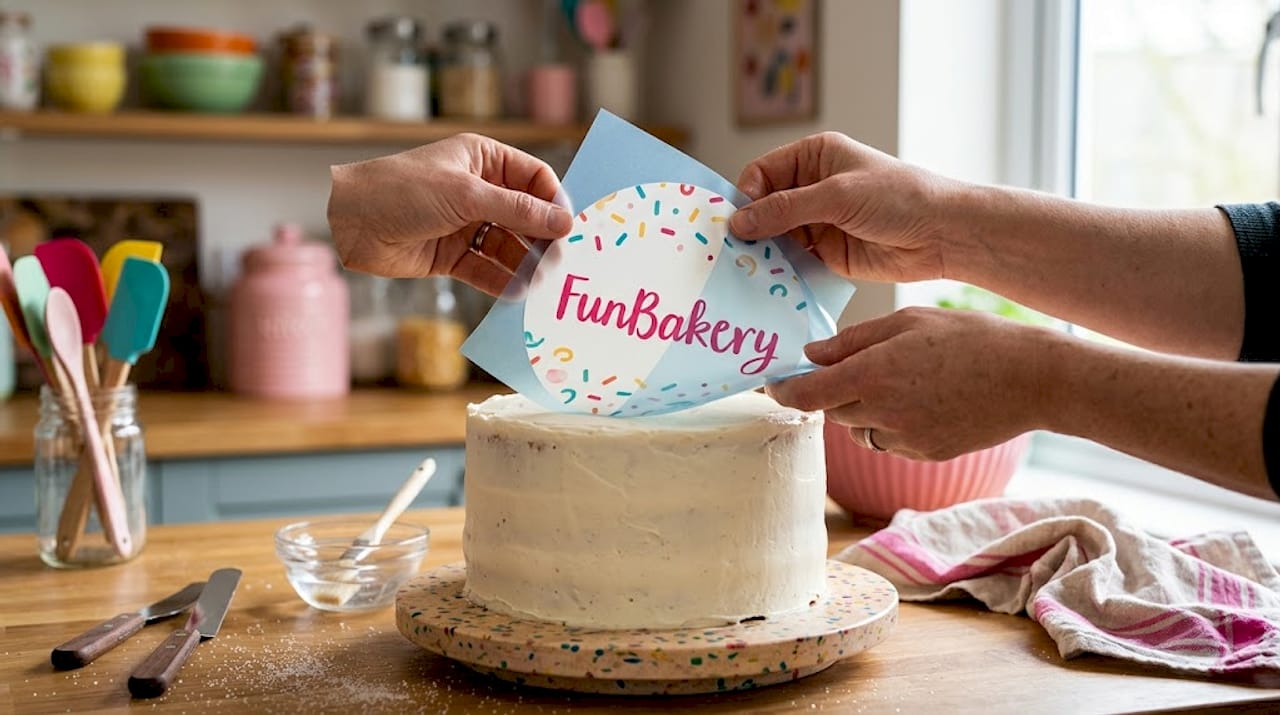
The process always starts the same: remove the protective acetate sheet, center the paper on the surface, and smooth it from the center to the edges with your fingers or a clean spatula to remove air bubbles.
Professional tip: Never moisten the sugar paper directly. Always moisten the surface of the dessert, not the sheet. The paper reacts upon contact with the moisture of the base and sets naturally.
Limitations and incompatible surfaces
Knowing the function of decorative sugar paper also implies knowing where it does not work well. The most frequent error is placing it directly on milk or dark chocolate. The fat in chocolate is incompatible with the paper: it absorbs the oil and alters the image, erasing details or creating stains.
The solution is to place an insulating layer in between. These are the precautions you should follow:
- Insulate with white chocolate: Apply a thin layer of melted white chocolate on the surface of the cake and let it solidify before placing the paper. White chocolate has much less free fat and does not affect the image.
- Use buttercream as a base: If the cake is covered in chocolate, spread a thin layer of buttercream on top and let it rest for a few minutes before sticking the paper.
- Control the timing: Sugar paper must adhere at the right time. Neither when the base is freshly made and too soft, nor when it has already been out for hours and is completely dry.
- Avoid the refrigerator: The humidity of the refrigerator deteriorates the paper. If the cake needs refrigeration, place the paper just before serving, not hours in advance.
- Store the leftover sheets properly: Unused sheets should be stored in an airtight bag in a dry place, away from heat sources and direct light. Well preserved, they can last for weeks without losing quality.
Storage conditions are just as important as the placement technique. A properly stored paper is a paper that works well when you need it.
Creative applications in celebrations and baking
Decoration with sugar paper goes much further than putting a photo on top of a cake. With the right techniques, this material becomes an incredibly versatile personalization tool for any type of event.
These are the most common uses and some lesser-known ones that are worth exploring:
- Birthday cakes: The most classic application. A personalized image covers the entire top disc and transforms a standard cake into something unique. You can also use it to decorate the sides with printed strips.
- Cupcakes and muffins: For cupcakes, circles are cut to the exact size of the buttercream surface. The result is clean, professional, and fast.
- Decorated cookies: As it is done on cookies, the sugar paper is cut into the shape of the cookie and stuck with dissolved powdered sugar. Ideal for event reminders or personalized gifts.
- Cutouts and figures: You can cut the paper before placing it to create specific shapes: stars, hearts, letters. It is worked with scissors or cookie cutters used as a template.
| Application | Recommended technique | Ideal surface |
|---|---|---|
| Round cake | Full disc, smooth from the center | Fresh fondant or buttercream |
| Cupcakes | Custom-cut circles | Buttercream with edible glue |
| Cookies | Cut into shape, stick with powdered sugar | Glaze or dry coating |
| Cake sides | Long strips, progressive adhesion | Stretched fondant |
A trick that few people apply: when you have several small pieces to decorate, place all the cutouts on the same sheet before printing. Optimizing the space saves you sheets and time. If you work with edible paper for cakes, planning the design in advance makes a real difference in the final result.
My experience with sugar paper: what no one tells you
I have seen how sugar paper can completely transform a celebration, and I have also seen the mistakes that are repeated over and over again. The most common one is not technical: it is not fully understanding what function this material has before using it. Many people buy it expecting it to stick on its own and work on any surface, and when the result fails, they blame the product.
In my experience, sugar paper works perfectly when two basic conditions are respected: the proper surface and the right time. I have placed papers on cakes with fondant ready for days and on freshly spread buttercream. The difference in the result is enormous. Slightly aged fondant, with some natural surface moisture, is the most cooperative support that exists.
What seems most interesting to me about this material is its potential in the personalized baking market. It is not just a decoration. It is a visual communication tool. A cake with the face of the guest of honor, a child's favorite design, or the colors of a company conveys something that no modeled fondant can match in time and precision. Whoever learns to work well with sugar paper has a real advantage in any custom order.
My most honest advice: experiment first on practice surfaces before doing it on the main cake. The material does not forgive improvisation, but it rewards preparation.
— David
Decorate your cakes with Funbakery sugar paper
If after reading this you are clear that you want to start using sugar paper in your creations, the next step is to choose a supplier that guarantees image quality and food safety.

Funbakery specializes in edible wafers and personalized sugar paper for cakes, cupcakes, muffins, and cookies. Its catalog includes hundreds of ready-to-use designs, from children's characters to adult themes, and they also offer a completely personalized design service where you can upload photos, add names and texts for any celebration. If you are looking for something more specific, such as a personalized cake wafer, you will find options that adapt to any theme. Enter Funbakery and discover everything you can create.
Frequently asked questions
Is sugar paper edible?
Yes, sugar paper is completely edible. It is made with starches, sugars, and glycerin, and the ink used to print it is food-grade and safe for consumption.
How long before can the paper be placed on the cake?
Ideally, place it between 30 minutes and 2 hours before serving. If the cake goes into the refrigerator, it is better to stick it just before presenting it, as the cold humidity deteriorates the sheet.
Can sugar paper be used on chocolate?
Not directly. Chocolate releases fats that absorb the paper and damage the image. You must first apply a layer of buttercream or solidified white chocolate to insulate the surface.
How are unused sugar paper sheets stored?
Store them in an airtight bag, in a dry place, away from heat and sunlight. Do not put them in the refrigerator. Well preserved, they can last several weeks without losing quality or flexibility.
What is the difference between sugar paper and wafer paper?
Sugar paper is thinner, flexible, and translucent, with better color reproduction. Wafer paper is thicker and more opaque. For decorations with sharp and personalized images, sugar paper gives better visual results.