TL;DR:
- Wafer sheets on cupcakes serve decorative and protective purposes, improving presentation and preservation.
- Choosing between rice paper or sugar paper depends on the desired flexibility and print quality, which influences their use.
Many people believe that wafer sheets on cupcakes are just a pretty decoration. The reality is that the function of wafer sheets on cupcakes goes much further than the visual: they act as a protective barrier, influence the texture when bitten, and can make the difference between a cupcake that looks professional for hours and one that deteriorates before reaching the table. This guide explains what they are, how they really work, when to use them, and how to apply them without ruining them in the process.
Table of contents
- Key points
- What edible wafer sheets are and their characteristics
- Decorative function: why they transform a cupcake
- Practical function: protection, texture, and preservation
- How to apply wafer sheets on cupcakes step by step
- Wafer sheets versus other cupcake decorations
- My experience with wafer sheets on cupcakes for events
- Custom wafer sheets for cupcakes at Funbakery
- FAQ
Key points
| Point | Details |
|---|---|
| Dual decorative and practical function | Wafer sheets do not just beautify. They also protect the surface of the cupcake and keep the frosting in better condition during the event. |
| The type of wafer sheet matters | Sugar paper offers sharper prints and greater flexibility than rice paper, making it more versatile for cupcakes. |
| The adhesion technique is key | Applying the wafer sheet on moist buttercream or using edible glue on fondant makes the difference in the final result. |
| The application time affects the texture | Placing the wafer sheet too early or too late can cause it to soften, wrinkle, or harden depending on the environment. |
| Personalization adds real value | Wafer sheets with photos, names, and themes turn a standard cupcake into a memorable detail for any celebration. |
What edible wafer sheets are and their characteristics
Edible wafer sheets are thin sheets made from food-safe ingredients that serve as a support for edible printing or direct decoration. There are two main types you will find in baking: rice paper and sugar paper.
Rice paper is made from rice flour and water. It is porous and rigid, which means that handling it requires care to prevent the printed colors from losing vibrancy or the sheet from breaking before being placed. Its texture when chewing can be somewhat crunchy or hard if exposed to the air for a long time.
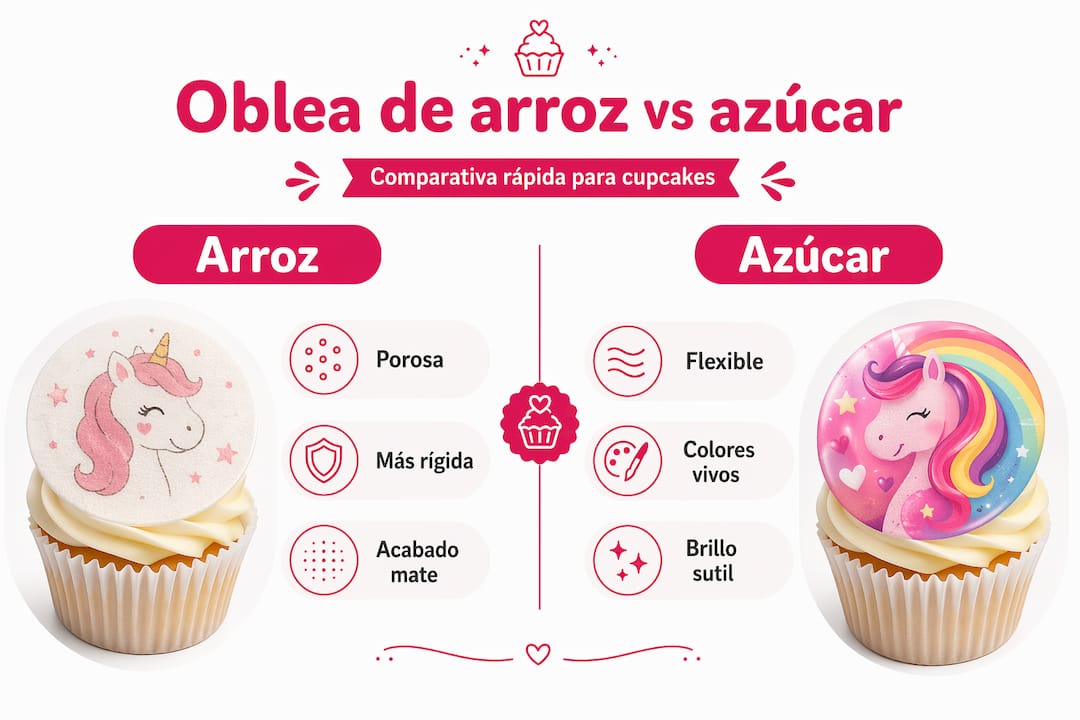
Sugar paper, also called frosting sheet, is made with sugar, cornstarch, and glycerin. It is more flexible and less porous, allowing for sharper prints and more saturated colors. It adheres easily to both fondant and buttercream, and integrates better with the texture of the cupcake.
Here are the most relevant differences between both types:
- Flexibility: sugar paper bends without breaking; rice paper is more brittle.
- Print quality: sugar paper offers more vibrant colors and finer detail.
- Adhesion: both work well, but with different techniques depending on the type of frosting.
- Flavor and texture: sugar paper tends to dissolve better in the mouth; rice paper can be left with more body.
- Availability: rice wafer sheets are easily found in stores and supermarkets, while sugar paper is usually ordered from specialized suppliers.
Knowing these differences before choosing your wafer sheet saves you unpleasant surprises on the day of the event.
Decorative function: why they transform a cupcake
The decorative function of wafer sheets on cupcakes is probably the best known, but few people understand to what extent they can elevate the presentation of a dessert table. A cupcake with a personalized wafer sheet goes from being just another little cake to becoming an element with its own identity.
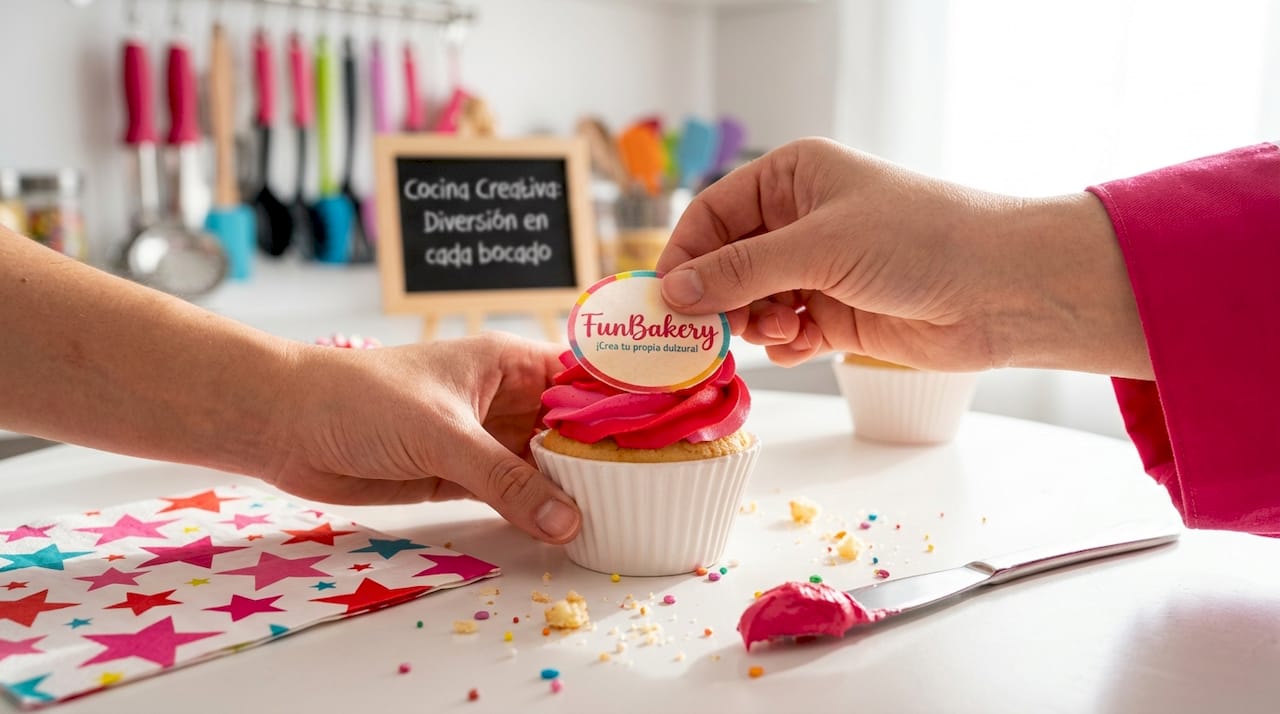
Personalized wafer sheets with designs or photos allow you to reflect children's themes, anniversaries, logos, and special messages. You can replicate a child's favorite character, include a family photo, or add the birthday person's name with complete clarity. That level of personalization previously required fondant painting skills or complex stencils. Today, a printed wafer sheet solves it in seconds.
Let's see how a cupcake with a wafer sheet compares visually to one without it:
| Feature | Cupcake without wafer sheet | Cupcake with wafer sheet |
|---|---|---|
| Personalization | Limited to frosting or topper | Total: photos, texts, exact colors |
| Professional appearance | Depends on the decorator's skill | Always uniform and sharp finish |
| Theme adaptation | Difficult without experience | Easy with a custom design |
| Visual impact at event | Discreet | High: creates coherence on the dessert table |
| Preparation time | Variable, can be high | Very short once the wafer sheet is printed |
Among the most popular decorative applications are:
- Cupcakes for children's birthdays with cartoon characters or superheroes.
- Dessert tables for weddings with initials, flowers, or specific color palettes.
- Corporate events with logos or company messages.
- Themed celebrations such as Halloween, Christmas, or graduations.
The use of wafer sheets for cupcakes turns any celebration into something visually cohesive without needing to be a professional pastry chef.
Practical function: protection, texture, and preservation
Here is the side of wafer sheets that almost no one mentions. Beyond how pretty they look, wafer sheets can protect the surface of the cupcake by acting as a barrier against ambient humidity and physical contact. On an event table where cupcakes remain exposed for hours, that makes a real difference.
However, there are important nuances that are worth knowing:
- Prolonged exposure to the environment: the texture changes over time. A wafer sheet that is placed long in advance can absorb moisture from the frosting and become gummy, or dry out excessively and become hard.
- Real edibility vs. decorative: although wafer sheets are technically edible, they often become hard or brittle after application, so many diners remove them before eating the cupcake.
- Interaction with frosting: on moist buttercream, the wafer sheet adheres and can partially soften, integrating better. On dry fondant, it acts more like an independent layer.
- Protection against touch: a well-adhered wafer sheet protects the frosting from direct contact during transport or handling.
Professional tip: apply the wafer sheet between 30 minutes and 2 hours before the event. If you place it too early, the moist frosting softens it excessively and it loses texture. If you place it right at serving, it will not have time to adhere correctly and may slide.
The chemical interaction between the wafer sheet and the base is one of the factors that most affects the final result. Understanding this allows you to make better decisions about when and how to place each wafer sheet.
How to apply wafer sheets on cupcakes step by step
Knowing how to use wafer sheets on cupcakes correctly is what separates a professional result from a disappointing one. These steps apply to both rice paper and sugar paper, with small variations depending on the frosting.
-
Prepare the cupcake with the right frosting. Buttercream is the most recommended base because its moist texture facilitates natural adhesion. Fondant also works well, but requires an extra step.
-
Cut the wafer sheet to the correct size. Use clean and dry scissors. Trim the outer edge slightly so it does not stick out from the cupcake. Handle it by the edges to avoid leaving fingerprints on the printed area.
-
Apply directly on moist buttercream. Place the wafer sheet on the freshly spread cream and press gently from the center toward the edges. The moisture of the buttercream itself fixes it without the need for any additional product. Placing the wafer sheet at the right time prevents wrinkles and color loss.
-
If you use fondant, apply a small amount of water with a clean brush or edible glue on the surface of the fondant. Wait 10 seconds and then carefully place the wafer sheet. Rice paper requires little wetting to prevent it from wrinkling.
-
Smooth gently. Use the pad of your finger or a small spatula wrapped in plastic wrap to press the wafer sheet and remove air bubbles. Do not rub.
-
Let it rest in a cool and dry place. Not directly in the refrigerator, as condensation can ruin the wafer sheet. If you need to refrigerate, place the cupcakes inside a closed box first.
Professional tip: the most common mistakes include wetting the wafer sheet too much, placing it on completely dry frosting, and handling it with wet hands. Any of these three mistakes ruins the design even if the wafer sheet is perfect.
For a manual to apply wafer sheets on cupcakes without surprises, always keep thin latex gloves, kitchen scissors, a fine-tip brush, and a small angled spatula at hand.
Wafer sheets versus other cupcake decorations
When you decide how to decorate your cupcakes, wafer sheets compete with other quite popular options. Here is a direct comparison:
| Decoration | Personalization | Ease of use | Edibility | Cost |
|---|---|---|---|---|
| Edible wafer sheet | Very high (photos, texts) | Medium (requires technique) | High if sugar paper is used | Medium |
| Modeled fondant | High (3D shapes) | Low (requires skill) | Acceptable | Medium/high |
| Traditional frosting | Medium (colors, strokes) | High | High | Low |
| Plastic or paper toppers | Low (fixed design) | Very high | None | Low |
| Sprinkles or pearls | Very low | Very high | High | Low |
Wafer sheets for cupcakes clearly win in personalization and the professional finish they offer without needing advanced decorating skills. Their main disadvantage compared to traditional frosting is that they require a learning curve and a reliable supplier. Plastic toppers are easier, but they are not edible and limit personalization.
For children's events and celebrations where visual impact is a priority, the use of wafer sheets on cakes and cupcakes offers the best result with less preparation time than worked fondant.
My experience with wafer sheets on cupcakes for events
I have seen many times how someone arrives at an event with cupcakes that look perfect and end up with the wafer sheets detached, wrinkled, or completely absorbed by the frosting. And almost always the problem is not the wafer sheet. It is not having understood that applying them correctly requires knowing both their decorative function and their physical behavior.
What has surprised me the most working with wafer sheets is how much the environment influences. A place with a lot of humidity can soften a wafer sheet in less than an hour. A very dry place with air conditioning can dry it out and make it brittle. Almost no basic tutorial says that.
My most practical advice: always do a test with one or two cupcakes before the day of the event. This way you check how the wafer sheet reacts with your specific frosting and in the conditions of the place. That test is worth more than any guide.
I also think people underestimate the differential value they add to a celebration. A cupcake with the photo of the grandmother on her 80th birthday is not comparable to any other. That detail is what people remember. And it is what makes someone ask who made the cupcakes.
— David
Custom wafer sheets for cupcakes at Funbakery
If you want to take your cupcakes to the next level without complicating yourself with advanced techniques, Funbakery has exactly what you need.

Funbakery specializes in the creation of custom wafer sheets for cupcakes with designs for all types of celebrations: children's birthdays, anniversaries, corporate events, and much more. You can choose from hundreds of designs in the catalog or order a completely custom wafer sheet with a photo, name, age, and any text you need. Funbakery's custom design service guarantees a sharp and professional finish, both on sugar paper and rice paper.
In addition, in the decoration collection of Funbakery you will find options for cakes, muffins, and cupcakes of all sizes. Each order arrives ready to place, with clear instructions so that the result is perfect from the first time.
FAQ
What function do wafer sheets have on cupcakes?
Wafer sheets serve a dual function: decorative, providing personalized designs and a professional finish, and practical, protecting the surface of the frosting and helping to preserve the presentation during the event.
How is a wafer sheet adhered to a cupcake?
On buttercream, the wafer sheet is placed directly on the moist cream and adheres by itself. On fondant, a small amount of water or edible glue is applied before placing it to guarantee the fixation.
When is it best to place the wafer sheet on the cupcake?
It is best to place it between 30 minutes and 2 hours before the event. Applying it too early can make the wafer too soft; doing it right before serving may prevent it from adhering correctly.
Are wafers really edible?
Yes, but their texture after application can become hard or brittle depending on the exposure time and the environment. Many diners remove them when eating the cupcake, so they mainly serve as a decorative element.
What is better for cupcakes, rice paper or sugar paper?
Sugar paper offers greater flexibility, sharper prints, and better integration with the frosting. Rice paper is more affordable and accessible, but stiffer and more brittle. For cupcakes with detailed designs, sugar paper gives better results.