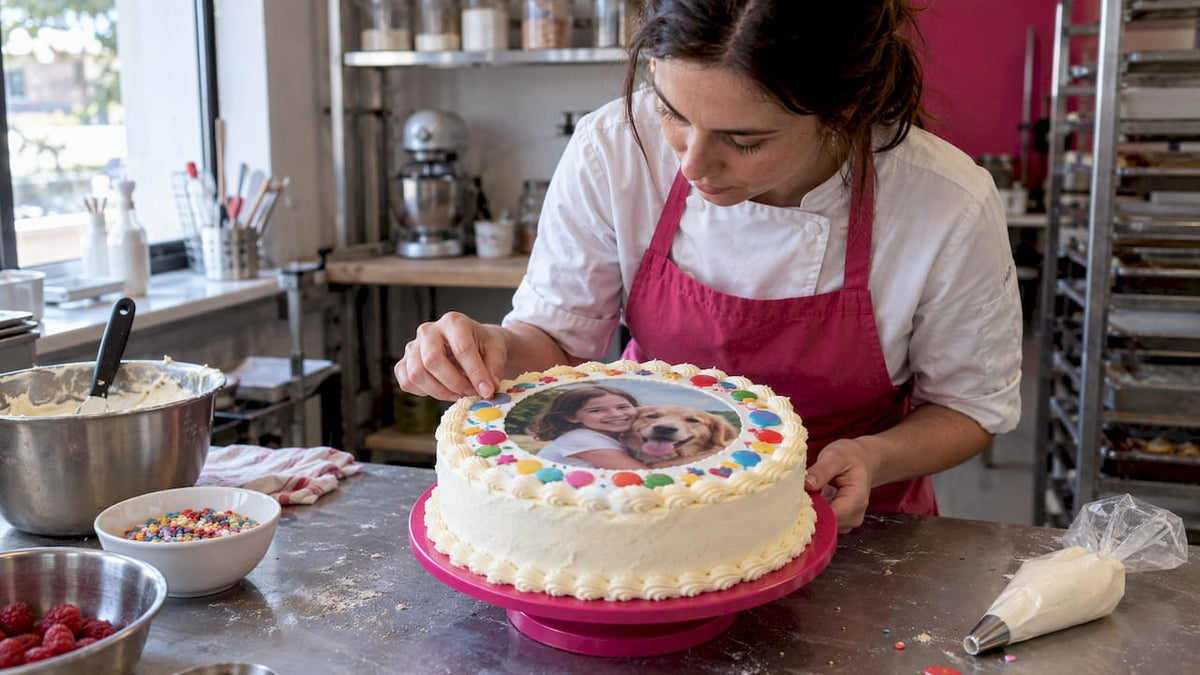
Before putting an image on a cake, the right question is not “where can I find it?”, but “can I use it?”. In Spain, drawings, illustrations, and photographs are protected by copyright from the moment they are created, and being on the internet does not make them free to use. That is why the most worry-free decoration is one made from your own photographs, names, and texts, arranged in an original design. This is what FunBakery designers do when they personalize an edible image or a sheet of sugar paper for your birthday, communion, or wedding.
In summary
- In Spain, original drawings, illustrations, and photographs are protected from the moment they are created, without the need for registration.
- An image published on the internet still has an owner: downloading it does not give you permission to print it.
- Your photographs, the birthday person's name and age, and a custom design are the safest way to create a personalized cake.
- If other people appear in the photograph, especially children, you should also consider their image rights and ask for their consent.
- Anyone who sells decorated cakes needs permission from the copyright holder, unless there is a license or legal exception.
Table of Contents
- What Spanish law protects in cake decoration
- Home party or cake for sale: what is the difference
- Images you can use with complete peace of mind
- Internet images, characters, and logos
- Photographs with people: image rights
- If you make cakes to sell
- What happens if you use an image without permission
- Step-by-step guide to a personalized cake without any doubts
- A design entirely your own, created by our designers
- Our perspective
- Frequently asked questions
- Sources
What Spanish law protects in cake decoration
The basic rule comes from the Ministry of Culture: Spanish law protects original creations from the moment they are created, including paintings, photographs, and audiovisual works, without the author having to register anything. In other words, the absence of a © symbol does not mean that the image is free to use.
The law governing this is the Intellectual Property Law, approved by Royal Legislative Decree 1/1996. Its Article 10 lists drawings, comics, artistic works, and photographs among the protected creations. Translated to the party table: a character illustration, a drawing by an artist you found on social media, or a photograph by a professional photographer are all owned works.
What matters to those who decorate cakes is what that owner controls. In Articles 17 and 18, the same law reserves the right of reproduction, distribution, public communication, and transformation of the work to the author. Reproduction means fixing the work on a medium that allows it to be communicated or copied, and printing an image on an edible image is exactly that: fixing it on a new medium, in this case, an edible one.
There is also a time limit. Under Article 26, exploitation rights last for the author's entire life plus 70 years after their death, as a general rule. Only after that does the work enter the public domain, and each case must be analyzed according to the rule that applies to that specific work.

Home party or cake for sale: what is the difference
This is the most common question among parents and families who are planning a party. Spanish law has an exception called private copying: Article 31.2 allows reproduction for the private use of the person making the copy, but only when that copy is not used collectively or for profit.
In practice, this creates two very different situations:
| Situation | What changes |
|---|---|
| Cake for your own party, with your photographs and texts | The image is yours: you can use it freely |
| Cake for your party with someone else's image | The private copying exception is narrow and is not a general authorization |
| Cake or image sold to customers | There is commercial exploitation: permission is required, unless a license or applicable exception applies |
| Photograph with other identifiable people | In addition to copyright, the image rights of those people also apply |
The conclusion is simple: the more the image is yours, the fewer questions you will have to ask. A photograph you took last summer, your daughter's name, and the age numbers do not raise any copyright questions, because you are the author.
Images you can use with complete peace of mind
Educational material from the CSIC on images, from May 2023, summarizes the safe options well: you can use photographs that you own, images for which you have obtained permission, works in the public domain, and images under a Creative Commons license, always respecting the terms of that license. Let's look at each one, applied to a cake.
Your own photographs
They are the best raw material for a personalized cake. The baby's photograph at their christening, the couple on their engagement day, the grandmother celebrating her 80th birthday, or your child's football team at the end of the season. If you took it, the rights are yours. If a family member took it, just ask them. To make the most of these images, we have a complete guide to photographs on cakes with advice on resolution, framing, and lighting.
Names, ages, dates, and phrases
The birthday person's name, “Happy 7th birthday,” the wedding date, or a family phrase are your own texts. Combined with colors, frames, and decorative elements created by a designer, they create a unique result without relying on other people's works.
A design created especially for you
When you order a custom design, the composition is created for your cake using the material you send us. It is the most direct way to have a decoration that looks professional without spending hours looking for images whose origin you do not know.
Public domain and open licenses
Works whose protection period has already ended and images under a Creative Commons license can also be used. The University of Córdoba recommends always checking the license associated with the image: some require you to credit the author, while others prohibit commercial use or transformation. For a cake to sell, a “non-commercial” license is not enough.
Internet images, characters, and logos
The most common mistake is thinking that if an image appears on Google, it can be used. The Ministry of Culture is clear: publishing a work on the internet does not mean that the copyright holder has waived the right to authorize its use or receive payment. An image downloaded from a website, an image bank, or Pinterest still has an author.
With characters, logos, and club emblems, two different types of protection come into play. An official legal guide from the Spain Audiovisual Hub explains the distinction: copyright protects original artistic expressions, while trademarks protect registered distinctive signs for products or services. The same original graphic element can be protected by both at the same time if it has been registered as a trademark.
For those planning the party, the lesson is to choose the origin of the decoration carefully: a specialized catalog or a design made from your photographs and the theme your child loves, rather than a low-quality screenshot. If you are still deciding on a theme, our themed cake guide helps you combine edible images, sugar paper, and party colors.

Photographs with people: image rights
Copyright protects the person who took the photograph. But the people who appear in it also have rights. The University of Córdoba reminds us that, in photographs with identifiable people, image rights and personal data protection may be relevant.
For a family cake, this can be resolved with common sense:
- If the photograph is of the birthday person or the couple getting married, just confirm that they agree with the choice.
- If friends, classmates, or other children appear, ask their parents before putting them on the cake, especially if the cake will be photographed and shared on social media.
- For a company or farewell cake, confirm with the colleagues who appear in the image.
We write more about this topic in Spanish in the article on image rights on cakes.
If you make cakes to sell
Pastry chefs, bakeries, and those who sell cakes made to order are in a different situation from a family planning a party. Here, commercial exploitation is involved, and the Ministry of Culture presents permission as the general rule: you must ask permission to use a protected work, unless a legal exception applies, and exceptions are limited. The request should be made to the rights holders or, for certain works, to collective management organizations, which are organizations that manage and license rights on behalf of authors.
The Ministry itself provides sample permission request letters. According to this guidance, the request should describe:
- The specific work you want to use (title, author, where you found it).
- The intended use: printing on an edible image or sugar paper to decorate cakes.
- The approximate number of copies.
- The purpose and whether the copies will be sold.
For a professional, the time-saving alternative is to work with the client's own material: the photographs, names, and texts sent by the family, transformed into an original design. Our team does this work in rectangular and round formats, as well as for cupcakes and strips for the side of the cake.
What happens if you use an image without permission
Spanish law provides for civil actions. The rights holder can ask the court for the cessation of the unlawful activity and compensation for material and moral damages, under Articles 138 and 140. The compensation can be calculated based on losses and lost profits or the remuneration that would have corresponded to a license. The court can also order the removal of the items from commerce or the destruction of the unlawful copies.
For those who sell cakes or publish photographs of their creations to attract customers, this is a risk that can be avoided by choosing the origin of each image carefully.
As for updates: the 1996 Intellectual Property Law remains the reference text, although it is amended from time to time. The consolidated version in the BOE is always the place to confirm the current wording. The principles we have explained here—protection from the moment of creation, permission as the rule, and limited exceptions—are the stable foundation of the system.
Step-by-step guide to a personalized cake without any doubts
- Choose the idea and format. Decide whether you want a rectangular image covering the cake, a round disc, small discs for cupcakes, or strips for the side. If you have doubts, see which edible image format to choose. The typical mistake is choosing the image before measuring the cake.
- Gather your material. Photographs taken by you or a family member, the name, age, date, and phrase you want to see. Avoid screenshots and downloaded images: in addition to copyright issues, they are often low resolution. Our guide to choosing images for cakes explains what works best.
- Confirm who appears. If the photograph includes other people, especially children, ask for their consent before ordering.
- Request the design. Send the material to our designers, who will create the composition with photographs, names, ages, and texts. The steps to create personalized images show the process in detail.
- Choose edible image or sugar paper. Both mediums work; the choice depends on the type of frosting and the finish you are looking for.
- Apply it to the cake. Follow the application instructions so that the colors stay vibrant and the image does not wrinkle.
A design entirely your own, created by our designers
If you want a cake with your photos and the birthday person's name without having to search for images, our custom design service takes care of it. FunBakery's designers create a custom image with photos, names, ages, and text for printing on wafer paper or icing sheets.

Design service prices start at 6 USD for rectangular, disc, and cupcake formats, and at 10 USD for banners. In the custom design studio you will also find rectangular, round, and cupcake formats from 6 USD and banners from 9 USD. For orders over 25 €, shipping is free within 24 hours, and you can talk to us anytime via WhatsApp or email.
Our perspective
A personalized cake is worth what it represents: the face of the daughter turning 6, the newlyweds on the day they met, the grandfather in his club jersey. These are the cakes that end up in the party photos.
That is also why we work with our own designers. A well-composed photo of yours, a name, and an age give a professional finish that no downloaded image can match, and leave you at ease regarding the origin of what is on the cake.
Our advice is simple: start with your memories. Send us the photos you like best, tell us the party theme, and leave the composition, colors, and the right format for your cake to us.
David
Frequently asked questions
Can I print an image I found on Google on a wafer paper?
Finding an image on the internet does not give you permission to use it: the owner retains their rights even when the work is online. The safe way is to use your own photos, licensed images that allow it, or public domain works. A custom design made with your material avoids any doubt.
Do I need to register my photo to have rights over it?
No. In Spain, protection exists from the moment of creation, without registration formalities. If you took the photo, you are the author and can use it on your cake.
Can I use a photo of my child's friend on the birthday cake?
You can, with the consent of that child's parents. In photos with identifiable people, in addition to copyright, the image rights of those who appear also apply. Asking beforehand avoids misunderstandings, especially if the cake is going to appear on social media.
How long do the copyright of a drawing last?
As a general rule, for the author's entire life plus 70 years after their death. Only then does the work enter the public domain, and each case must be confirmed with the rule applicable to that work.
I am a pastry chef: what do I need to sell cakes with images?
To commercially use a protected work, you need the authorization of the rights holder or a management entity, unless there is a license or legal exception. Working with the photos and texts your client sends you, transformed into an original design, is the simplest way to avoid the problem.
Sources
- Ministry of Culture: Intellectual property in general
- BOE: Royal Legislative Decree 1/1996, consolidated text
- BOE: Royal Legislative Decree 1/1996, original text
- BOE: Royal Legislative Decree 1/1996, version of 12/12/2001
- BOE: Intellectual Property Law, consolidated version
- CSIC: Images and Copyright
- University of Córdoba: Use of images
- Ministry of Culture: Permissions to use protected works and services
- Ministry of Culture: Authorization request letters
- Spain Audiovisual Hub: Intellectual and industrial property
Recommendations
- How to choose images for cakes: practical guide 2026
- Use of photos on cakes: complete guide for 2026
- Image rights on cakes: what can be printed on wafer paper and icing sheets
- Steps to create custom images for wafer paper and icing sheets
Thank you for reading us! 🎂
At FunBakery we love helping you add a special touch to your celebrations. That is why we are giving you a 10% discount on your next order at funbakery.es. You just have to enter the code: funbakery10 at checkout.
Personalize your edible cake image with your favorite photo, a name, or the design you like best. Make your next celebration even sweeter! ✨