TL;DR:
- The design choice should complement the colors and style of the event theme.
- Image and support quality affect the final result of the dessert.
- It is important to handle and store the wafers correctly to preserve their quality and appearance.
Choosing the design of an edible wafer seems simple until you sit down in front of the screen with hundreds of options and a celebration date approaching. Do you use the family photo, your child's favorite character, or a classic design? The decision matters more than it seems: a well-chosen wafer transforms an ordinary cake into the visual centerpiece of the party and is captured in photos forever. This guide gives you the exact criteria to make the right choice, compare materials, and handle your wafers without mistakes, regardless of whether you are organizing a children's birthday, an anniversary, or a communion.
Table of Contents
- Essential criteria for choosing the design of your wafer
- Personalization options: themes, photos, and characters
- Comparison: traditional wafer vs. sugar paper
- Practical recommendations for handling and storing your wafers
- Our perspective: the art of personalizing without complications
- Creators of unique moments: design your personalized wafers
- Frequently Asked Questions
Key Points
| Point | Details |
|---|---|
| Adapt the design to the event | Choose colors and motifs that fit the theme to achieve greater visual impact. |
| Take care of image quality | Use sharp and well-lit images to get attractive prints on the wafers. |
| Choose the support carefully | The traditional wafer incorporates subtle designs; sugar paper provides more vibrancy and contrast. |
| Handle and store with care | Store the wafers in airtight bags and away from moisture to preserve their quality. |
Essential criteria for choosing the design of your wafer
Before clicking "add to cart," it is advisable to review some points that make the difference between a professional result and one that disappoints on the day of the party.
The color palette is everything. The design of the wafer should complement, not compete with, the color of the fondant, cream, or frosting of the cake. If the cake is in pastel tones, a design with bright colors creates an attractive contrast. If the cake already has a lot of color, a cleaner and more centered design is more elegant. Always match the dominant colors of the design with those of the overall decoration of the event.
Image quality determines the final result. A blurry or pixelated photo printed on a wafer will still be blurry. For personal photos, use images of at least 300 dpi (dots per inch). For characters or graphics, vector files guarantee sharp edges regardless of size. Our cake decorating guide explains in detail how to prepare files to get perfect prints.
Adapt the design to the audience of the celebration. A children's design with saturated colors and animated characters works for 4-year-old birthdays. A design with delicate flowers and elegant typography fits better in a communion or a wedding anniversary. Thinking about who is going to see and enjoy the cake before choosing the design is the step that many parents skip.
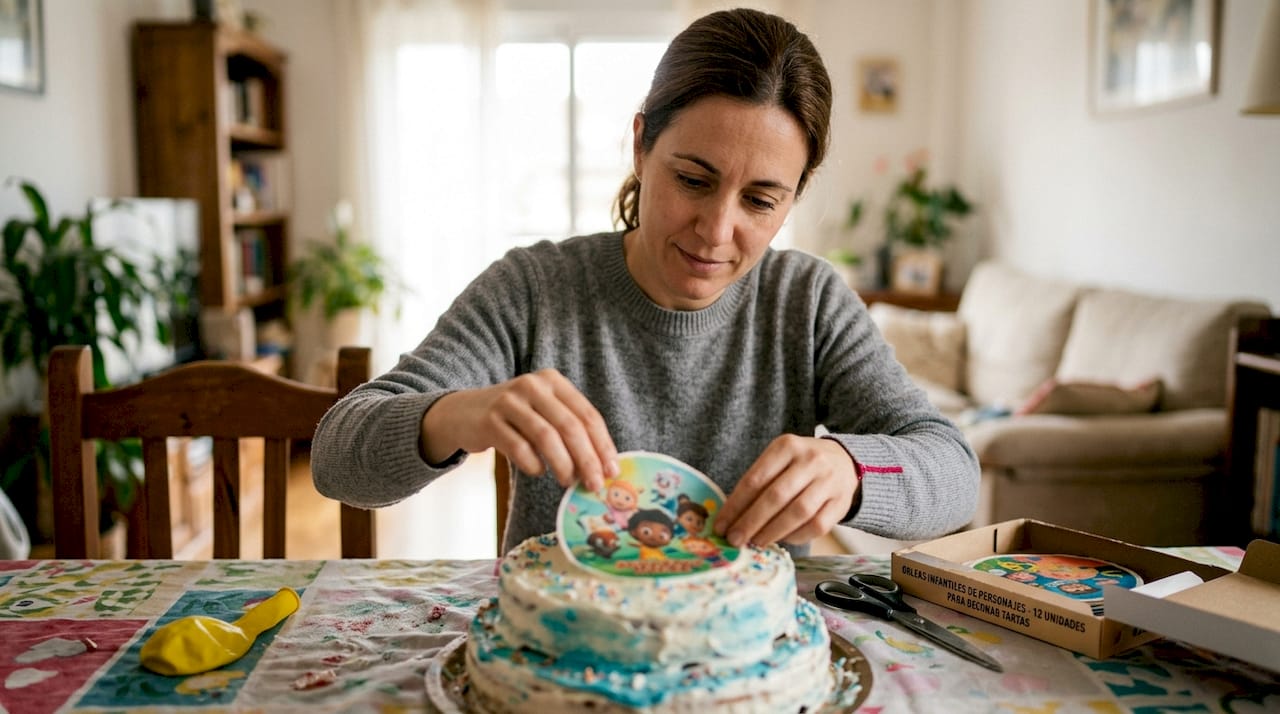
Format and size matter depending on the support. A wafer for a 20 cm round cake needs a different design than a wafer for individual muffins. Small details get lost in large formats, and long texts do not fit on cupcakes.
Key points not to forget before choosing:
- Avoid images with very dark backgrounds: they print worse and can stain the dessert
- Use colors that match the overall theme of the event
- Choose clear images with good contrast
- Confirm the exact size of the dessert before ordering
- Check that the texts (name, age) are spelled correctly before sending
Professional tip: If you have doubts about the size, always order a little larger. It is easier to trim a wafer than to regret that the design is too small on the cake.
Personalization options: themes, photos, and characters
Now that you know the essential criteria, let's explore how to personalize according to the type of event and the audience.
Personalization options have grown enormously in recent years. Today you can print practically any image on an edible wafer, but some options work much better than others depending on the context.
Trending characters: the children's favorite. Frozen, Stumble Guys, Fortnite, Bluey, or Spiderman are constant requests for children's birthdays. The key here is to use high-quality official images and combine them with the child's name and age for a unique touch. You can explore images for children's wafers with the most requested characters of the season.
Family photos: the most emotional touch. A wafer with the birthday child's photo or the couple's photo on an anniversary creates an emotional impact that no generic design can match. For it to look good, the photo must be well lit, focused, and preferably with a light or neutral background. Avoid photos taken at night or with very dark filters.
Classic designs for formal events. Flowers, branches, hearts, and elegant typography are the perfect option for communions, weddings, or anniversaries. These designs have an advantage: they do not visually expire. In ten years, the photo will still be beautiful even if the character of the moment is no longer.
Common mistakes when choosing personalization:
- Uploading low-resolution photos expecting them to "look good"
- Choosing a character that the child no longer likes (always ask!)
- Putting too much text in a small space
- Ignoring the background of the design, which can clash with the color of the cake
- Not checking the spelling of the name before confirming the order
The process of personalizing wafers is more flexible than many parents imagine. You can combine a photo, name, age, and a themed background in a single cohesive design.
Professional tip: For events with several desserts, such as cupcakes and a main cake, use the same base design with size variations. Create visual unity without exact repetition, and the result looks like it came from a professional bakery.
Personalized designs to theme the event are the ones that generate the most impact in photos and in the memory of the guests.
Comparison: traditional wafer vs. sugar paper
No matter how you personalize, it is key to understand the differences between the available supports.
The traditional wafer and sugar paper are the two most used materials for printing edible images, but they are not interchangeable. Each has its strengths and limitations.
| Feature | Traditional wafer | Sugar paper |
|—|—|—|
| Texture | Thin and crispy | Softer and more flexible |
| Flavor | Neutral, almost imperceptible | Slightly sweet |
| Visual integration | Softer and more natural colors | More vibrant and intense colors |
| Best use | Cakes with fondant or cream | Cupcakes and smooth surfaces |
| Moisture resistance | Lower | Higher |
| Ease of handling | Requires more care | Easier to place |
The traditional wafer integrates pastel colors subtly and naturally, while sugar paper offers a more intense visual impact and more saturated colors. Neither is better in absolute terms: it depends on the effect you are looking for.
For fondant cakes with delicate designs, the traditional wafer blends visually with the surface and gives a more artisanal result. For cupcakes with buttercream or cakes that need very bright colors, sugar paper is the winning option.
"The choice of support is as important as the design itself. A brilliant design on the wrong support can lose all its impact."
If you want to delve deeper into the practical differences, our guide on decorating with wafers or sugar paper covers real cases with visual examples.
Practical recommendations for handling and storing your wafers
Now that you know how to choose and compare, make sure the final presentation is perfect with these professional tips.
A perfect wafer can be ruined in minutes if it is not handled and stored correctly. These are the most frequent mistakes and how to avoid them.
Correct storage before use. Wafers are sensitive to moisture and heat. Store them in closed airtight bags, away from heat sources such as the oven or window. High humidity makes it difficult to peel off and can cause the wafer to stick to the protective paper or deform before reaching the cake.
Duration and expiration according to the type of support:
| Type of support | Approximate duration | Ideal condition |
|---|---|---|
| Traditional wafer | Up to 12 months | Airtight bag, dry place |
| Sugar paper | Up to 12 months | Airtight bag, no direct light |
| Wafer with printed photo | 6 to 8 months | Away from heat |
What to do if the wafer is stiff. Do not pull it hard. Place it in the freezer for exactly 15 seconds and try again. The temperature change makes it more flexible without damaging the print.
List of things you should always avoid:
- Handling the wafer with damp or wet hands
- Storing it outside its protective bag
- Reusing wafers that have already been in contact with the dessert
- Exposing them to steam or very humid environments
- Folding or rolling them so they "fit" in the drawer
Our checklist for handling wafers summarizes all these steps in an easy-to-follow format on the day of the party. And if you want to see the complete placement process, the step-by-step guide to decorating wafers shows you every detail with images.
Professional tip: On very hot days or in humid environments, take the wafer out of the bag just before placing it. Every minute exposed to the environment in those conditions counts.
Our perspective: the art of personalizing without complications
After years of helping families design wafers for all types of celebrations, we have learned something that goes against intuition: the most cluttered designs are not the most memorable.
Parents sometimes believe that more elements mean more impact. More characters, more colors, more text. But in the photos of the event, the clean and well-chosen designs are the ones that stand out. A large name, a clear photo, and a background that matches the cake generate more "how beautiful!" than a collage of ten cramped images.
The design of a wafer should communicate an emotion, not just decorate. Is it an intimate and emotional celebration? Choose something simple and personal. Is it a loud and fun party with children? Then yes, the full-color favorite character makes perfect sense.
Perfection in family celebrations does not exist, and it is not necessary. What does exist is that moment when the child sees their cake and their eyes light up. That is achieved by a good design, not a perfect one. You can find more creative wafer ideas that demonstrate exactly this principle: less visual noise, more real impact.
Creators of unique moments: design your personalized wafers
If you are looking to apply these tips practically, Funbakery makes it very easy for you.

At Funbakery you can design personalized wafers from scratch with the help of our design team, or choose from hundreds of themed templates ready to personalize with the name, age, and photo you want. The process is fast, secure, and designed so you can get to the day of the party without stress. If your child is a fan of video games, our personalized Fortnite wafer with photo, name, and age is one of the most requested designs. On-time deliveries, professional print quality, and a result that turns any cake into the protagonist of the celebration.
Frequently Asked Questions
What type of image is most recommended for printing on a wafer?
Clear, colorful images in high resolution with simple backgrounds are the best options. Dark images print worse and can give an unattractive result on the dessert.
How long can an edible wafer be stored before using it?
Wafers can be stored for up to 12 months if kept in airtight bags in a dry, cool place away from direct light.
What to do if the wafer is stiff and difficult to peel off?
Place the wafer in the freezer for exactly 15 seconds so that it becomes more flexible and you can peel it off without breaking it.
Is it possible to reuse unused wafers?
It is not recommended to reuse wafers that have already been in contact with the dessert because they lose freshness and can break or stick when trying to use them again.