In summary:
- Photo wafers are edible sheets printed with certified food-grade inks to decorate personalized desserts. There are two main types: wafer paper for rigid structures and sugar paper for higher-resolution images. Moisture can quickly ruin the design, so it is essential to store them in dry conditions and apply them at the right time.
A photo wafer is a printed edible sheet with certified food-grade inks, made from starch, potato starch, or sugar, and designed to decorate cakes and desserts with personalized images. The inks used comply with European Regulation EU 10/2011, which regulates materials in contact with food. This type of decoration has transformed event baking: it allows photographs, illustrations, and text to be reproduced on any dessert with a professional finish. Funbakery has specialized in this format for years, offering personalized wafers for birthdays, weddings, and all types of celebrations.
What types of photo wafers are there?
Photo wafers are divided into two main categories according to the base material: wafer paper and sugar paper.
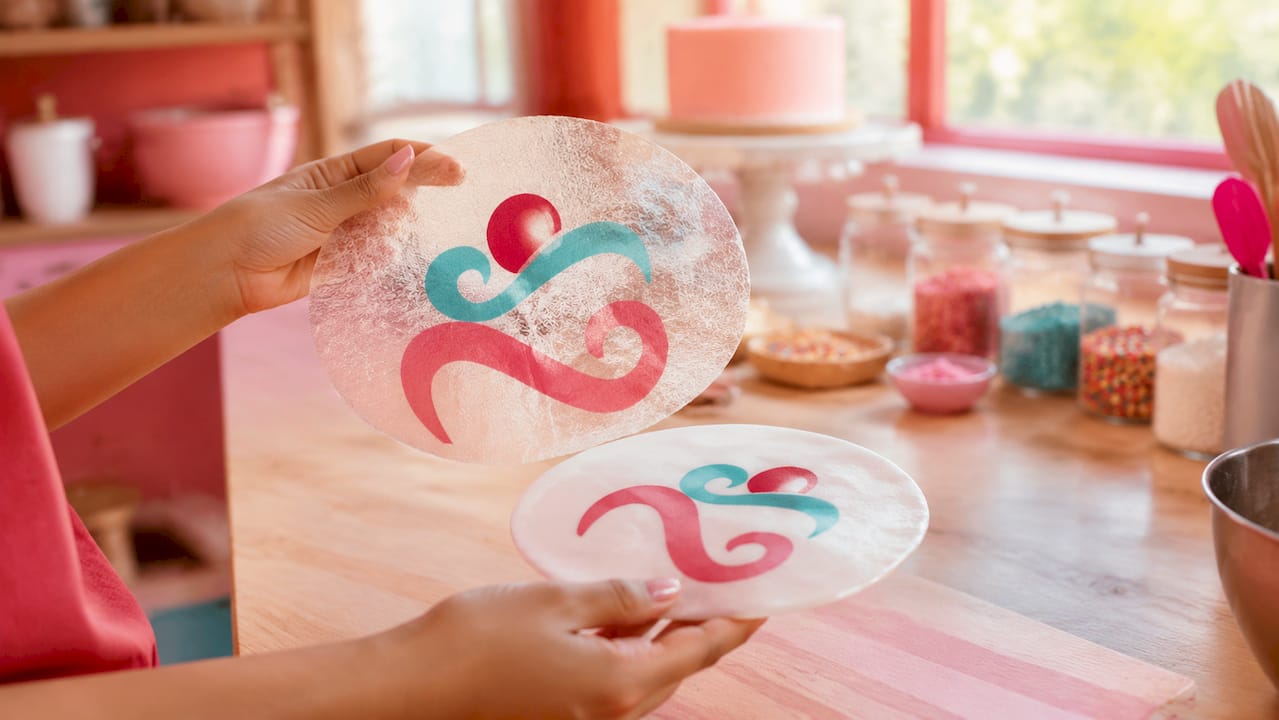
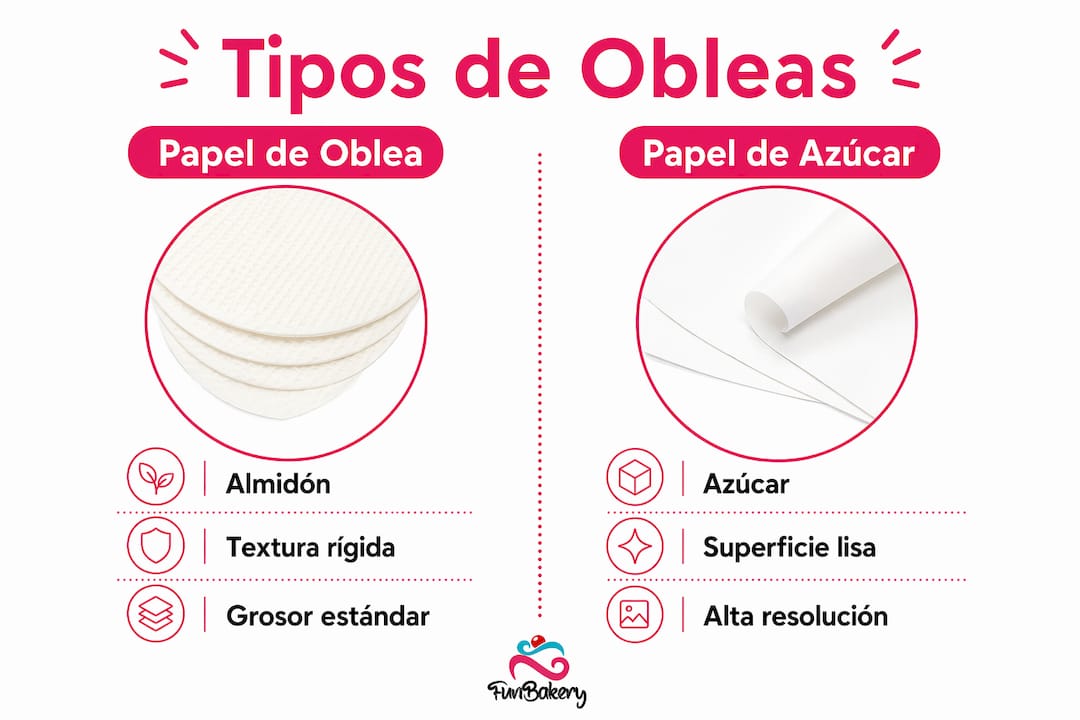
Wafer paper is made with starch and potato starch. It has a stiffer and more porous texture, and its standard thickness ranges from 0.35 to 0.60 mm. This stiffness makes it ideal for decorations that need to stand upright, such as flowers, butterflies, or three-dimensional structures. Its surface absorbs ink well, although the image resolution is slightly lower than that of sugar paper.
Sugar paper (also called fondant paper) offers a smoother surface and superior image resolution, making it the best choice for reproducing photographs with fine detail. It adheres directly to fondant, buttercream, or ganache toppings without the need for additional adhesive. Its more delicate texture makes it less suitable for three-dimensional structures.
| Feature | Wafer paper | Sugar paper |
|---|---|---|
| Base material | Starch, potato starch | Sugar, glucose |
| Standard thickness | 0.35–0.60 mm | Thin and flexible |
| Image resolution | Medium | High |
| Best use | Rigid decorations | Detailed photographs |
| Compatibility | Dry or fatty toppings | Fondant, buttercream, ganache |
The choice between one and the other depends on the type of topping and the desired visual result. For a wedding cake with a photograph of the bride and groom, sugar paper gives better results. To decorate cupcakes with butterflies or bows, wafer paper holds its shape better.
Professional tip: Before ordering your wafer, confirm what type of topping you will use. That decision determines which material works best and prevents surprises during assembly.
How does moisture affect photo wafers?
A photo wafer is a hygroscopic material: it absorbs moisture from the environment and from the surface on which it is placed. This behavior is the most common mistake among those who are new to decorating with wafers.
Surfaces with a high water content, such as whipped cream or fresh creams, attack the wafer from the first contact. Without an insulating layer, visual degradation begins in 20–30 minutes. The design loses sharpness, the edges curl, and the colors blur. The result is a decoration that looks sloppy, even if the original print was perfect.
The most effective solution is to apply an insulating layer between the moist topping and the wafer. Melted chocolate spread in a thin layer acts as a barrier and extends the visual integrity of the decoration by up to an additional 30 minutes. Fatty toppings like buttercream naturally offer better durability, as they do not transfer water to the wafer as quickly.
For storage, the ideal conditions are a temperature between 18 and 22 °C in a dry and dark place. Storing wafers in the refrigerator is a common mistake: the moisture in the refrigerator deteriorates the design irreversibly before the wafer reaches the cake.
Steps to properly preserve a wafer before using it:
- Keep the wafer in its original packaging until the moment of application.
- Store it in a dry place, away from heat sources and direct light.
- Never refrigerate it: the moisture in the refrigerator ruins the colors and structure.
- If the cake topping is moist, first apply a thin layer of melted chocolate or cocoa butter.
- Place the wafer just before serving if the topping has a high water content.
Professional tip: If you prepare the cake in advance, apply the wafer at the last possible moment. The less time it spends on a moist surface, the better it will preserve the design.
How to properly print and apply photo wafers?
Printing photo wafers requires specific equipment. Printers not certified for food use leave toxic residues on the paper that do not disappear even if the ink appears dry. A standard home printer should never be used to print on edible paper.
Food printers use inks with colorants approved under E numbers, the same ones used in commercial candies and sweets. This guarantees that the wafer is completely safe for consumption. Funbakery works with certified equipment and approved food-grade inks that comply with current European regulations.
The most common application mistakes are:
- Handling the wafer with wet hands. Moisture from the fingers leaves marks and deforms the edges before placing it.
- Folding or rolling the wafer. Edible paper tears easily if handled roughly.
- Applying it over a freshly made topping. You must wait until the surface is at room temperature and slightly firm.
- Ignoring the orientation of the image. Placing the wafer upside down is a mistake that cannot be fixed once adhered.
- Storing printed wafers for weeks. The quality of the colors degrades over time, especially if there are temperature fluctuations.
The food printing combines graphic design with food safety regulations. It is not enough to have a beautiful image: the entire process, from the design file to the application on the dessert, must respect specific technical standards to guarantee a safe and visually flawless result.
What advantages do photo wafers offer at celebrations?
Photo wafers turn a standard cake into the visual centerpiece of any celebration. This effect does not depend on the baker's ability to draw or model: anyone can achieve a professional result with a well-printed and applied wafer.
The advantages of printable wafers for events are concrete and measurable:
- Total personalization. A photograph of the birthday person, a company logo, the bride and groom at a wedding, or a child's favorite character can be reproduced faithfully on any dessert.
- Speed of production. Decorating a cake with a wafer takes minutes, compared to the hours required for a hand-modeled decoration.
- Thematic consistency. For events with a defined theme, the wafer allows maintaining visual consistency across all desserts, from the main cake to the cupcakes.
- Social media impact. Personalized cakes with photographs generate more interaction on platforms like Instagram, making them a visibility tool for bakers and pastry shops.
- Accessibility for hobbyists. No artistic training is needed to achieve an attractive result. The technique is accessible to amateur bakers who want to surprise at a family celebration.
The personalization and aesthetics of photo wafers bring originality and differential value to weddings, birthdays, and corporate events. A cake with the photo of the bride and groom or with the name of the guest of honor creates a memory that no generic decoration can match.
Key points
The photo wafer is the most accessible and versatile dessert personalization technique available for amateur and professional bakers, as long as the printing, application, and storage conditions are respected.
| Point | Details |
|---|---|
| Material definition | Edible sheet printed with inks certified under EU 10/2011 regulations. |
| Two main types | Wafer paper is stiffer; sugar paper offers higher photographic resolution. |
| Moisture is the enemy | Applying it over moist surfaces without an insulating layer destroys the design in 20–30 minutes. |
| Printing with certified equipment | Non-food printers leave toxic residues; only use approved equipment. |
| Proper storage | Store between 18 and 22 °C, in a dry and dark place, never in the refrigerator. |
What I have learned after years with wafers on cakes
When I started working with photo wafers, I made the mistake that almost everyone makes: underestimating moisture. I placed a beautiful wafer on whipped cream without any intermediate layer, and twenty minutes later, the design was unrecognizable. That experience taught me more than any tutorial.
What surprises me most is that most problems with wafers have nothing to do with the print quality. They have to do with subsequent handling. A well-printed wafer can be ruined in seconds if touched with wet hands or placed on a freshly made and still warm topping.
My advice for those starting out: always choose sugar paper for photographs and wafer paper for decorative structures. Do not try to use the same material for everything. And if your cake topping contains cream or fresh cream, always apply a layer of melted chocolate before placing the wafer. That step makes the difference between a professional result and a disappointing one.
Food printing technology has improved greatly in recent years. Current inks reproduce colors with a fidelity that was previously impossible to achieve in edible format. But the technique still requires attention to detail. Knowing the material you work with, respecting its limitations, and properly preparing the surface are the three factors that determine the final result.
— David
Personalized wafers for your next celebration with Funbakery
Funbakery designs and prints personalized edible wafers for cakes, cupcakes, and muffins, with certified materials and food-grade inks approved under European regulations.

The catalog includes superhero designs, children's characters, sports themes, and options for adults. For unique celebrations, the personalized design service allows incorporating photographs, names, ages, and custom text. Funbakery designers work the file until achieving a finish that matches the cake and the event. You can explore all the options in the personalized wafer catalog and place your order directly from the website.
Frequently asked questions
What exactly is a photo wafer?
A photo wafer is an edible sheet made from starch or sugar, printed with certified food-grade inks to decorate cakes and desserts with personalized images.
Is it safe to eat a photo wafer?
Yes. Food-grade inks use colorants approved with E numbers, the same ones used in commercial candies and sweets, and comply with European food safety regulations.
How long does a wafer last on the cake?
On fatty toppings like buttercream, the wafer maintains its visual quality for several hours. On moist surfaces like whipped cream, the design begins to degrade in 20–30 minutes without an intermediate insulating layer.
Can I store the wafer in the refrigerator?
No. The moisture in the refrigerator deteriorates the colors and structure of the wafer irreversibly. Store it at room temperature, between 18 and 22 °C, in a dry and dark place.
What is the difference between wafer paper and sugar paper?
Wafer paper is stiffer and is used for three-dimensional decorations. Sugar paper offers higher image resolution and is the best choice for reproducing photographs with detail.