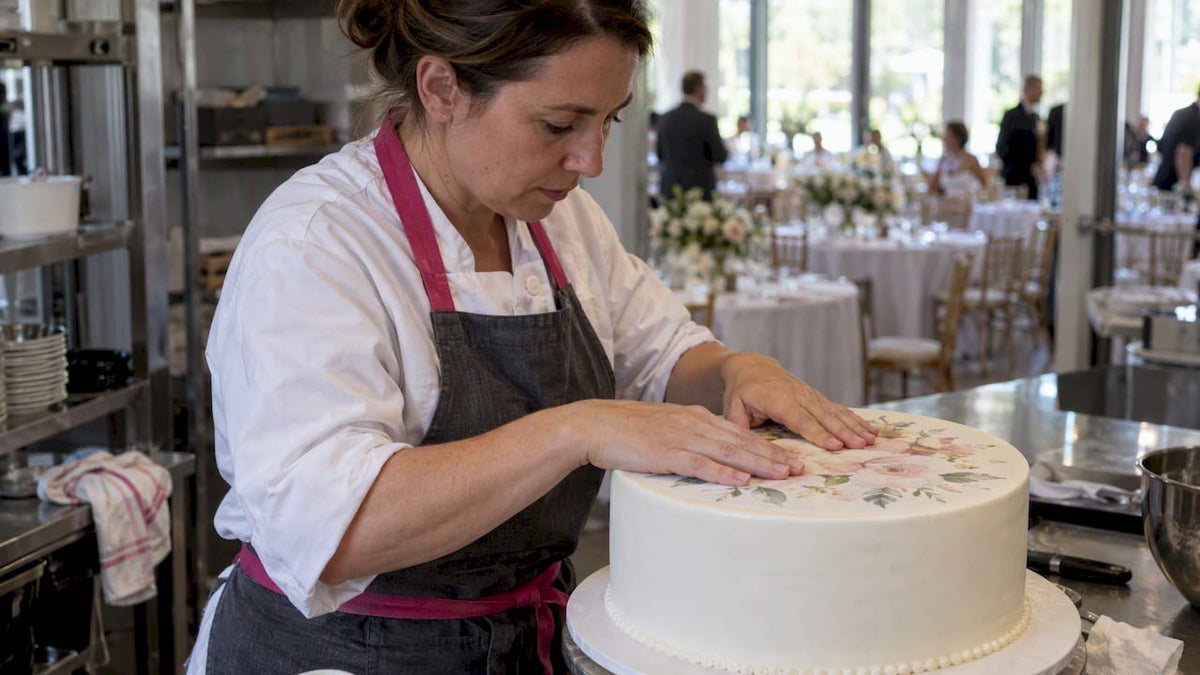
An edible wafer collage consists of several photos printed on an edible sheet ready to place on a cake: you can buy it already printed or order a custom design. There are round, rectangular, strip, and multi-circle commercial formats, and we customize it with your photos, names, and text according to the design you choose.
In summary:
- Choose multiple circles to show different stages of a life; reserve the disc for a featured photo and the strips for cupcakes or the sides.
- Sugar paper reproduces colors and faces more clearly; the wafer, which is stiffer and neutral in flavor, is suitable for raised decorations.
- Send original high-resolution files, fit each image into the space without distorting it, and request a preview to correct the framing before printing.
- Place the sheet on smooth, dry fondant or buttercream; if the frosting is damp, add a dry layer and apply it shortly before serving.
- Round, rectangular, and cupcake designs start at 6 USD; orders over 25 € include free 24-hour shipping.
Table of contents
- Commercial formats and when to choose each one
- Materials: wafer or sugar paper for your photos
- How to prepare the photos to print the collage
- How to apply the printed collage on the cake
- Storage, transport, and the ideal time to place it
- Order your collage at Funbakery: services and process
- Practical difference between wafer and sugar paper for photos
- Instructions for secure purchase and service guarantees
- Questions about allergies and edible paper ingredients
- Personalization: names, ages, text, and photos
- How to choose the design according to the type of celebration
- Combine the wafer with other decorative elements
- Estimated prices, order, and delivery times
- Quick recommendation according to the type of celebration
- Order your collage at Funbakery now
- Frequently asked questions
- Fonts
Commercial formats and when to choose each one
The shape of the wafer determines how many photos fit and what visual effect you achieve. A single disc centers a single image as the main feature, while a sheet with several small circles works best when you want to tell a story with different moments.
- Round disc: ideal for one large photo as the centerpiece of the cake.
- Rectangular: adapts to square cakes or panoramic group photos.
- Multiple small circles: allows you to distribute several photos, for example 15 discs of 5 centimeters spread across the surface.
- Strips: fit on the side of the cake or on cupcakes in a row, widely used at children's parties.
To choose, first think about the available surface. A two-tier cake accommodates a large rectangular collage on the bottom tier, while a small birthday cake benefits more from a single well-cut disc. When the tribute gathers several stages of the person (baby, child, adult), the multiple circle formats are usually the option that best tells that story without visually saturating the cake.
Materials: wafer or sugar paper for your photos
The choice of material changes the final result in both color and handling. Rice paper, known as wafer, is lighter and more translucent, which makes it very manageable for three-dimensional decorations, but somewhat less intense in reproducing the color of a photograph.
- Wafer (rice paper): stiff, neutral in flavor, and convenient for pieces that need to hold their volume.
- Sugar paper: more opaque and flexible, with better color definition for portraits and group photos.
Key fact: in color reproduction tests between both materials, sugar paper achieves more vivid and clear tones compared to the somewhat more muted finish of the wafer, so it is usually preferred when the photograph is the central element of the design.
If you are looking for a photo collage with several clear portraits, sugar paper gives a result more faithful to the original. If you prioritize a stiffer texture and neutral flavor, the wafer is still a solid option, especially combined with other raised elements.
How to prepare the photos to print the collage
A pixelated image ruins the effect of any collage, so it is advisable to check some details before sending it.
- Use high-resolution photos: the larger the original file, the clearer the detail will come out in the print.
- Crop each photo to the proportion of the space it will occupy in the template, avoiding stretching or distorting the image.
- Save the file in JPG or PNG format, which are the ones accepted by most edible printing services.
- Avoid dark photos or those with little contrast, because edible ink tends to soften the lower tones.
- Check the final framing before confirming the order, imagining where each face will be within the collage.
Professional tip: if you have doubts about the framing, ask for a preview of the design before approving the final print; this way you avoid surprises once the wafer is already cut.
How to apply the printed collage on the cake
The surface of the cake determines whether the wafer is placed easily or risks wrinkling. A base of fondant, well-smoothed buttercream, or firm ganache offers the best grip without adding excessive moisture.
- Prepare the surface making sure it is smooth and free of lumps before bringing the sheet close.
- Carefully peel the wafer from the protective paper, starting from a corner.
- Place the sheet from the center toward the edges, pressing gently to remove air bubbles.
- Smooth with clean fingers or a silicone spatula to fix the edges well.
If the cake frosting is very damp, it is better to add beforehand a thin and dry layer of buttercream or fondant that serves as a barrier, following this guide to glue wafer to fondant without it peeling off or wrinkling. When the wafer gets too damp prematurely, it loses stiffness and is harder to handle without breaking.
Storage, transport, and the ideal time to place it
The wafer is best stored in a dry place, away from the refrigerator until the time to use it, because condensation softens it and makes it harder to handle.
- Keep it in its original packaging until just before applying it to the cake.
- Avoid direct contact with damp surfaces during transport.
- If the cake is already decorated, place the wafer as close as possible to the time of serving, especially with very fresh cream or ganache frostings.
- Order the collage a few days in advance of the event to have time to review it and, if necessary, request adjustments.
Order your collage at Funbakery: services and process
We offer several services designed for each collage format: the Rectangular Design Service, the Disc Design Service, the Cupcake Design Service, and the Design For Strips, each one adapted to the shape of the wafer or sugar paper you choose.
The process is simple: you upload your photos, our design team prepares the composition, we show you a proposal for you to approve, and, once confirmed, we print and ship the order. We work with resistant packaging designed so that the sheet arrives intact, and we offer free 24-hour shipping on orders over a certain amount. You can review examples and rates in the custom design services collection before deciding the format that best fits your celebration.
Practical difference between wafer and sugar paper for photos

Beyond the composition, what you will notice when using them is the difference in the visual result and how each material behaves when handling it. The wafer is thinner, almost transparent when held to the light, and its neutral flavor makes it discreet on any frosting. That lightness makes it the preferred option for flowers and raised details, where very thin sheets, around 4 millimeters, are usually used, which fold easily.
Sugar paper, on the other hand, is thicker and more opaque, which favors the colors of a photograph looking more saturated and defined. For a collage with several recognizable faces, that opacity makes the difference between a clear image and one that looks washed out. That is why, when the goal is for the faces of the collage to be clearly distinguished, sugar paper usually gives better photographic results than traditional wafer.
In practice, many photo cakes use somewhat thicker sheets, between 7 and 9 millimeters, which sacrifice some flexibility in exchange for more comfortable handling during printing. If your collage combines photos with raised elements, you can mix both materials: sugar paper for the images and wafer for three-dimensional decorations around.
Instructions for secure purchase and service guarantees
Before ordering a wafer collage, it is advisable to verify that the provider works with materials certified for food use and clear labeling on their ingredients. A study by the Austrian agency AGES on colorants for edible printing found that a relevant percentage of samples presented labeling or composition failures, which confirms that material compliance is not always guaranteed in the market.
That is why, before paying, it is advisable to check that the provider clearly indicates the ingredients of the paper and the inks, and that they offer some direct contact channel to resolve doubts before and after the order. In our case, we answer questions via WhatsApp and email, and we take care of the packaging so that the sheet arrives undamaged despite transport. Reviewing the product sheet, the exact format, and the delivery time before confirming the order avoids last-minute setbacks, especially when the collage is needed for a specific date like a birthday or a religious celebration.
Questions about allergies and edible paper ingredients
Edible wafer is made mainly with potato or rice starch, water, and vegetable oil, while sugar paper adds sugar and starches to its composition, which makes it more flexible and opaque. Neither of the two materials contains gluten in its usual formulation, although it is always advisable to confirm it with the provider if there is a specific allergy or intolerance in any guest.
The inks used to print the photos are food colorants, and their compliance varies according to the manufacturer, just as pointed out by the AGES study on colorants for food printing, which found composition non-compliance in a part of the analyzed samples. That is why it is advisable to choose providers who detail their ingredients and food safety certifications before buying, especially if the collage is served to small children or people with known food sensitivities.
Personalization: names, ages, text, and photos
The real value of a wafer collage is in what you can personalize beyond the photo. Adding the name of the honoree, their age, or a short phrase turns a generic sheet into a custom-made piece for that specific birthday or celebration.
Our design service allows combining several photos with overlaid text, choosing fonts, and adapting background colors to the party theme. For orders like My First Communion, Boy or My First Communion, Girl, it is enough to indicate the name and the date so that the final design includes that data along with the chosen photograph. The process to request it is simple: you send the photos and the texts you want to include, our design team prepares a composition proposal, and you review it before it goes to print.
How to choose the design according to the type of celebration
The style of the collage changes a lot according to the occasion you celebrate. A children's birthday allows bright colors, characters, and eye-catching fonts, while a communion or a family tribute usually asks for more sober compositions, with soft tones and fewer decorative elements around the photo.
For themed parties, the collage background should complement the overall table decorations, for example by repeating a color or motif that also appears on the balloons or tablecloth. For adult celebrations, such as anniversaries or retirements, a collage with several photos from different eras usually generates more of a reaction than a single recent image. If you are not sure which format suits your event, reviewing examples already mounted on a real cake helps you visualize the result before ordering the final design.
Combining the wafer with other decorative elements
A photo collage does not have to stand alone. Combining it with other decorative elements helps the cake look complete rather than like a sheet stuck on a plain background.
Surrounding the collage with a buttercream border using a piping tip, or adding small fondant flowers around the photo frame, adds depth to the composition without covering the images. For children's parties, adding themed figures next to the collage (instead of on top of it) keeps the photo as the main focus. If you are looking for overall presentation ideas for the dessert table, this guide on homemade desserts and their presentation offers useful references on how to combine textures and colors in the final plating. You can also distribute the same design in a smaller format on matching cupcakes, following these tips for decorating desserts with wafers and sugar paper.
Estimated prices, ordering, and delivery times
The cost of a custom collage depends on the chosen format. The Rectangular Design Service, the Disc Design Service, and the Cupcake Design Service start at 6 USD, while the Ribbon Design Service starts at 10 USD. In the custom design collection, the Rectangular Design, the Round Design, and the Cupcake Design also start at 6 USD, and the Ribbon Design starts at 9 USD.
The ordering process begins with choosing the format and sending the photos you want to include. Our team prepares a design proposal that you review before approving the final print, and once confirmed, the order is securely packaged and shipped. Orders over €25 include free 24-hour shipping, so it is advisable to allow enough time before the event date, especially if the collage is part of a celebration with a fixed date such as a birthday or communion.

Quick recommendation according to the type of celebration
For children's birthdays, sugar paper in a multiple-circle format usually gives the best visual result. For tributes and adult celebrations, a single disc wafer with a well-chosen photo conveys more than several small images. For party cupcakes, small strips make handling easier without losing sharpness in the photo.
— David
Order your collage now at Funbakery
If you already know the format you are looking for, the next step is simple: choose between disc, rectangular, cupcake, or ribbon and upload your photos to us to start the design.

We offer free 24-hour shipping on orders over €25 and secure packaging designed to ensure the wafer arrives intact at your celebration.
- Review the available formats in our design services collection.
- View custom examples such as Ribbon Design before deciding.
- Write to us via WhatsApp or email if you have questions about deadlines or customization.
Order your collage a few days before the event and approve the design as soon as we send it to you, so you will have time to adjust any details before it goes into production.
Frequently asked questions
How to print on edible wafer?
It is printed with food-grade ink on wafer sheets using printers adapted for edible use, a process normally carried out by a specialized supplier. When ordering the design with us, you simply send the photos and we take care of the printing and final finishing.
Can I print photos on edible paper?
Yes, both wafer and sugar paper allow for photo printing, although sugar paper usually gives more vivid and sharper colors for portraits. The choice depends on whether you prioritize color reproduction or the rigidity of the material.
How to stick an edible sheet on a cake?
Carefully peel off the protective paper and place the sheet from the center toward the edges on a smooth surface, such as fondant or well-smoothed buttercream. It is advisable to review our guide for sticking wafer to fondant if the coating is especially moist.
How much do edible prints cost?
The price varies depending on the format: the Rectangular, Disc, and Cupcake Design Services start at 6 USD, while the Ribbon Design Service starts at 10 USD. You can view all formats and prices in our design services collection.
Sources
- Differences between rice paper and sugar paper - Scoolinary
- Investigation of food colors for use in printers and other applications (AGES)